
You got a 2-star review. Maybe a 1-star. The first instinct is to delete it, argue with it, or sit on it for a week hoping no one sees. None of those work, and the data on how to respond to negative reviews on Shopify is unusually clear about what does.
Most new Shopify owners freeze when the first bad review lands. The reviewer feels unfair. The complaint feels wrong. The fear of making it worse outweighs the urge to respond. Then weeks pass, the review is still public, future buyers read it without context, and conversion takes a quiet hit you never see in the analytics.
Here is the honest framing: the reply is not for the unhappy customer. It is for the next 200 people who will read that review before deciding whether to buy. That single reframe changes what you write and how fast you write it. The rest of this post is the framework and five templates by review type, plus the small workflow that keeps you from falling behind.
Why responding to negative reviews matters more than you think
The first thing to know is that perfect ratings are suspicious. Loox reports that around 30% of consumers assume online reviews are fake when a store has no negative ones at all. A 5.0 average across 200 reviews triggers more doubt than a 4.6 average with a couple of well-handled complaints in the mix.
The second thing is the revenue lift from responding. Businesses that respond to at least 25% of their reviews earn roughly 35% more revenue than businesses that do not. The effect is even larger for stores that respond to negative ones specifically, because that is where the trust signal is strongest. A future buyer is not impressed when you thank a 5-star reviewer. They are watching what you do when something goes wrong.
The third is the structured-data angle. Review responses get pulled into Google Search results, Google Shopping listings, and increasingly into AI search engines like ChatGPT and Perplexity when they cite your store. If your SEO and GEO work is meant to surface your store in those places, the reply text is part of the asset, not an afterthought.
For a brand-new store with 30 to 100 orders total, one bad review feels enormous because it is. It moves your average from 5.0 to 4.0 in a single click. That math gets less brutal as you collect more reviews, but the response habit needs to start now, while the volume is low and each reply is easy to write.
The four-step response framework
Every good response to a negative review does four things, in order. Listen. Acknowledge. Solve. Take it offline.
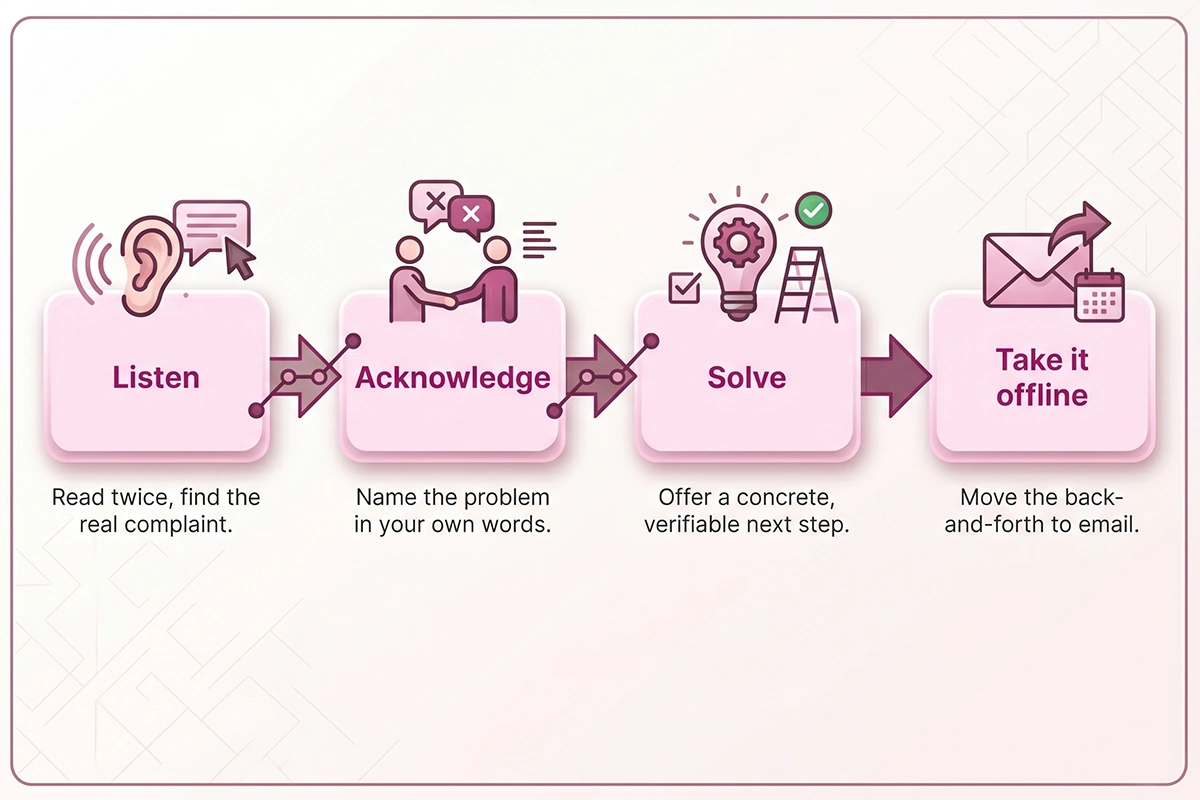
Listen before drafting
Read the review twice. Find the actual complaint, which is often buried under tone. If the review says "this is a scam and you stole my money," the underlying complaint might be "my order arrived two weeks late and I could not reach support." You are responding to the underlying complaint, not the tone.
If your first impulse is to defend the store, walk away from the keyboard for at least 30 minutes. The reply you write angry is the reply you will regret reading the next morning.
Acknowledge specifically, not generically
"We are sorry to hear about your experience" is a copy-paste line every customer has read 50 times. Specific acknowledgment names the problem in your own words: "I am sorry your order took 14 days to arrive when our shipping page said 3 to 5 business days." That shows the reviewer you actually read what they wrote, and shows the next buyer you understand the problem, which is the prerequisite for trusting that you can fix it.
Solve with a concrete next step
A reply that ends with "we will do better" is not a reply, it is a non-commitment. A reply that ends with "I have refunded your order in full as of this morning and the confirmation is in your inbox" is a reply. The future buyer reading along now knows what your default is when something goes wrong.
The concrete step does not have to be a refund. It can be a replacement, a discount on a future order, a free product exchange, or a clear escalation path. What matters is that the action is specific and verifiable.
Take it offline for the back-and-forth
The public reply is one round. Two at most. If the reviewer responds with new complaints, the answer is a private email or direct message, not a third public reply. Judge.me supports both public and private replies from the review dashboard, and the customer gets notified for both. Use the private reply for the back-and-forth. Use the public one to show future readers how it ended.
Five reply templates by review type
Templates are starting points. Every reply needs at least one specific detail (the customer's actual order, the actual product, the actual issue) so it does not read like a script. These five cover roughly 90% of the negative reviews a Shopify store will see in its first two years.
Template 1: The shipping or fulfillment complaint
This is the most common negative review for new stores. Late delivery, damaged packaging, lost shipment, wrong tracking number. The reviewer is frustrated about something often outside your direct control (the carrier), but the responsibility still lands with you.
Template:
Hi [Name], I am sorry your order took [X days] to arrive. The carrier delay is on us to communicate better, and I have refunded your shipping cost as of today. I have also emailed you directly with a discount code for your next order if you would like to try us again. If anything else came up I should know about, please reply to that email so I can fix it. Niza, Studio Niza.
Template 2: The product did not match expectations review
The product arrived as described, but the customer expected something else. The color was different in real light. The size felt smaller than they pictured. The material was lighter than they thought. This is the expectation-reality gap, and it is on you to surface in product copy and on them to interpret.
Template:
Hi [Name], thank you for the honest review. I am sorry the [product] did not match what you were expecting from the photos. The [specific detail, e.g. the lighter peach tone in natural light] is something I am going to add to the product page so future buyers can decide more confidently. I have started a return on your order, the email is in your inbox. If a different [color/size/variant] would work better, let me know and I will swap it for you.
This validates the gap without admitting fault, and commits to a product-page improvement you should actually make.
Template 3: The customer service complaint
The customer reached out, waited for a response, and got either silence or an unhelpful reply. This one is fully on the store and the reply needs to acknowledge it without excuses.
Template:
Hi [Name], you are right to be frustrated. Your email on [date] should have been answered within 24 hours and it was not. I am the only person on support here and I missed your message. I have replied directly to that email now with [the answer / the refund / the next step]. If you want to talk this through further, my address is contact@studioniza.com and you will hear back from me the same day.
Template 4: The customer is objectively wrong
This is the hardest one. The customer ordered the wrong size after the size guide clearly listed the measurements. They expected a feature the listing did not promise. They left a review meant for a different store. You are not wrong, and pretending you are will undercut your credibility with the future buyer.
Template:
Hi [Name], thank you for the review. I want to clarify a couple of points for anyone reading this. The product page lists [the specific detail, e.g. the size chart in inches and centimeters, the materials, the shipping timeline], and I am happy to walk you through it over email. I have emailed you with a return option so we can get you sorted out. Please reply there and we will sort it out.
Template 5: The defective or quality issue
The product arrived broken, defective, or below the quality the listing implied. This one needs the fastest, most specific response of the five, because the reviewer is right, and the future buyer needs to see exactly what your default is when something is genuinely wrong with the product.
Template:
Hi [Name], I am sorry the [product] arrived [defective / damaged / not as described]. I have processed a full refund as of today and you will see it back in 3 to 5 business days. I would also love to send you a replacement at no charge if you would like one, just reply to the email I sent and I will get it out the same day. If you are seeing a pattern with this product, I want to know about it, so any photos you can share will help me check the rest of the batch.
Refund first, replace second. The future buyer learns that defective product means immediate refund, which is a stronger signal than any "100% satisfaction guarantee" badge.
What not to write back
Three response patterns actively hurt conversion. Avoid them even when the reviewer is rude or wrong, because the audience watching is judging both of you, and you are the one with the brand.
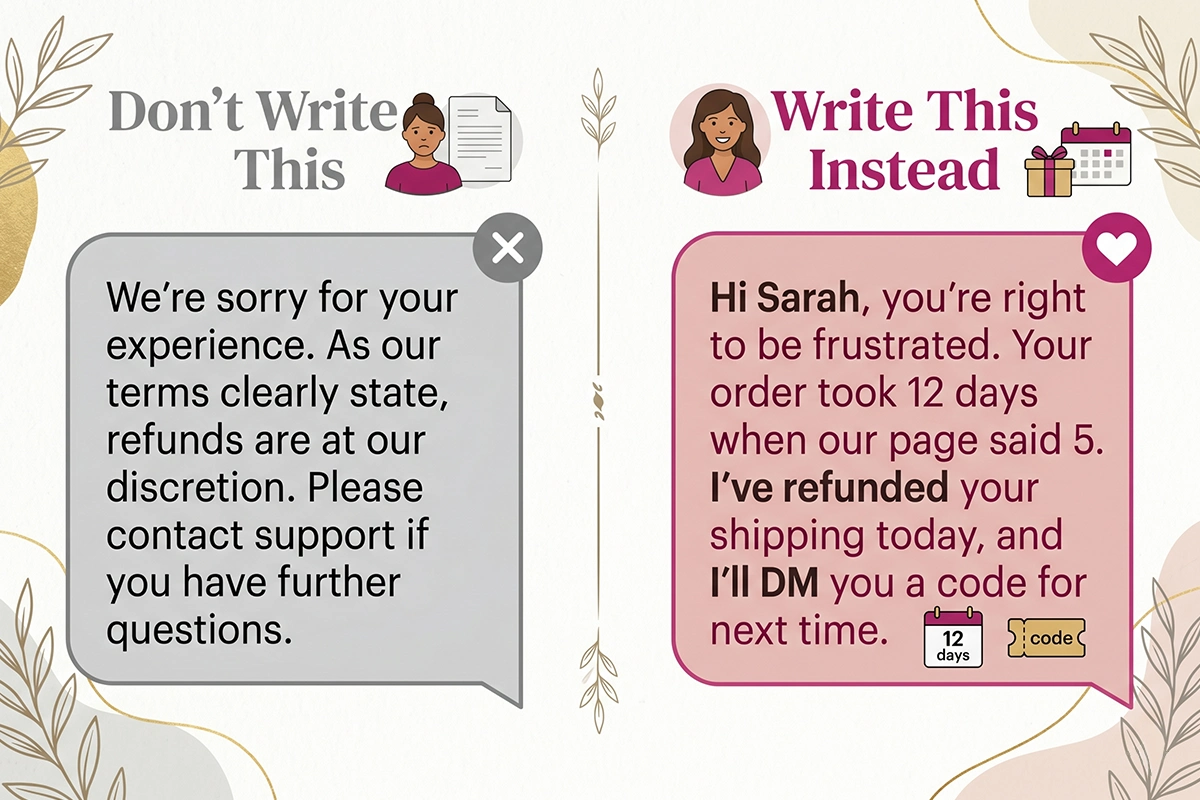
Do not write defensively
Defensive replies (the ones that explain why the customer is wrong, list the policies they violated, or invoke "as our terms clearly state") read as rude even when the policy is on your side. The future buyer reads a defensive reply and assumes that if something goes wrong with their order, they are about to be lectured.
Do not use a generic copy-paste apology
"We are sorry for your experience. Please contact us so we can make this right." Five reviews in a row with that exact reply tells a careful reader you are not actually reading the complaints. BrightLocal's 2026 consumer review survey notes that generic, templated responses now have a measurable negative impact on trust. The minimum standard has moved up.
Do not deny the customer ever existed
The "we have no record of you in our system" reply is the most common reputation-killer. Even when it is true, the public reply is not the place to litigate it. Take that conversation to email, sort it out privately, and if the review is genuinely from a non-customer, flag it through the platform. Publicly accusing a reviewer of lying almost never lands the way the responder thinks it will.
How fast you actually need to respond
Consumer expectations on response time have accelerated quickly. BrightLocal's 2026 Local Consumer Review Survey found that 19% of consumers now expect a response the same day they leave a review (up from 6% the year before), 32% expect a response within 24 hours, and 81% expect a reply within a week. Same-day expectations have tripled in twelve months.
Meanwhile, the median Shopify store is responding much more slowly. A 2026 benchmark by ReplyOnTheFly puts the average business response time at 2.7 days, and notes only around 54% of reviews get a response at all. That gap is a problem for the average store and an opportunity for the store that responds well.
The realistic cadence for a solo founder is not same-day, it is 24 to 48 hours, consistently, on weekdays. A store that always replies within two business days will outperform a store that replies in two hours sometimes and never other times. Turn on email or push alerts in Judge.me, Loox, or Stamped.io (all available on free or starter tiers) and add a single weekly reminder to clear any backlog. That is the entire system.
When not to respond at all
Public replies are not always the right move. Four situations call for flag or stay silent instead of engaging.
Reviews that violate platform policy. Profanity, threats, slurs, identifying personal information, or content unrelated to the transaction. Every major reviews platform (Judge.me, Loox, Stamped, Yotpo) has a violation flag and a removal process. Use it.
Reviews from non-customers. If you can prove the reviewer never placed an order, flag the review with proof (no matching email, no matching order ID). Most platforms remove these within a few days if the case is clean. Do not call them out publicly.
Obvious competitor sabotage. A flurry of low-star reviews in the same week with similar language and no order matches is a coordinated attack, not a customer experience problem. Flag every one, contact platform support, document everything.
Reviewers looking for an argument. Two or three replies in, some will keep escalating no matter what you write. Stop responding after your first calm, factual reply. Future buyers can tell who is being reasonable and who is not.
Building the habit when you are a one-person team
If you are running your store solo, the response habit has to fit into a workflow that already feels full. The good news is that the time investment is small, especially in the first year when review volume is low.
The simplest workflow is a 15-minute Wednesday morning ritual. Open your reviews dashboard. Reply to any new reviews from the past week (positive and negative). Flag any that violate policy. Update any product pages where a review surfaced a real expectation gap. Done.
Brand voice consistency takes longer. The first 20 replies you write will sound a little different from each other because you are still calibrating tone. By the 50th, you will have a recognizable voice. Save your best three or four as memory-jog templates for similar reviews. Not copy-paste, just starting points.
When the Wednesday ritual starts taking an hour, that is the signal to either build a personal template library, train a VA to handle the first draft, or hand it to a service. Studio Niza's Reviews Management service is one option, with pricing from $199 per month. Honest scope: we cannot guarantee a number of reviews per month (that depends on your order volume and customer satisfaction, neither of which we control), but we can guarantee that every review gets a considered, brand-aligned reply within 48 hours.
Wrapping up
Negative reviews on Shopify are not a problem to be solved. They are a public conversation, and your half of that conversation is one of the strongest trust signals a future buyer will see before they hit add-to-cart.
The framework is simple. Listen before drafting. Acknowledge specifically. Solve with a concrete next step. Take the back-and-forth offline. Five templates cover most of what you will face in your first two years, and the habit of replying within 48 hours, every week, beats the occasional same-day reply by a wide margin.
If you have a backlog right now, start with the most recent five reviews, write thoughtful replies, and build the Wednesday ritual from there. The reviews you reply to this week will quietly help every conversion next month, and the month after that. That is the long game, and it is one of the few growth tactics on Shopify that compounds without paid spend.
Want this off your plate?
Studio Niza's Reviews Management service replies to every review on your store within 48 hours, in your brand voice, using the framework from this post. Pricing starts at $199 per month, with the discontinued listing redirect included on every tier so old reviews stay attached to your active products.
See how reviews management works →Or email contact@studioniza.com if you have a specific question about your store. I read every one.
Frequently asked questions
If you're still unsure after reading these, just send the question.
Should I respond to every negative review on my Shopify store? +
Yes, with three exceptions: reviews that violate platform policy, reviews from non-customers you can prove never bought, and reviews where the reviewer is clearly trying to bait you into a public argument. Everything else gets a calm, specific reply within 48 hours. The reply is for the future buyer, not the reviewer.
How long do I have to respond to a negative review before it hurts my store? +
Consumer expectations have tightened fast. BrightLocal's 2026 data shows 32% of consumers expect a response within 24 hours and 81% expect one within a week. For a solo founder, a consistent 24 to 48 hour response time on weekdays is the realistic target. Slower than a week starts to hurt trust.
Can I delete a negative review on Shopify? +
You can remove reviews that violate the platform's policy (profanity, threats, spam, non-customer reviews you can prove), but you cannot delete a review just because you disagree with it. Deleting legitimate negative reviews tends to backfire, because a store with only 5-star reviews reads as fake to roughly 30% of consumers.
What if the negative review is from someone who never bought from me? +
Flag the review through your reviews platform with proof: no matching email, no matching order ID, no record of the transaction. Most platforms (Judge.me, Loox, Stamped) will remove it within a few business days if the case is clean. Do not call out the reviewer publicly, since that almost always reads worse than the original review did.
Should I offer a refund in a public reply to a negative review? +
Yes, when the complaint is legitimate. Offering a specific, verifiable next step (full refund, replacement, store credit) in the public reply shows future buyers exactly what your default is when something goes wrong. Vague offers like "please contact us so we can make this right" are weaker than a specific commitment the reader can verify.
Does responding to negative reviews help SEO? +
Indirectly, yes. Review content (including the response text) is part of the structured data Google and AI search engines pull when they cite your store, and active engagement signals freshness and authenticity. The bigger SEO impact comes from review schema and star snippets driving click-through rate from search results, but a consistent response habit feeds the same trust signal.
What is the best reviews app for handling negative reviews on Shopify? +
For any Shopify store under roughly $200K per year in revenue, Judge.me is the default recommendation. The free tier includes public and private replies, email notifications, and policy-violation flagging. Loox and Stamped.io are also strong choices, especially if you want better visual review widgets. The choice of platform matters far less than the habit of using one consistently.
Can I ask a customer to update their review after I resolve the issue? +
Yes, and you should. After you have resolved the underlying issue through email or direct message, send one polite follow-up asking if they would consider updating their review to reflect the resolution. Most reviewers will either update it or leave it alone. Do not pressure, do not offer money in exchange, and do not ask more than once.