Most new Shopify stores collect text reviews and stop there. The review widget loads, the star rating shows, and the founder assumes the social proof is doing its job. Then conversion stays flat, and no one can quite explain why.
Here is what the data actually says. When shoppers interact with customer photos on a product page, conversion roughly doubles. In some categories it nearly triples. The most-cited public claim from visual UGC research is that shoppers who view customer-submitted photos are around five times more likely to buy than shoppers who do not. The headline number depends on the study, but the direction is unanimous: photo reviews convert better than text reviews on every benchmark we have.
This post explains why that gap exists, which Shopify stores benefit most, how to actually get customers to upload photos, where the 2024 FTC rule draws the line on incentives, and which review app to use depending on your stage. Written for solo founders running stores in their first 12 to 18 months.
The conversion gap between photo and text reviews
Three independent research bodies have published numbers on this. They do not all match, because they measure slightly different things, but the pattern is the same.
PowerReviews found that when shoppers interact with visual user-generated content on a product page, the conversion rate nearly doubles, jumping from 3.4% to 6.6%. That is a 91.4% lift. In apparel the lift climbs to 119%, in home and garden 149%. A later PowerReviews study put the conversion lift at 106% when shoppers interacted with photo and video content, and 110.7% when they clicked on the image gallery itself.
Bazaarvoice ran the math across five major ecommerce industries and found an average 161% conversion lift when shoppers saw or interacted with UGC on the path to purchase. Their data also shows 85% of consumers trust visual UGC over branded content when making purchase decisions.
Yotpo reports a 137% lift in purchase likelihood when shoppers see customer photos, with shoppers viewing UGC as roughly 2.5 times more authentic than brand-created content.
The often-cited "5x" claim comes from earlier visual commerce research, which found shoppers who view customer-submitted photos are around five times more likely to buy than shoppers who do not. That number is the high end of the published range. The 2x to 3x conversion lift on interaction is the more reliable working number.
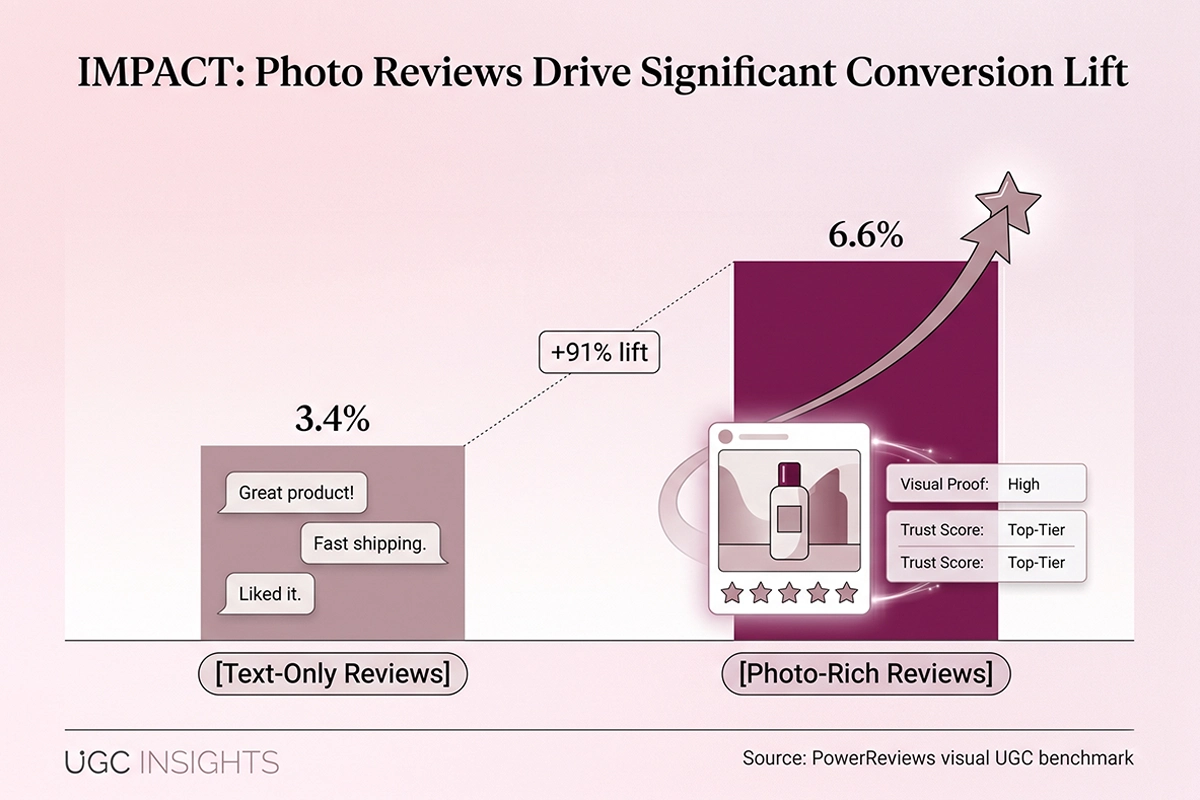
The realistic frame: a product page with healthy text reviews converts around your store average. The same page with a clickable gallery of customer photos converts roughly 2x higher when shoppers engage with the photos. On visual-heavy products like apparel, the lift gets bigger.
This is one of the highest-ROI moves available to most Shopify stores under $200K per year. Software cost is zero on free or starter tiers. Setup takes about an hour. And it compounds, because every photo you collect today is doing work on the product page two years from now.
Why photo reviews actually convert better
The conversion lift is not random. There are specific reasons customer photos move buyers in a way that text reviews cannot.
Photos answer the questions text cannot
Most product page hesitations are visual. "Does this dress look like that on a real body?" "Is the gold tone warm or cool in actual light?" "How big is this candle next to a hand?" A five-star text review that says "love it" answers none of these. A customer photo answers all three in two seconds.
This is why 85% of consumers say they prefer customer photos over brand photos. The brand photo is staged, lit, and retouched. Buyers assume that. The customer photo is a phone snap in a real kitchen with mixed lighting. That is the photo that builds trust, because it cannot be faked.
Photos remove the perceived purchase risk
Most online shopping anxiety is about return logistics and disappointment. A buyer who has been burned by drop-shipped junk is scanning your product page for evidence the product is real. A customer photo is that evidence. Stores with strong photo review coverage on apparel and home products sometimes see lower return rates too, because shoppers self-filter at the product page. The buyer who would have returned the dress saw a photo of someone with a similar body shape wearing it and decided not to order in the first place.
Photos make the review section worth reading
Text-only review sections are skimmable. Most shoppers read the summary, the average rating, and one or two recent reviews. A photo gallery interrupts the skim. Shoppers click through photos in a way they do not click through paragraphs. This is the interaction effect behind the PowerReviews and Bazaarvoice numbers. The lift is not from photos sitting passively on the page, it is from shoppers actively clicking through the gallery.
Which stores need photo reviews most
Not every Shopify store needs aggressive photo review collection. The honest answer depends on what you sell.
High value: apparel, beauty and skincare, home goods and decor, jewelry, accessories, kids and baby products, pet products, fitness equipment, and anything where size, fit, color accuracy, or "what does this look like in a real home" matters. These see the biggest conversion lifts from visual UGC, with Bazaarvoice's apparel data showing lifts above 150% in some segments.
Medium value: food and beverage (especially packaged consumables), supplements (where the buyer wants to see the bottle and capsule size), and craft or handmade products. The lift is real but smaller.
Lower value: commodity products where the spec sheet does the selling (USB cables, basic office supplies, generic phone cases), digital products, and most B2B catalog products. Photo reviews do not hurt these stores, but the conversion lift is small enough that text reviews and clear product photography do most of the work.
If your store fits the high or medium category, photo reviews are a top-three priority. If you sell commodity hardware or digital products, photo reviews are nice to have, not essential.
How to get customers to actually upload photos
This is where most Shopify owners get stuck. The app is installed. Photo uploads are enabled. And six months later, the store has 47 text reviews and three photos, two of which are blurry. The path to better numbers is timing, request copy, and friction reduction, in that order.
If you are still building from scratch, we covered the foundational request flow in how to get your first 50 reviews on Shopify. This section assumes that flow exists and focuses on the photo-specific layer.
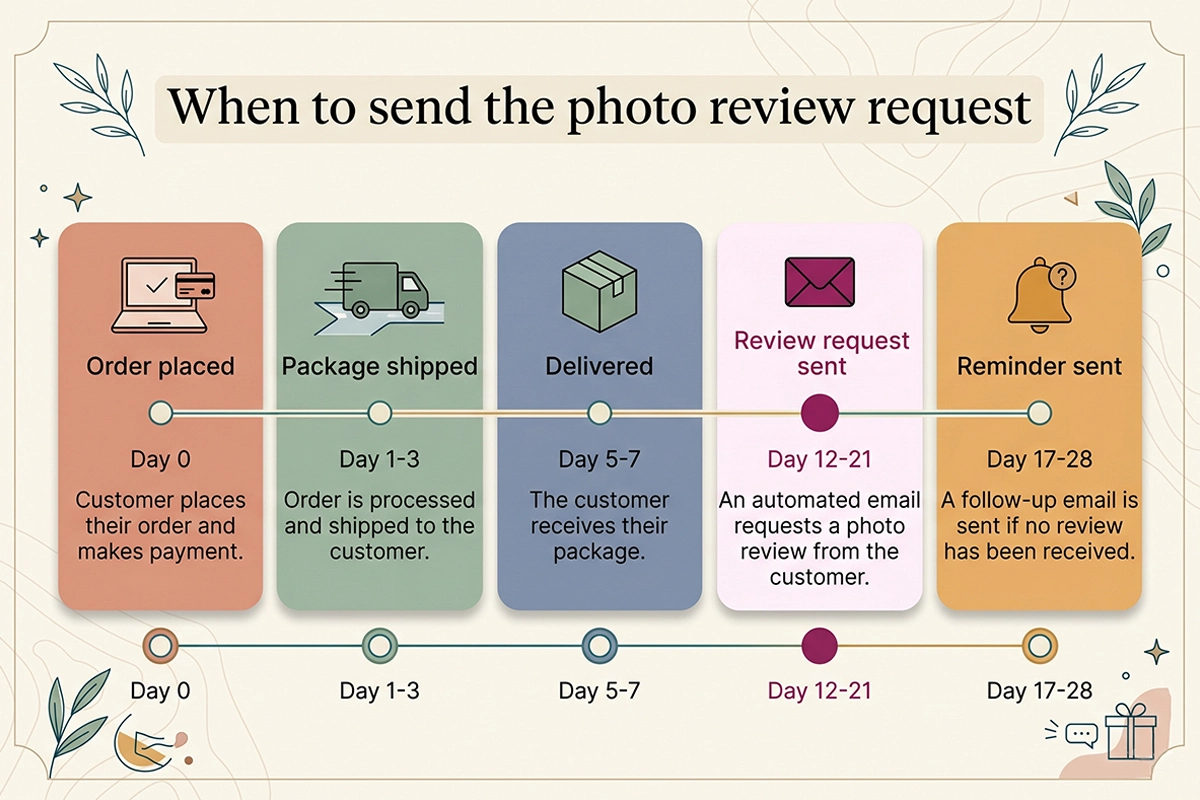
Send the request 7 to 14 days after delivery, not fulfillment
The default on most reviews apps is to send a fixed number of days after the order is fulfilled. Wrong anchor. Customers do not have an opinion until the package arrives, opens, and gets used.
Judge.me supports delivery-based scheduling via the order's tracked delivery status. This is what you want. Timing windows by category:
| Product Type | Send Request | Why |
|---|---|---|
| Consumables (food, supplements) | 5 to 7 days post-delivery | Customer has tried it a few times |
| Beauty and skincare | 10 to 14 days post-delivery | Results take time, photos look more honest |
| Apparel and accessories | 7 to 14 days post-delivery | Customer has worn it once, photographed it once |
| Home goods and decor | 7 to 10 days post-delivery | Customer has placed it, lived with it briefly |
| Jewelry | 5 to 10 days post-delivery | Customer has worn it out, gauged compliments |
Ask for the photo in the subject line and the first sentence
Most review request emails say "How was your order?" and bury the photo upload below the fold. The subject line and opening sentence are the only parts most customers read. Put the photo ask there.
A subject line like "Quick photo of your [product name]?" outperforms "Tell us what you thought" on photo submission rate. The body should reinforce: "If you have a phone photo of it in your home or on you, that helps other shoppers more than text alone. Two-tap upload below." That last phrase is doing real work. Most customers do not realize the upload is two taps from their phone, and they assume it is a 10-minute hassle.
Send the reminder, just once, 5 to 7 days later
Most photo reviews come from the reminder, not the first request. One reminder is good practice. Two feels like nagging. Three earns the spam folder.
Reduce upload friction to zero on mobile
Roughly 60% of Shopify orders are placed on mobile, and an even higher share of review submissions come from phones. If your reviews app forces customers to switch to desktop, click through three pages, or create an account just to upload, you have already lost most of them. Judge.me and Loox both support in-email submission with photo upload on mobile, which is the friction floor.
Include a packaging insert
A small printed card in the shipped package, with a QR code linking directly to the review form, lifts photo submission noticeably. Brand-friendly card stock, one sentence ("Send us a photo of your [product] in its new home, it helps other shoppers more than you'd guess"), and a QR code. Cost is usually under $0.10 per order at small scale.
The FTC line on photo review incentives
The most-asked question in every Shopify reviews thread on Reddit is some version of "Can I offer a discount for photo reviews?" The answer is yes, with two conditions. This is one of those areas where the rule is simpler than the internet makes it sound.
The relevant rule is the FTC's Consumer Reviews and Testimonials Rule, which went into effect on October 21, 2024. Two parts of that rule directly affect how you ask for photo reviews.
You cannot incentivize a positive review
You cannot offer a discount, gift, store credit, or any other incentive in exchange for a review that expresses a specific sentiment. "Get $10 off when you leave us a five-star review" is illegal. "Tell everyone how much you love us and we will send you a free sample" is illegal.
What is allowed is offering an incentive for an honest review, regardless of sentiment. "Leave a review for $10 off your next order, positive or negative" is fine. As the Holland and Knight summary puts it, the incentive cannot be conditioned on review sentiment.
You must disclose the incentive clearly and conspicuously
If a customer left a review because you offered store credit, that incentive must be disclosed on the visible review itself. Not in the terms of service. Disclosed where any shopper reading the review would see it.
The standard way on Shopify reviews apps is a small badge ("Incentivized review" or "Customer received a discount for this review"). Most major apps handle this automatically when you flag a review as incentivized. If your app does not, do not run incentivized campaigns until it does.
What this means for photo reviews specifically
You can run a "Get $5 off your next order for a photo review" campaign. The offer must be available for any honest photo review including negative ones, you must disclose the incentive on every review collected, and you cannot suggest the review needs to be positive to qualify. Phrases like "if you loved it, share a photo" are on the wrong side of the line. The cleaner copy is "if you have a phone photo of it, share it for $5 off your next order."
Photo review incentives work. They are legal when scoped correctly. They are the fastest way to bootstrap a photo gallery on a young store.
Photo review apps compared
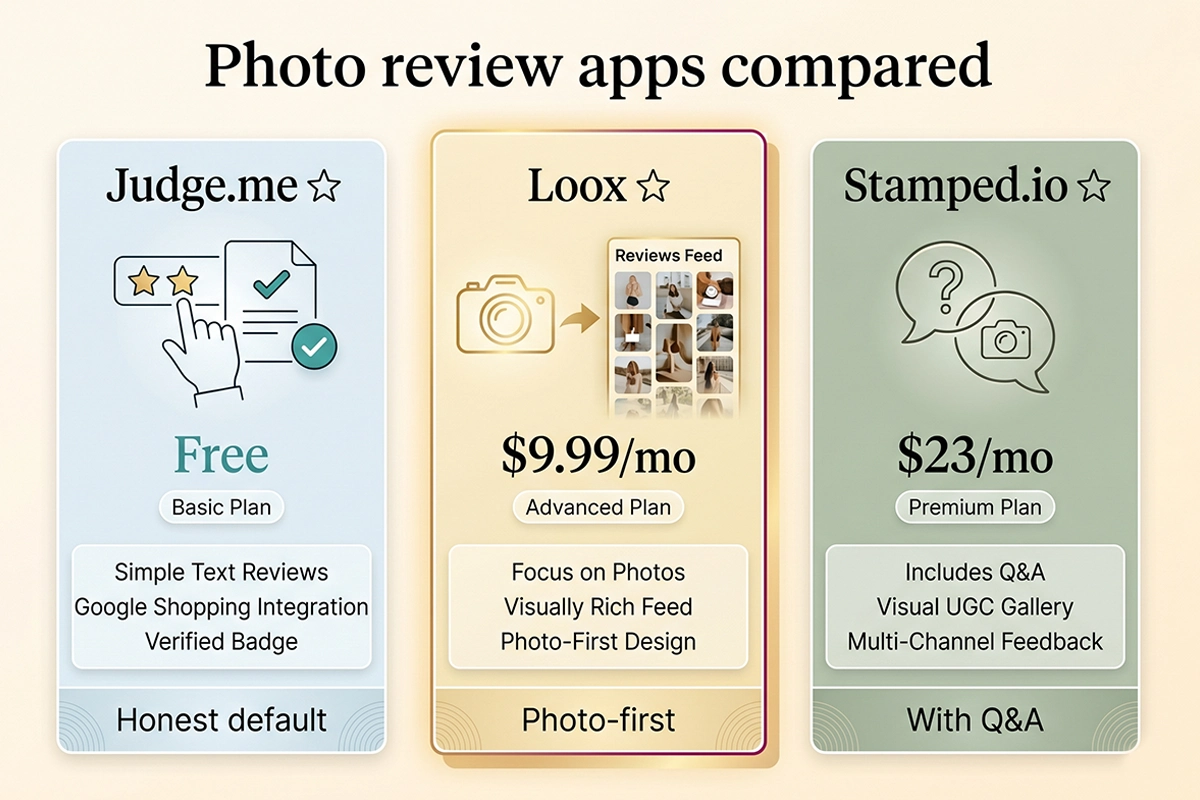
Three apps cover roughly 90% of new Shopify stores: Judge.me, Loox, and Stamped. The choice depends on your stage and budget.
| App | Photos on free plan | Starting paid tier | Best for |
|---|---|---|---|
| Judge.me | Yes, unlimited | $15 per month (Awesome) | New stores under $200K per year revenue |
| Loox | 14-day trial | $9.99 per month (Beginner) | Visual-heavy categories prioritizing photo-first widgets |
| Stamped.io | Limited free | $23 per month (Basic) | Stores wanting visual review widgets and Q&A together |
Judge.me: the honest default
For new Shopify stores under $200K per year, Judge.me's free plan is the right starting point. Unlimited photo reviews, automated email requests, delivery-based scheduling on the paid Awesome tier ($15 per month), photo galleries on product pages, Google Shopping rich snippet syndication, and an in-email review form that lets customers submit photos without leaving Gmail. The free tier is genuinely capable, which is rare in this category.
The honest case for Judge.me is that you can run a full photo review program for under $200 per year (Awesome tier billed annually), and the platform supports moving accumulated photos to a replacement listing when a product retires or merges with a variant. Most reviews services skip that.
Loox: photo-first by design
Loox is built for visual review collection specifically. The widgets are more photo-forward than Judge.me's default look, discount-for-photo automation is built in, and the company markets a higher submission rate. Paid plans start at $9.99 per month (Beginner) and scale with order volume. The case for Loox is real if photos are the entire strategy and your category is highly visual. The case against is that pricing scales with orders, so a successful store moves up tiers faster than on Judge.me, and much of the widget polish can be replicated with theme code on Judge.me at no extra cost.
Stamped.io: better for stores wanting Q&A too
Stamped's basic tier starts at $23 per month and includes reviews, photos, and Q&A. The Q&A feature is the differentiator. If your product pages get a lot of pre-purchase questions ("Does this come in a wide width?"), Q&A reduces email and chat burden meaningfully. If you do not need Q&A yet, Stamped is hard to justify over Judge.me at twice the price.
Yotpo is the fourth name in every comparison. For a store under $500K per year, Yotpo is overkill. Pricing scales aggressively, feature set built for Shopify Plus brands. Most solo founders should not be on Yotpo.
Wrapping up: a realistic year-one photo review target
The honest target for a Shopify store in its first 12 months: a 2 to 3% overall review submission rate, with 15 to 30% of those reviews including photos. On a store shipping 200 orders per month, that is roughly 4 to 6 reviews per month and 1 to 2 with photos, assuming no incentives.
Add a $5 photo-review incentive with proper FTC disclosure, and the photo rate often climbs into the 20 to 40% range of submitted reviews. That moves the math to 1 to 3 photo reviews per month, or 12 to 36 in year one. Not a flood. Enough to build a small but credible gallery on your top three or four products.
The work that delivers those numbers is unglamorous: a correctly scheduled request email, a subject line that asks for the photo, a packaging insert with a QR code, an honest incentive offer, and quick approval. None of it requires expensive tools. Most of it takes a Saturday to set up and 20 minutes a week to maintain.
Want photo reviews actually showing up on your store?
The Studio Niza Reviews Management service handles request scheduling, photo-friendly email copy, replies to every review, and the discontinued listing redirect so accumulated photos stay attached when SKUs retire. Pricing starts at $199 per month.
See Reviews Management pricing →Or email contact@studioniza.com if you have a specific question about your store. I read every one.
Frequently asked questions
If you're still unsure after reading these, just send the question.
How much can photo reviews actually lift conversion on a Shopify store? +
Independent research from PowerReviews, Bazaarvoice, and Yotpo all show conversion lifts in the 90% to 160% range when shoppers interact with photo reviews on a product page. The often-quoted "5x" claim is the high end of the published range and refers to viewers of customer photos being roughly five times more likely to buy than non-viewers. The reliable working number for a new Shopify store is 2x conversion lift on engaged photo-review shoppers, with bigger lifts in apparel, beauty, and home goods.
What's a realistic photo review submission rate for a new Shopify store? +
Industry-baseline review submission rates sit around 2 to 3% of orders on most reviews apps, with 15 to 30% of those reviews including photos on visual-product categories. A store shipping 200 orders per month should expect roughly 4 to 6 reviews per month and 1 to 2 with photos, assuming no incentives. A photo-specific incentive can roughly double the photo rate.
Can I offer a discount for photo reviews under the 2024 FTC rule? +
Yes, with two conditions. The incentive must be available for any honest review regardless of sentiment (you cannot require a positive review to qualify), and the incentive must be clearly disclosed on the visible review itself. Standard "Incentivized review" badges on Judge.me, Loox, and Stamped handle the disclosure automatically when you flag a review as incentivized.
Which is the best free Shopify app for photo reviews in 2026? +
Judge.me's free plan is the honest default for any Shopify store under $200K per year in revenue. Unlimited photo reviews, in-email submission, Google Shopping rich snippet support, and product page galleries are all included at no cost. Loox is a strong alternative if photos are the entire strategy and you can spend $9.99 per month from day one.
Do I need video reviews if I already have photo reviews? +
Not at the new-store stage. Photo reviews cover most of the trust and conversion gap for visual-category products. Video reviews are harder to collect (most customers will not record one) and are mostly worth the friction once you are past $200K per year in revenue and competing in a category where video unboxing is the norm.
What's the right timing to ask for a photo review after delivery? +
Send the first request 7 to 14 days after the order is marked as delivered (not after it is fulfilled). Earlier for consumables (5 to 7 days), later for skincare or anything where results take time. Send one reminder 5 to 7 days after that. Two reminders is the ceiling.