
You launched the store. You ran the ads. The orders started coming in. And now you're spending two or three hours a day answering the same five questions: where is my order, what's your return policy, do you ship to Canada, does this come in black, can I change my address.
That's the moment every small Shopify owner hits the same fork. Do you set up Shopify customer support automation, hire a part-time support person, or just keep doing it yourself a little longer? The advice online is unhelpful because it's almost always selling you one of those three options. This post isn't.
What follows is a decision guide built on the numbers that actually matter for a store doing under 500 orders a month. There are three of them. Once you know yours, the answer becomes obvious. I'll show you the real costs of each path, the threshold where a chatbot starts paying for itself, and the threshold where a hire becomes the right call instead. The honest answer for most stores in their first year is "automate first, hire later, and probably not the way you're thinking."
What Shopify customer support automation actually means
Customer support automation is the deflection of repeatable support tasks so a human doesn't have to handle them one at a time. Research cited by MESA shows that 69% of shoppers will try to find an answer themselves before contacting a human. That's a useful starting point. Most of your customers actually want to self-serve. They just need a way to.
On Shopify, automation has three layers. They get conflated all the time, which is part of why the chatbot conversation gets confused.
The three layers
Proactive notifications. Shopify already sends order confirmation, shipping, and delivery emails by default. Every "where is my order" question that a customer doesn't ask is automation working in the background. Most stores leave the default copy in place and miss the chance to add tracking links, expected delivery windows, and a clear "what to do if it's late" line. Improving these notifications is the cheapest support automation you can do, and it's free.
Self-service pages. A real FAQ page, a clear shipping and returns policy, a contact form that confirms the message was received. Shopify's own guidance is that policy documentation, FAQ pages, and account portals deflect routine tickets before anyone needs a tool. Most stores have these. Most stores also have them buried in the footer and written like legal documents.
Chat and voice automation. This is what people usually mean when they say "chatbot." A widget on your site that can answer common questions, pull live order data, recommend products, and hand off to email or a human when it can't. Shopify Inbox is the free starting point. Beyond that, you're looking at a managed AI chatbot trained on your specific store.
What automation can't do
A chatbot is not a returns department, a complaints resolution channel, or a one-of-a-kind sizing consultation. It's not the right tool for emotional conversations or anything where the customer needs to feel heard. It also can't write thoughtful replies to negative reviews, which is a related but separate problem covered by reviews management. Knowing what automation isn't is half of using it well.
What most stores get wrong about the chatbot vs hire question
The framing is almost always wrong. It's not chatbot or hire. For almost every small Shopify store, it's automate first, hire second, and only hire to do what automation can't.
Most stores skip the automation step because they think chatbots are a "growing brand" thing. Then volume creeps up, the founder burns out replying to "where is my order" at 11pm, and the first move is to hire a virtual assistant. Now the VA spends 60% of their time looking up tracking numbers, which is the exact task a $99/month chatbot would have handled without supervision. The store is paying both for the VA's time and for the gain in time and capacity that automation would have given for a fraction of the cost.
The other common mistake is the opposite. A founder sets up a cheap self-serve chatbot, never trains it on the store's actual products and policies, gets one bad customer experience, and concludes "chatbots don't work for my brand." Honest scope beats impressive scope. A chatbot that only answers the 10 questions it knows well, and hands off everything else to email cleanly, beats a chatbot that tries to answer everything and fails 30% of the time.
The three numbers that decide for you
Forget your gut feeling about whether you're "ready for a chatbot." Three numbers will tell you. Open your inbox, your Shopify Inbox, and your calendar from the last 7 days, and count.
Number 1: Tickets per week
A "ticket" is any inbound message that needs a reply. Email, chat, Instagram DM, contact form, all of it. A single support agent typically handles 30 to 50 tickets per day depending on complexity. So a full-time hire's natural capacity is around 150 to 250 tickets per week. Below that, you don't have a person's worth of work yet. You have an automation opportunity.
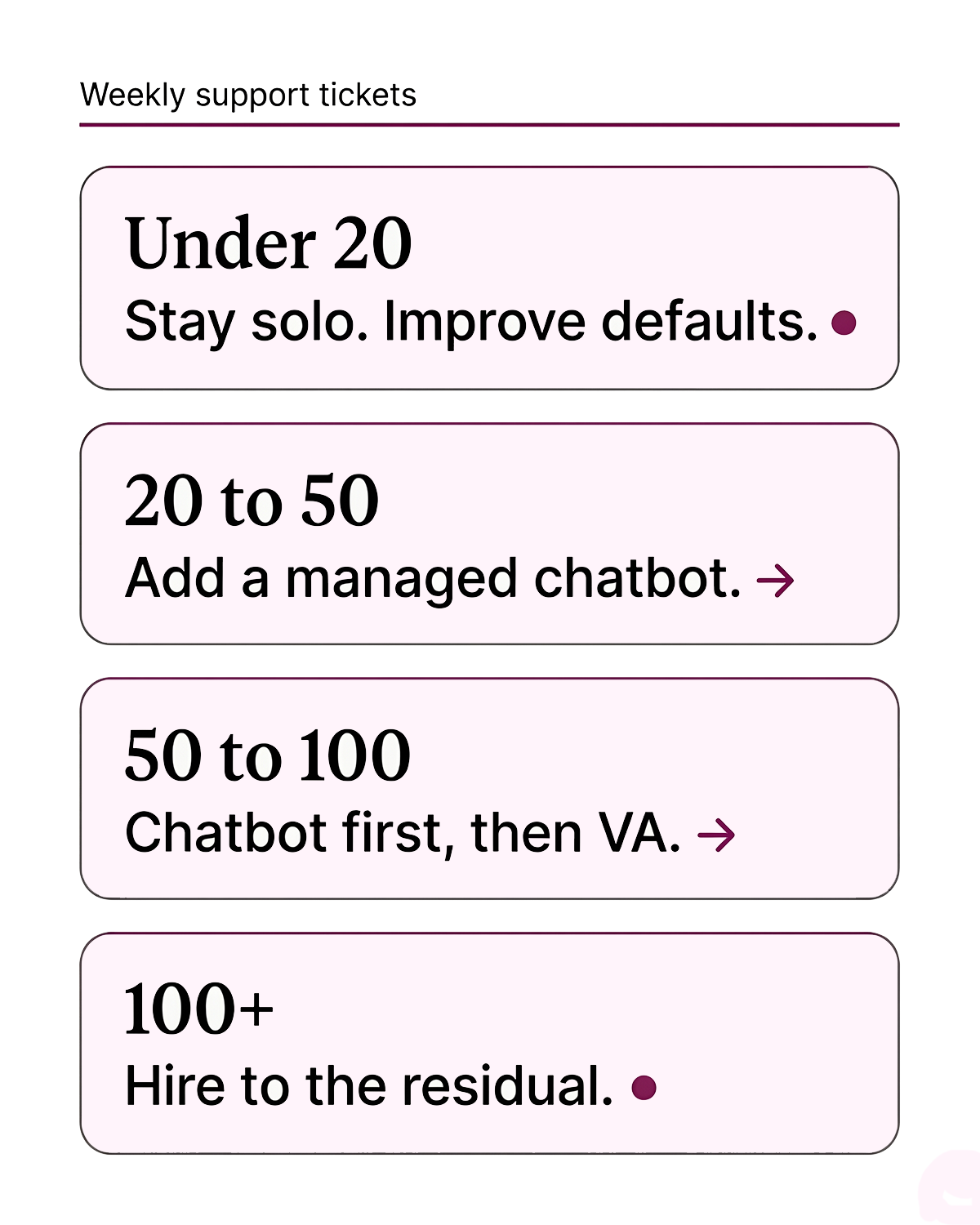
Rough thresholds for a small Shopify store:
Under 20 tickets/week: You're fine doing it yourself. Improve Shopify's default notifications, write a real FAQ, and batch your replies twice a day. Don't pay for anything yet.
20 to 50 tickets/week: Automation pays for itself here. Shopify Inbox plus a basic managed chatbot will deflect 40 to 60% of these messages. You're not ready to hire.
50 to 100 tickets/week: Automation is no longer optional. Set it up first, then decide if a part-time VA makes sense for the residual.
100+ tickets/week: You're at hire-or-outsource volume, but only after automation has done its work. A chatbot at this volume should be deflecting 50 to 70% of inbound, leaving 30 to 50 tickets a week for a human to handle thoughtfully.
Number 2: Hours per week you're losing
Add up the time you spent on support last week. Include the context-switching tax: every time a notification interrupted what you were actually trying to do. Most founders undercount by half.
If you're losing more than 5 hours a week to support, the cost isn't the hours themselves. It's everything you didn't do with them. That's the product photo shoot you postponed, the supplier email you didn't send, the new collection you didn't launch. Time the founder spends on routine support is the most expensive time in the business.
Number 3: The percentage of tickets that are WISMO and FAQ
WISMO stands for "where is my order." It is, reliably, the single biggest category of inbound support for any ecommerce store. Radial's data, cited by Consio, puts WISMO at 25 to 35% of contact center interactions and notes it can spike to 50% during peak season.
For a small Shopify store, the WISMO plus FAQ percentage is usually higher. Go through your last 50 tickets and tag each one. If 60% or more are tracking, shipping policy, return policy, or product detail questions, automation will handle most of your support load. If 60% or more are unique, emotional, or high-value-decision conversations, you need a human, and a chatbot won't change that.
The honest cost of each path
Here's where the chatbot vs hire conversation usually gets sales-pitched. Let me show you the actual math instead.
| Path | Monthly cost | Setup time | What it handles | Best for |
|---|---|---|---|---|
| Shopify Inbox only | $0 | ~1 hour | Live chat with you on the other end. AI-suggested replies. No 24/7 coverage. | Under 20 tickets/week, founder still doing replies personally. |
| Self-serve chatbot software | $39 to $279 | 10 to 40 hours of your time | FAQ-style answers, basic WISMO. You build it, train it, maintain it. | Founders who genuinely enjoy product-building and have spare hours. |
| Managed chatbot service | $99 to $300 | None. Built for you in 2 to 4 weeks. | WISMO, FAQ, abandoned cart recovery, clean email handoff. Trained on your store. | Stores doing 20 to 150 tickets/week. The sweet spot. |
| Part-time virtual assistant | $400 to $1,200 | 2 to 6 weeks of training | Everything a human can do. Quality varies. Needs supervision. | Stores already running automation, with 50+ tickets/week of complex residual. |
| Part-time domestic hire | $1,500 to $3,500 | 4 to 8 weeks to be self-sufficient | Brand voice, complex returns, real customer relationships. | Stores past $200K/year in revenue with brand-sensitive support needs. |
| Full-time customer support rep | $3,200 to $5,200 + onboarding | 4 to 12 weeks | Owns the support function end to end. | Stores past $500K/year with consistent 150+ tickets/week. |
A few notes on those numbers. Domestic part-time figures use US averages where ecommerce customer service hourly rates average around $18.80/hour, scaled to 20 hours/week. VA rates assume offshore hires at $4 to $8 an hour through platforms like OnlineJobs.ph or Upwork. Shopify's own research puts hiring and onboarding cost at up to $4,000 per support rep, and notes that the wrong hire can cost up to $240,000, which is the underweighted number in this whole conversation.
When a Shopify chatbot earns its keep
A chatbot earns its keep when three conditions are true. First, you have enough WISMO and FAQ volume that deflection is meaningfully reducing your inbox. Second, the chatbot is actually trained on your store, not running on a generic ecommerce template with your name swapped in. Third, it hands off cleanly when it doesn't know the answer, instead of looping the customer.
For a store doing 30 to 100 orders a week with reasonably predictable products, a well-built chatbot will deflect 40 to 70% of inbound tickets. That number isn't a marketing claim; it's a function of how much of your support is routine. If you're a custom-product brand where every question is about a one-off, deflection rates will be lower and a human-first approach is correct.
The honest math on a managed chatbot looks like this. Forrester research, also cited by Consio, found that 53% of US online adults are likely to abandon an online purchase if they can't get a quick answer to their question. If your store does 100 orders a week at a $60 average order value, and a chatbot prevents even a small percentage of cart abandonment because it answers pre-purchase questions at 11pm, the math on $99 to $300 a month is not close. The chatbot is paying for itself in the first week.
Where it stops earning its keep: when the founder picks the cheapest self-serve option, doesn't invest 20 hours in training it, and is surprised when it doesn't work. A chatbot is infrastructure, not a one-click install. If you don't want to manage that yourself, a managed Shopify chatbot service exists for exactly this reason.
When it's time to actually hire
Hiring is the right answer when automation has already done its work, and the residual support load is consistently more than you can handle in 10 hours a week. That usually shows up around 50 to 100 leftover tickets per week after deflection, sustained over at least two months.
The first hire is almost never a full-time customer support manager. It's a part-time VA at $400 to $1,200 a month, or a part-time domestic hire at $1,500 to $3,500 a month if brand voice matters more than budget. Either way, hire to do what the chatbot can't: handle complex returns, write thoughtful replies to negative reviews, manage VIP customer relationships, and spot the patterns in support that signal product or operations problems.
The biggest mistake at this stage is hiring for the wrong job. A VA is great for executing a clear playbook. They're not great at writing in your brand voice from scratch or making judgment calls about when to escalate. If you don't have automation set up before you hire, you'll spend the first three months of the VA's time on tasks a $99/month tool would have handled, and the brand-sensitive work will still fall back on you.
The mistake of hiring before automating (or vice versa)
The two failure modes look opposite but cost about the same.
Hiring first. You hire a VA at 30 tickets a week. They spend 60% of their time on WISMO. After three months, your support is faster but you've spent $1,500 to $3,000 on work a chatbot would have done. Worse, the VA learns to do the routine work well, which means when you finally add automation, the VA's job gets smaller and your sunk cost feels harder to walk away from.
Automating first, then never hiring. Less common but real. You set up a chatbot, it deflects nicely for six months, and then volume keeps growing. Now you have 80 tickets a week of residual that no chatbot will ever handle, and you're still personally doing all of it because the chatbot is "working" so you keep delaying the hire. The chatbot deflecting half your tickets doesn't make the other half disappear. It just makes the founder feel less urgency about the part that actually needs a human.
The right sequence is automate, measure, then hire to the residual. Set up the chatbot, run it for 60 to 90 days, look at what's left, and hire for that specific shape of work. It's the only way to know what kind of person you actually need.
Wrapping up
If you remember nothing else from this post, remember the order: improve your default Shopify notifications first, write a real FAQ second, add a chatbot third, hire fourth. Skipping ahead costs more than doing it in sequence, every time.
For most small Shopify stores in their first year, Shopify customer support automation is the highest-impact move on the table. It's not the most exciting purchase. It doesn't come with a flashy revenue-multiplier case study. What it does is buy back 5 to 10 hours of your week so you can spend that time on the parts of the business that actually need you. That's the trade.
Hiring is the right answer eventually. It's almost never the right answer at 30 tickets a week. And it's almost always the wrong answer if you haven't automated WISMO and FAQ first. The honest call for stores doing under 500 orders a month is to put a chatbot in front of the human-needed work, see what's left, and hire for that. Not the other way around.
Want this set up for you?
Studio Niza's Basic chatbot tier handles exactly this kind of automation: WISMO, FAQ deflection, abandoned cart recovery, and a clean handoff to email when the bot doesn't know. Setup is $599 one-time, then $99 a month all-in.
See chatbot pricing & scope →Or email contact@studioniza.com if you have a specific question about your store. I read every one.
Frequently asked questions
If you're still unsure after reading these, just send the question.
What is Shopify customer support automation? +
Shopify customer support automation is the deflection of repeatable support tasks using built-in Shopify features plus optional tools like Shopify Inbox or a managed AI chatbot. It typically covers order tracking, shipping and returns FAQs, and product detail questions so a human only handles the conversations that actually need one.
When should a Shopify store hire its first customer support rep? +
The honest threshold is around 50 to 100 tickets per week of residual volume after automation is already in place, sustained for at least two months. Below that, automation is faster, cheaper, and easier to scale. Most stores try to hire too early, before deflection has done its work.
How much does it cost to automate customer support on Shopify? +
The free baseline is Shopify Inbox, which every Shopify store already has. Self-serve chatbot software runs $39 to $279 a month but takes 10 to 40 hours of your time to set up. A managed AI chatbot service trained on your store typically runs $99 to $300 a month with a one-time setup fee, and someone else handles the build and maintenance.
Will a chatbot frustrate my customers? +
Only if it loops without a clean handoff. A chatbot trained on a tight scope, with a clear "I'll pass this to a human" fallback to email or live chat, is faster than a 24-hour reply wait. The chatbots that frustrate customers are the ones that try to answer everything and fail. Honest scope beats impressive scope.
Can I just hire a virtual assistant on Upwork or OnlineJobs.ph? +
Yes, and many small Shopify stores do at the $400 to $1,200/month range. The honest tradeoff is training time, ongoing supervision, and quality variance. A VA is also doing the WISMO and FAQ work manually that a $99/month chatbot would handle without supervision. Most stores get better results by automating first, then hiring a VA for the residual work that requires judgment.
What's the difference between Shopify Inbox and a managed chatbot? +
Shopify Inbox is free, built into every Shopify plan, and gives you live chat with AI-suggested replies that you approve before sending. A managed chatbot is trained on your specific products, policies, and voice, integrates with Shopify order data, and runs 24/7 without anyone on your side approving each message. Inbox is great for under 20 tickets a week. A managed chatbot earns its keep once volume crosses that line.