
You found a Shopify app that promises blog posts on autopilot. Pick a keyword, hit generate, and a stack of articles publishes to your store while you sleep. The price is low. The pitch is easy. And somewhere in the back of your mind sits the worry that Google will notice and quietly tank the rankings you have been trying to build.
Here is the short version. AI-generated blog content can rank, and using AI is not against Google's rules. What gets stores in trouble is not the tool. It is what most one-click apps actually publish: thin, generic, near-identical articles built for search engines instead of readers.
This post is about the line between those two outcomes. We will look at what Google actually rewards, where set-and-forget AI blog apps quietly hurt your store, the edit-and-fact-check layer that turns a risky draft into something safe to publish, and an honest cost comparison of doing it yourself with an app versus a managed, human-edited post.
I run a one-person Shopify studio, and I use AI in my own content work every week. So this is not a "robots bad, humans good" argument. It is a practical look at when AI-generated blog content helps your SEO, and when it works against you. If you launched your store in the last year and you are deciding whether to trust an app with your blog, this is the decision you are actually making.
Does Google penalize AI-generated blog content in 2026?
No. Google does not penalize content for being made with AI. It never has, and that has not changed for 2026.
Google has been clear about this for years. Its ranking systems aim to reward original, high-quality content that shows experience, expertise, authoritativeness, and trustworthiness, regardless of how the content was produced. You can read the position in Google's own guidance on AI-generated content. The focus is quality, not authorship.
This matters because AI content is already everywhere. Ahrefs analyzed 900,000 new web pages and found that about 74% of them contained some AI-generated content. Looks at top-ranking pages show the same pattern: the large majority use AI somewhere in the mix, and only a tiny share are pure, unedited machine output. If Google were demoting pages for touching AI, most of the web would have already vanished from search.
It is worth being precise about the history. A few years ago Google's public comments were more skeptical of automation, but the written policy has settled into one rule: make content for people, not for the ranking. For the 2026 reality of Google AI content ranking, that single rule is the one that counts.
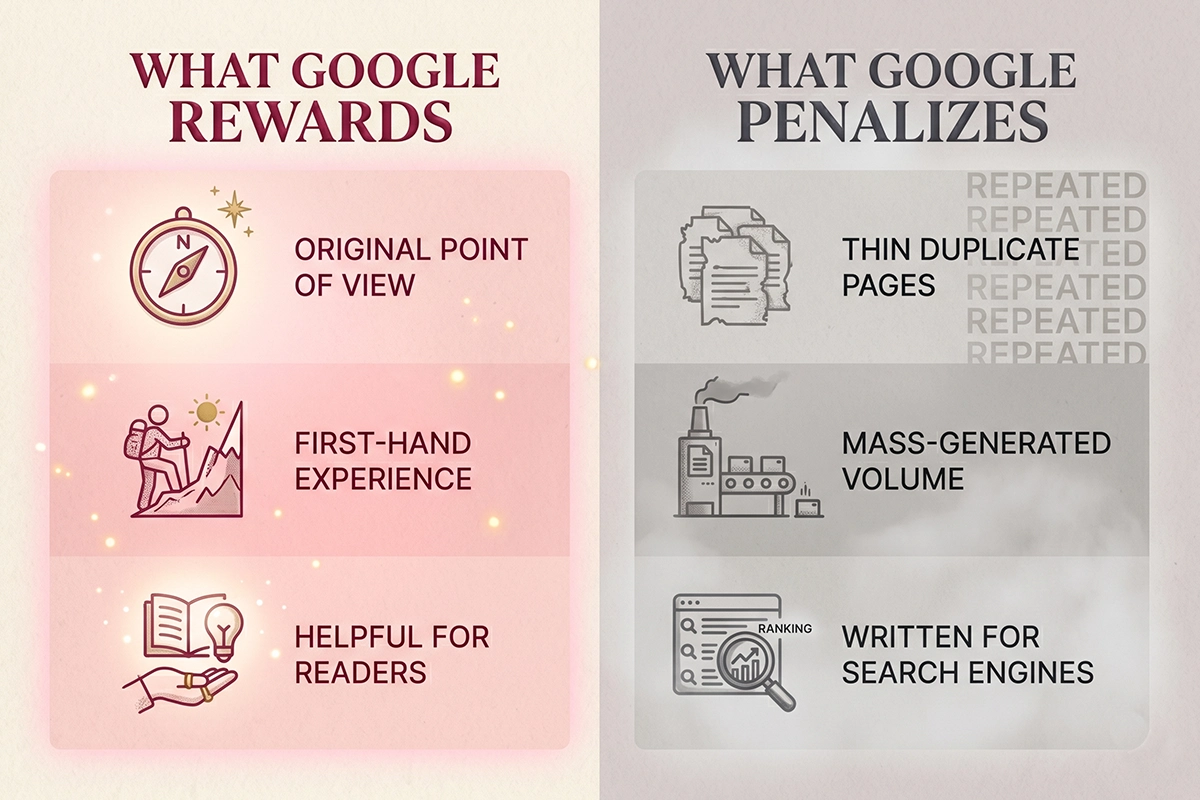
So where is the catch? It lives in Google's spam policies, not its AI policy. Google treats scaled content abuse, meaning mass-produced pages with little originality or added value, as a violation. The trigger is not the AI. It is publishing at volume to game rankings instead of to help anyone. That distinction is the whole post, so let us unpack both sides.
What Google actually rewards: quality and originality over authorship
Google's standard is the same whether a person or a model writes the draft. It wants helpful, reliable, people-first content. Its guidance on people-first content spells out the test: would a visitor leave your page feeling they learned something, or feeling they read filler?
The part that trips up AI content is originality. Google's guidance for its AI features asks for non-commodity content with a unique point of view. In plain terms: do not just restate what is already on the internet, or what a model could produce on its own. A first-hand review beats a summary of other reviews. Your real take beats a tidy paraphrase of the top three results.
For a Shopify store, that unique point of view is the thing you already have and an app does not. You know why customers pick your product over the cheaper one. You know the three questions every buyer asks before they check out. You have photos, returns data, and a reason you started the store. That is the raw material Google rewards, and it is exactly what set-and-forget AI skips.
The other piece is Experience, the first E in E-E-A-T that Google added because so much content now reads like it was written by someone who never touched the topic. Real testing, real results, and real customer stories are signals a generic AI draft cannot fake.
Where set-and-forget AI blog apps quietly hurt your store
Most one-click Shopify blog apps are built around one promise: volume with almost no effort. They generate ten to fifty posts a month, schedule them to publish daily, and ask almost nothing of you. The monthly price is usually small, somewhere between $8 and $25.
That model is the exact thing Google's spam policy describes as scaled content abuse: many pages produced with little effort, little originality, and little value, mainly to pull in search traffic. You are not penalized for using the app. You are at risk because of what the app publishes if you leave it untouched.
The damage is rarely a dramatic penalty. It is quieter than that. Google's helpful content assessment works at the site level, so a pile of thin auto-posts can weigh down the rankings of your genuinely good pages, including the product and collection pages that actually sell. One careless blog habit can cost you traffic everywhere.
There is a second problem that has nothing to do with penalties. Even when commodity content ranks, it increasingly does not get the click. Ahrefs found that an AI Overview at the top of the results now correlates with a 58% lower click-through rate for the top-ranking page. If your article only repeats what the AI summary already told the searcher, you have given them no reason to visit. Generic content competes for a click that barely exists anymore.
There is a quieter cost too. When you generate twenty posts on related keywords, the app reuses the same sentence patterns and the same shallow intros, so your own articles start competing with and cannibalizing each other. Add the auto-inserted product links that read like an ad, and you have a blog that signals low effort on every page.
The edit-and-fact-check layer that makes AI drafts safe
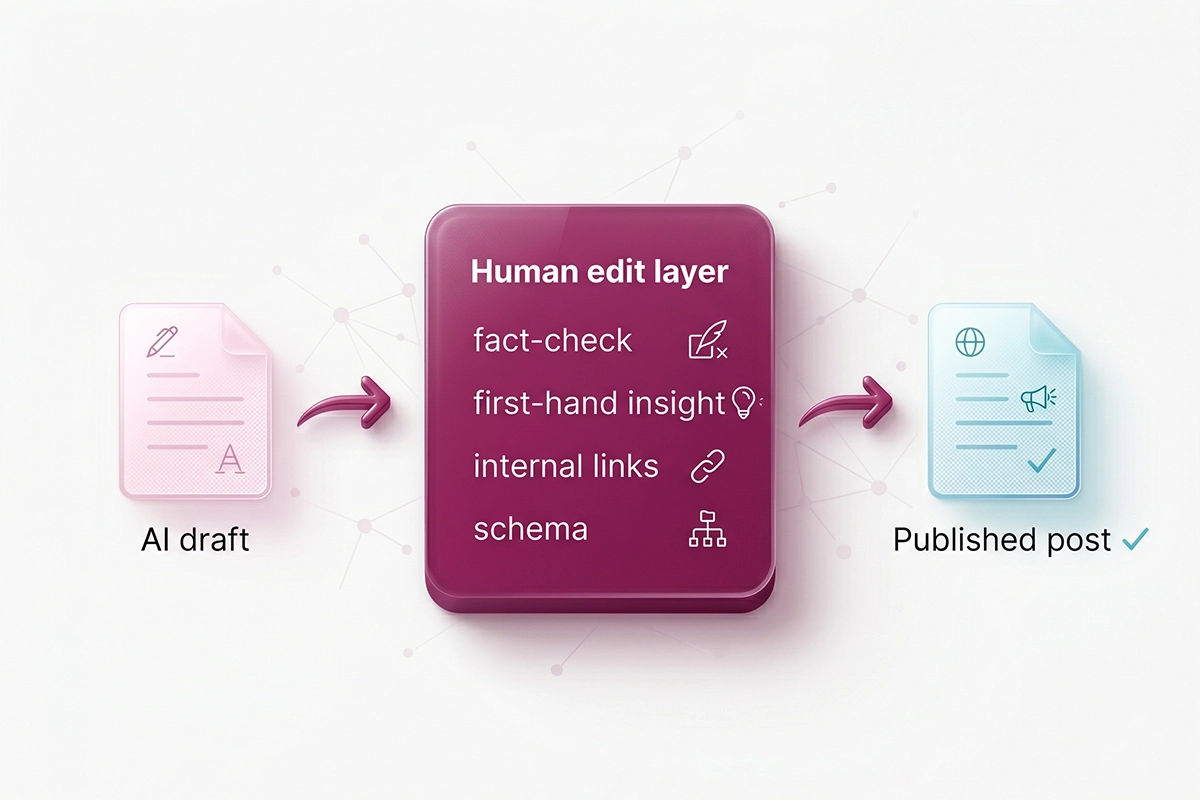
The difference between a risky AI post and a safe one is not the model. It is the human layer that comes after the draft. This is the step the cheap apps remove to keep the price low, and it is the step that does most of the work.
Here is what that layer actually does. It fact-checks every claim, because models invent statistics and confidently cite sources that do not exist. It adds first-hand experience and a real point of view. It writes internal links to your products and related posts. It adds proper schema markup so the post is eligible for rich results. And it removes the near-duplicate phrasing that creeps in when you generate many posts on related topics.
This is not a fringe opinion. In Ahrefs' research on how companies use AI, almost all of them edit and review their AI content, and only a small fraction publish raw machine output. The market has already worked out that the edit is where the value sits. Apps that skip it are selling the cheap half of the job.
It is also why I steer clients away from daily auto-blogging toward fewer, deeper posts. Google rewards depth over frequency, so two well-built articles a week will almost always beat fifteen thin ones. When I work on a store's blog, the AI draft is a starting point, and the editing, the real schema markup and indexing follow-up, and the first-hand detail are where the post earns its ranking.
DIY-AI vs managed human-edited: the honest cost math
The real question is not "AI or human." It is which mix fits your time, your budget, and how much SEO you want to learn. Here is the honest comparison.
| Option | Monthly cost | Your time | What you get | Ranking risk |
|---|---|---|---|---|
| One-click AI app, set and forget | $8 to $25 | Almost none | 10 to 50 generic posts a month, auto-published | High (scaled content abuse) |
| AI app plus your own edit | $8 to $25 plus your time | 2 to 4 hours per post | Solid posts if you know SEO and fact-check | Low to moderate |
| Managed human-edited service | From $449 | Almost none | Keyword research, edited posts, schema, internal links, indexing | Low |
None of these is wrong for every store. If you have a few hours per post and you are willing to learn the SEO basics, the middle option is genuinely fine, and I will tell you so. The trap is the first row: paying for volume, publishing it untouched, and assuming the traffic will follow. It usually does not, and sometimes it costs you.
The managed option exists for owners who would rather spend their hours on the store itself. That is the gap our human-edited blog content service fills: keyword research, a real edit-and-fact-check pass, schema, internal links, and indexing, with no AI slop. It is not cheaper than an app. It is a different job.
One honest note on the math. The cheapest apps look almost free next to a managed service, but the real price of the first row is paid later: in lost rankings on the pages that sell, and in the hours you spend cleaning up or starting over. Cheap content that does not rank is the most expensive content there is.
How to use AI on your Shopify blog without tanking rankings
If you want to use AI yourself, you can do it safely. The rules are simple, and they all point the same way: use AI for speed, keep a human in charge of quality.
Use AI for the parts it is good at. Outlines, research starting points, and first drafts of straightforward sections. It is a fast assistant, not a publisher.
Add what AI cannot. Your product knowledge, the real questions customers email you, your own numbers, and your photos. This is the originality Google looks for.
Fact-check every claim and statistic. If the draft cites a number, find the source yourself before it goes live. A confident wrong fact is worse than no fact.
Do not bulk-publish. Resist the daily schedule. A handful of strong posts a month will outrank a daily stream of filler, and it protects the rest of your site.
Get the foundations right first. A great post on a store with broken titles and missing schema is wasted effort. Work through your Shopify SEO foundations before you scale content.
Add internal links and schema by hand. Link each post to the products and related articles it should support, and add Article and FAQ schema so the page is eligible for richer results.
Wrapping up: is AI blog content worth it?
Yes, with one condition. AI-generated blog content is worth it for Shopify SEO when a human stays in charge of quality. The model is not the risk. Unedited volume is the risk, and that is exactly what the cheapest apps are built to produce.
So the decision is not really "AI or no AI." It is whether you will keep the edit-and-fact-check layer that turns a draft into something a real reader, and Google, finds useful. Skip that layer to save time and you are publishing the kind of commodity content that no longer earns clicks. Keep it, and AI becomes a legitimate way to write good posts faster.
If you want to go deeper on the building blocks, there is more in the Journal. And if you would rather hand the whole thing off, that is what the next section is for.
Want AI-assisted posts without the slop?
The Studio Niza Blog Content service uses AI for speed, then a human edit-and-fact-check layer for originality, real internal links, schema, and indexing. Keyword-researched, no AI slop, from $449/month.
See how Blog Content works →Or email contact@studioniza.com if you have a specific question about your store. I read every one.
Frequently asked questions
If you're still unsure after reading these, just send the question.
Can Google detect AI-generated content? +
Detection is not really the point. Google has said it judges content by quality and helpfulness, not by whether a machine helped write it, and AI detector tools are unreliable enough that Google does not lean on them for ranking. Focus on whether a post is original and useful, not on whether it could be flagged as AI.
Do I need to disclose that my Shopify blog uses AI? +
Google does not require an AI disclosure, and disclosure is not a ranking factor. It does suggest adding a note where a reader would reasonably wonder how the content was made. For a normal store blog, a short line about your process is fine, but it is optional.
How many AI blog posts can I publish before it looks like scaled content abuse? +
There is no magic number. Scaled content abuse is about intent and value, not a post count: mass-producing thin pages to game rankings is the problem, whether that is ten posts or a thousand. A daily auto-publish habit is the pattern that draws scrutiny, not the act of publishing AI-assisted content.
Will AI-written product descriptions hurt my store the same way? +
The principle is the same, but the risk shows up differently. Thin, near-identical descriptions generated across hundreds of products are a classic low-value signal, and they hurt both rankings and conversions. Edited descriptions that add real detail about fit, materials, or use are fine.
Is fully human-written content always better than AI-assisted for SEO? +
No. Edited AI-assisted content tends to perform about as well as fully human content, because Google measures the result, not the method. What consistently underperforms is pure, unedited AI output published at volume. The edit is what makes AI-generated blog content good for SEO.
How long does AI blog content take to rank on a new Shopify store? +
Plan for weeks to get indexed and three to six months to see meaningful rankings, the same timeline as human-written content. A new domain with little authority takes longer regardless of who or what wrote the post. Publishing fewer, stronger posts and earning links speeds things up more than publishing more.