
You want more reviews. You also just read that the FTC can fine businesses up to $53,088 per violation for fake or improperly incentivized reviews, and now you are not sure whether asking for reviews at all is safe. That hesitation is reasonable, and it is also fixable.
Here is the short version. Asking your customers for reviews is completely legal. The rule does not ban review requests, discounts for reviews, or reminder emails. What it bans is a narrow set of practices: fake reviews, reviews from people who never used the product, reviews bought in exchange for a certain rating, and hidden reviews from your own staff or family. Once you can see that line, staying inside it is easy.
This post is about how to ask for reviews on Shopify without crossing it. We will cover what the rule actually says, what you can and cannot offer as an incentive, the disclosure rule for employee and family reviews, and what you are allowed to do with a negative review. Then you get three request templates, for email, SMS, and a packaging insert, that are written to be compliant out of the box.
One note before we start. I run a Shopify reviews service, not a law firm. This is a plain-English summary of public FTC guidance, not legal advice for your specific store. If your situation is unusual or high-risk, talk to a lawyer. For most new Shopify stores asking customers for honest reviews, the rules are simpler than the headlines make them sound.
What the FTC rule actually says
The rule is officially the Trade Regulation Rule on the Use of Consumer Reviews and Testimonials, 16 CFR Part 465. It took effect on October 21, 2024, and it turned a set of older voluntary guidelines into hard law with penalties attached.
The FTC's final rule bans six main things: selling or buying fake reviews; reviews from people with no real experience with the product, including AI-generated ones; incentives tied to a specific rating or sentiment; undisclosed reviews from company insiders; suppressing reviews based on whether they are positive or negative; and fake "company-controlled" review sites dressed up as independent.
The penalty figure that scares everyone is real. As of 2026, the maximum civil penalty is $53,088 per violation, adjusted for inflation each January. Two things make that number less alarming than it looks, though. Penalties apply to knowing violations, not honest mistakes, and "per violation" tends to matter most when a business is running fake reviews at scale, not when one store sends one clumsy email.
Is the FTC actually enforcing this?
Yes, and recently. On December 22, 2025, the FTC sent its first round of warning letters under this rule to ten companies. It was the first public enforcement step since the rule took effect.
The flagged practices included paying employees to get five-star reviews from friends and family, collecting reviews from people who never bought anything, and contract terms that punished customers for leaving negative reviews. So the rule is not theoretical anymore. The good news for a normal store: none of those practices are things you need in order to get reviews honestly.
Can you offer a discount for a review?
Yes. This is the single most misunderstood part of the rule, so read it twice.
You are allowed to offer an incentive for a review. A discount code, loyalty points, a free sample, an entry into a giveaway, all of it is fine. What you cannot do is make the incentive depend on the review being positive, or on it expressing a particular sentiment. The difference is the condition, not the reward.
"Leave a review and get 10% off your next order" is compliant. The reward is for the act of reviewing, whatever the review says. "Leave a 5-star review and get 10% off" is not. Now the reward is tied to a rating, which the FTC treats as buying a positive review. The same goes for softer versions like "tell us how much you loved it for a discount."
One more rule lives next door, in the FTC's Endorsement Guides. If a customer gets something of value for a review, that material connection has to be disclosed clearly. Most Shopify review apps handle this for you by tagging incentivized reviews automatically, which I will come back to.
| What you offer or say | Compliant? | Why |
|---|---|---|
| "Leave a review, get 10% off your next order" | Yes | Reward is for reviewing, not for a rating |
| "Review us and you're entered to win a $50 gift card" | Yes | Entry is not tied to sentiment |
| "We'll send the discount once your review is posted" (any rating) | Yes | Neutral, the rating is irrelevant to the reward |
| "Leave a 5-star review for a free gift" | No | Reward is conditioned on a positive rating |
| "Tell us how much you loved it and save 15%" | No | Implies a positive review is required |
| "Reviews over 4 stars get featured and rewarded" | No | Rewards are filtered by sentiment |
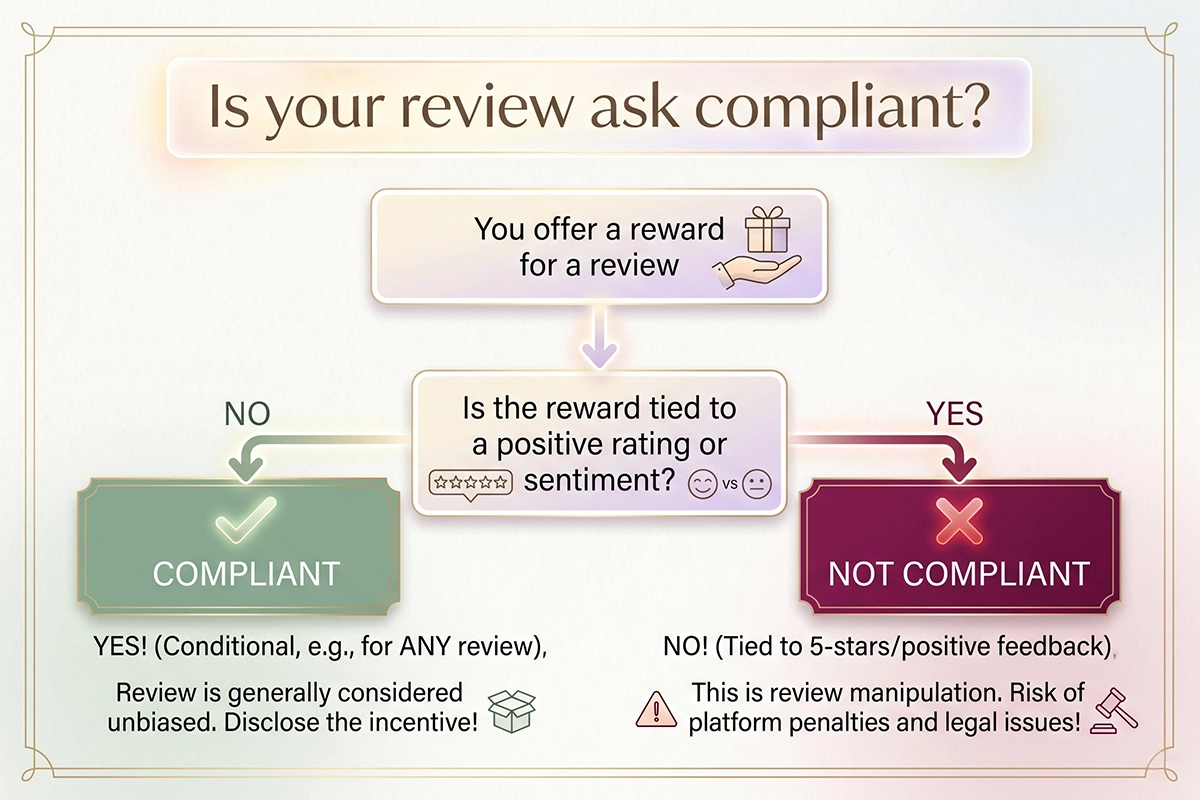
For what it is worth, I do not buy reviews or tie incentives to ratings for any client. The entire value of a review is that a shopper can trust it, and a bought rating quietly destroys that.
Reviews from employees, friends, and family
This is where well-meaning new owners get caught. In the early days you ask people you know to leave a review, because who else has bought anything yet. The rule does not forbid that outright, but it adds conditions.
A review from a company insider has to clearly and conspicuously disclose the relationship. "Insider" covers your employees, officers, and agents. The rule also covers your immediate relatives, which the rule defines as a spouse, parent, child, or sibling.
Two practical limits matter most for a small store. First, your friends and family can leave reviews, but only if they actually used the product, and the review discloses the connection. "I got this from my sister's shop, and it is genuinely great" is fine. A glowing five-star review from your brother that reads like a stranger wrote it is not.
Second, officers and managers cannot solicit reviews from employees or immediate relatives without making sure the relationship is disclosed, and cannot tell staff to go round up reviews from their own friends and family without that disclosure. That second pattern was one of the exact practices named in the December 2025 warning letters.
A clean disclosure does not need legal language. A plain line in the review itself, like "I work for this store" or "the founder is a friend of mine," is enough. It just needs to be obvious to a normal reader.
What you can and can't do with negative reviews
Negative reviews feel like emergencies. The rule is strict about what you may do with them, and the December warning letters show the FTC is watching this closely.
You cannot suppress reviews based on sentiment. You can't delete, hide, or bury reviews just because they are negative, and you can't show only the four and five-star ones while quietly filtering out the rest. You also can't use "review gating," where happy customers get routed to a public review and unhappy ones to a private feedback form so the bad reviews never go public.
You cannot use retaliatory contract terms either. Clauses that fine customers or cut off their access for leaving a negative review are illegal, and were specifically flagged in the FTC's warning letters.
What you can do is filter reviews using neutral criteria applied to every review regardless of rating. You can remove reviews that contain profanity, personal information, obvious spam, or content unrelated to the product, as long as you hold a one-star and a five-star review to the same standard.
And you can always respond. Replying to a negative review calmly and in public is good for trust and completely allowed. A considered reply often does more for conversion than the bad review costs you, because shoppers read how you handle problems. Honest reviews, good and bad, also feed the star ratings that can show up in your search results, which is part of why they matter beyond the product page.
Three compliant review request templates
Here is the part you can use today. Each template is neutral by design: it asks for an honest review, never hints at a rating, and where an incentive appears, it is offered for the review itself, not for praise. Swap in your brand name, product, and links, and if you offer an incentive, keep the wording exactly as neutral as it is here.
1. The email request
Send it 5 to 14 days after delivery, once the customer has actually had time to use the product.
Subject: How are you finding your [product]?
Hi [first name],
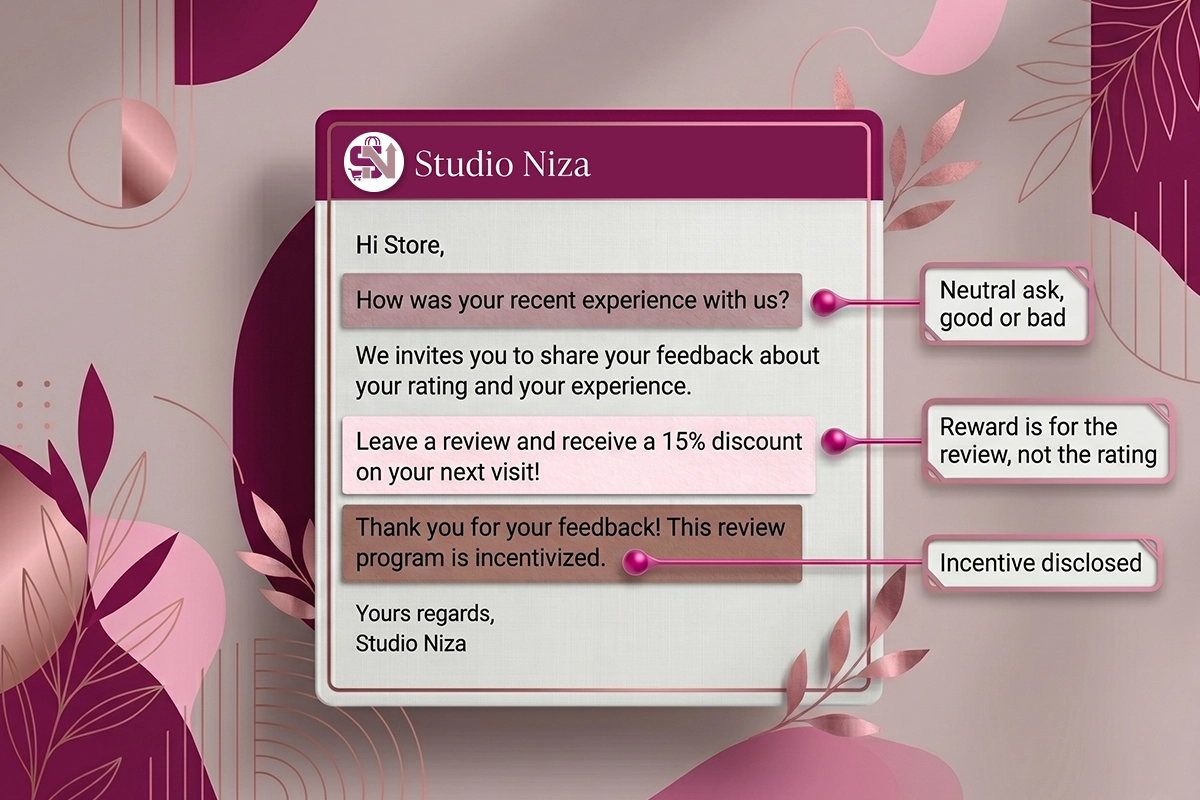
Thanks again for your order. Now that you have had a couple of weeks with your [product], I would love to hear what you honestly think, good or bad. Your review helps other shoppers decide, and it helps me make the store better.
It takes about a minute: [review link]
As a thank-you for taking the time, here is 10% off your next order: [code]. It is yours whatever you write.
Thank you,
[Your name], [Store name]
The last line is the one doing the compliance work. The discount is for taking the time, and it is theirs whatever they write. That single phrase keeps the incentive off the sentiment.
2. The SMS request
SMS has to be short, which actually helps. Keep it neutral and state the incentive plainly.
Hi [first name], it's [Store name]. Hope you're enjoying your [product]. Mind leaving an honest review? It takes a minute: [link]. We'll send 10% off your next order as thanks, whatever you write. Reply STOP to opt out.
3. The packaging insert
A small card in the box. Because it is printed, it can't link directly, so use a short URL or a QR code, and keep the same neutral framing.
Tell us what you really think.
Your honest review, good or bad, helps other shoppers and helps us improve. Scan the code or visit [short URL] to leave one. We'll send a thank-you discount for your time, whatever your rating.
Across all three, notice what is missing. No "5 stars," no "if you loved it," no "positive review." Just an honest ask and, where you choose to offer one, a reward for the effort.
Setting this up on Shopify
You should not have to think about any of this after today. The fix is to bake the compliant wording into an automated flow and leave it running.
Most Shopify stores use a reviews app for this. For stores under roughly $200K a year, Judge.me is the one I recommend most often, because its free tier is genuinely capable and it can send review requests automatically a set number of days after fulfillment. Stamped and Loox do the same job with more visual widgets at a monthly cost.
Whatever you use, set it up like this. Use a neutral request template. Paste the email wording above into the app's automated request, and rewrite any default "we'd love a 5-star review" copy the app ships with. Turn on incentive tagging. If you offer a discount or points, most apps can automatically label those reviews as incentivized, which handles the disclosure requirement for you. Show all reviews, not just the good ones. Display the lower ratings too. It is honest, it is required, and shoppers trust a 4.6 average more than a suspicious wall of fives. Reply to reviews, especially the critical ones.
While you are in your store settings, it is worth making sure your review widget and star ratings are set to show in search, since that is one of the higher-value wins on a product page. I cover where it fits in the broader Shopify SEO checklist.
This is also, honestly, the part most owners would rather hand off. Setting up compliant automated requests, tagging incentives correctly, and replying to every review is exactly what Studio Niza's reviews management service does, without ever buying or faking a single review. We measure the system, not a review-count promise, because nobody can honestly guarantee how many reviews your customers will leave.
Wrapping up
The FTC rule sounds frightening because the penalty number is large and the headlines are loud. The reality for an honest Shopify store is calmer than that.
You can ask every customer for a review. You can offer a reward for leaving one. You just cannot tie that reward to a rating, hide your insiders, or bury the reviews you do not like. Stay neutral in the ask, disclose the connections, show all the reviews, and you are inside the line.
If you do one thing after reading this, replace your current review request wording with one of the templates above, and make sure any incentive is offered for the review, not the rating. That is most of the compliance work, done in ten minutes. The rest is consistency. Reviews compound when you ask every customer, every time, and reply to what comes back. That part is slow and unglamorous, and it works.
Want review requests that stay compliant by default?
Studio Niza sets up automated, sentiment-neutral review requests on Judge.me, replies to every review, and keeps your incentive disclosures clean. No fake reviews, ever. Reviews management starts at $199/month.
See how reviews management works →Or email contact@studioniza.com if you have a specific question about your store. I read every one.
Frequently asked questions
If you're still unsure after reading these, just send the question.
Is it legal to offer a discount for a review on Shopify? +
Yes. The FTC rule allows you to offer a discount, loyalty points, or a giveaway entry in exchange for a review. The only restriction is that the incentive cannot be conditioned on the review being positive or expressing a particular sentiment. Offer the reward for leaving any honest review, and disclose it.
Do customers have to disclose that they got a discount for a review? +
Yes. Under the FTC's Endorsement Guides, an incentivized review needs to clearly disclose the material connection. Most Shopify review apps do this automatically by tagging incentivized reviews, so you usually do not have to manage it by hand.
Can my friends and family leave reviews for my store? +
They can, with two conditions. They must have actually used the product, and the review must clearly disclose the relationship, such as a note that the writer is related to or works with the store. Officers and managers also cannot solicit undisclosed reviews from immediate relatives or employees.
What counts as a fake review under the FTC rule? +
A review by someone who does not exist, including an AI-generated reviewer, or by someone who never used the product or service, or one that misrepresents the reviewer's actual experience. Buying, selling, or posting these reviews is what the rule prohibits.
How much is the FTC fine for fake reviews? +
As of 2026, the maximum civil penalty is $53,088 per violation, and that figure is adjusted for inflation each January. Penalties apply to knowing violations, and the FTC can also seek federal court orders and consumer refunds.
Can I delete or hide a negative review on Shopify? +
Not based on sentiment. You cannot remove a review just because it is negative, and you cannot route unhappy customers away from leaving public reviews. You can remove reviews using neutral rules applied to every rating equally, such as profanity, spam, or off-topic content.
Does the FTC rule apply to small Shopify stores? +
Yes. The rule applies to advertisers generally, regardless of size. A solo store and a large brand are held to the same standard, which is why a simple compliant request system is worth setting up early.
Can I ask a customer to change a negative review? +
The rule does not directly ban offering an incentive to take down a negative review, but the FTC has said it could still be an unfair practice. The safer move is to reply publicly, fix the underlying issue, and let the customer update the review on their own if they choose.