If you run a Shopify store doing under 200 orders a month, you have probably been told a chatbot is a must-have. Maybe five times this week. The honest answer is that AI chatbots do work for small stores, but not in the way most of those pitches imply, and not for every store at every stage.
So let's answer the real question. Do Shopify chatbots work? Yes, when the numbers line up. The trick is knowing which numbers actually matter and which ones are marketing theater. This post walks through resolution rate versus deflection rate in plain terms, the realistic auto-resolution range and when it falls apart, roughly how many tickets you need before a bot pays for itself, and the two cases where I'd tell you to wait.
I run a one-person Shopify studio. I build chatbots for clients, and I also tell some of them they don't need one yet. Both of those things are true at once, and that's the spirit of this post.
What "working" actually means (and why the word is slippery)
"Does it work" is a fair question with a frustrating answer, because "works" means different things to the person selling the bot and the person paying for it.
To a vendor, "works" often means the bot responded to a lot of conversations. To you, "works" should mean one of two concrete things: it saved you real time on repetitive questions, or it helped a hesitating shopper buy something they would have otherwise abandoned. Time saved or money made. Everything else is a vanity number.
Hold onto that distinction, because the rest of this post is really about separating the metric that flatters a dashboard from the metric that changes your week or your revenue.
Resolution rate vs deflection rate, explained plainly
These two terms get used interchangeably in sales decks, and they should not be. The gap between them is where most "my chatbot didn't do anything" complaints come from.
Deflection rate measures how many conversations ended without a human getting involved. Resolution rate measures how many customers actually got their problem solved. They sound the same. They are not.
Here is the catch. A conversation can be "deflected" because the customer gave up and closed the chat. That counts as a win on a deflection dashboard and a loss in real life. As one customer support analysis put it bluntly, a bot can post a 90 percent deflection rate while only resolving 40 percent of issues, and the dashboard usually can't tell you which happened. That is a 50 point gap hiding inside one cheerful number.
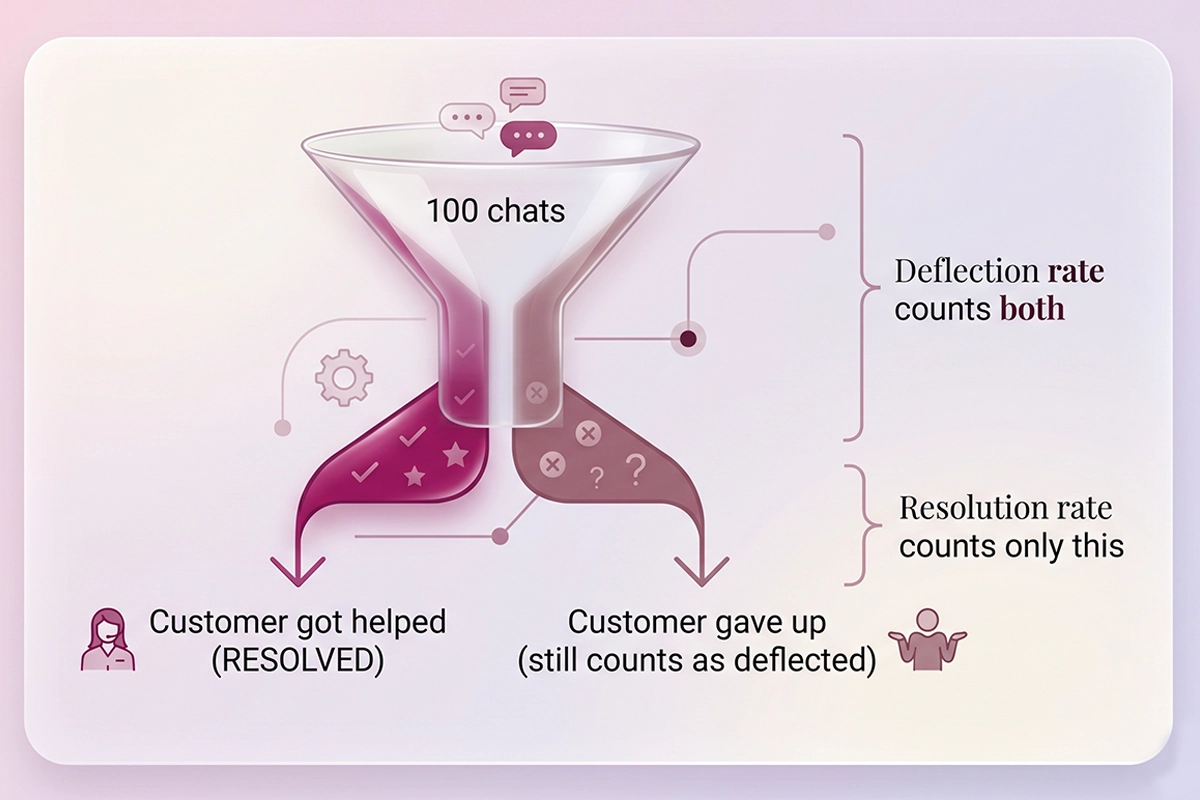
For a small Shopify store this matters more, not less. You don't have a support team noticing the silent failures. A frustrated customer who closed the chat and never emailed just quietly didn't come back. So when you evaluate a bot, ask the vendor for resolution rate, or better, containment rate paired with a satisfaction score. Deflection alone tells you almost nothing.
The realistic 50 to 80 percent auto-resolution claim (and when it doesn't hold)
You'll see "automate up to 80 percent of your tickets" everywhere. It's not a lie, but it's the ceiling, not the average, and it depends entirely on your question mix.
Here's the honest version. Industry-average AI resolution sits below 50 percent across all deployments, while well-built agents with real store integration land higher. For a Shopify store specifically, a chatbot trained on your products and connected to order data typically resolves 65 to 80 percent of routine inquiries like order status, return policy, and product availability. For mature, well-integrated deployments, 55 to 70 percent first-contact resolution is a realistic year-one target, and deeper backend integration pushes it higher.
The reason that range is achievable for small stores is that most of your tickets are the same handful of questions. One 2025 analysis of Shopify and WooCommerce implementations found that roughly 92 percent of small-store support tickets are routine: order tracking, product questions, returns, and shipping. Those are exactly the questions a bot handles well.
When the 80 percent claim does not hold
The high end falls apart in three situations, and you should know yours before you buy.
First, if your bot isn't connected to your live order data, it can't answer "where is my order," which is usually your single biggest ticket category. A bot that only reads your FAQ page will resolve far less than one wired into Shopify. Second, if your catalog is complex or your customers ask nuanced, judgment-heavy questions (custom sizing, compatibility, "will this work for my situation"), more conversations need a human. Third, if your product copy and policies are thin or contradictory, the bot has nothing accurate to pull from, so it guesses, and guessing is how you get the silent-failure problem from the last section.
Do small stores even have enough tickets to justify one?
This is the question that actually decides it for a store under 200 orders a month, and almost nobody selling chatbots wants to talk about it.
A chatbot pays back on support in two ways: time you stop spending answering repeat questions, and money you stop losing to slow replies. The cost side is real. The honest monthly math on a managed bot for a small store is roughly $65 to $105 all-in once you count the AI platform, the credits the conversations actually burn, and someone's time monitoring and improving it. That's why a sustainable managed price sits near $99/month rather than the $39 self-serve software you set up and forget.
So the break-even isn't about a magic order count. It's about whether the bot resolves enough to be worth that monthly cost. A useful rule of thumb from Shopify-focused ROI work: if your deflection rate sits below 40 percent, your support costs have barely moved, and above 70 percent the cost savings alone usually turn positive within the first month. The plainer warning comes from an ecommerce chatbot teardown: spending $300 a month to deflect thirty tickets is bad math.
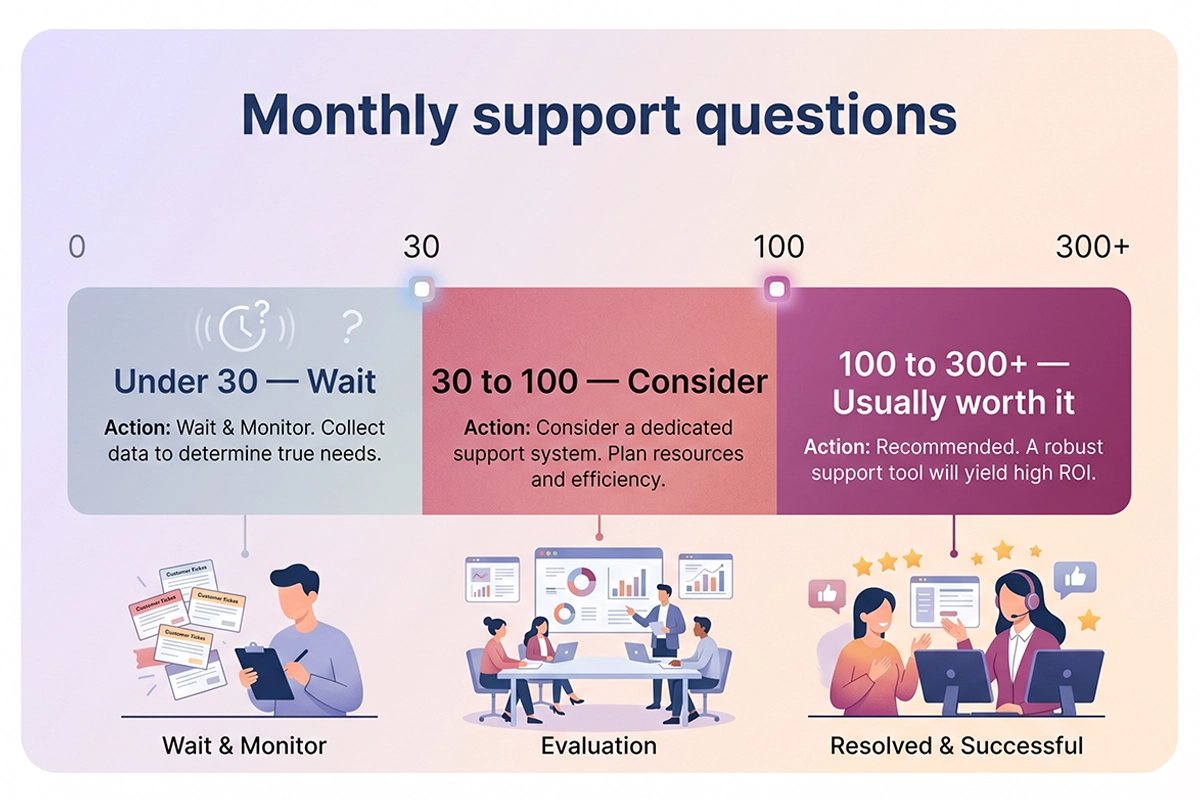
Here is how I'd think about it by stage, the same way you'd prioritize your SEO work by what moves the needle first.
| Monthly support questions | What it usually means | My honest read |
|---|---|---|
| Under 30 | You can answer these yourself in under an hour a week | Wait. A free tier or a good FAQ page is enough for now. |
| 30 to 100 | Repetition is starting to eat real time, mostly "where's my order" | Consider it, especially if you sell across time zones and miss overnight questions. |
| 100 to 300+ | You're answering the same things daily and replies are slipping | Usually worth it. This is where a resolving bot clearly buys back time. |
Notice that this is about support volume, not order volume. A store doing 150 orders a month with a simple catalog might get 25 questions. A store doing 150 orders of a confusing technical product might get 120. Count the questions, not the orders.
The half nobody mentions: chatbots that sell, not just deflect
Everything above treats a chatbot as a support tool. But the category quietly split in two, and the sales half is where small stores often see the clearer return.
A chatbot that answers a pre-purchase question (does this run small, will it ship before Friday, what's the difference between these two) at the exact moment a shopper hesitates can be the difference between a sale and a bounce. Well-deployed bots lift conversion 5 to 15 percent through cart recovery, in-chat recommendations, and clearing objections before checkout. McKinsey's work on personalization puts the revenue lift from good product matching in a similar 10 to 15 percent range.
Why does this matter for the break-even question? Because if your store gets too few support tickets to justify a bot on time savings alone, the sales side can still tip the math. Recovering even a couple of carts a month, or closing a few hesitating shoppers, can cover a $99 bot on its own. The strongest lift usually comes from proactive prompts triggered by hesitation, not from shoppers clicking the chat bubble themselves.
One caveat in the same honest spirit: a sales bot only helps if you have traffic to convert. If almost nobody is visiting your product pages yet, a chatbot has no one to sell to. Fix the visibility problem first, then add the bot to convert the traffic you've earned.
Two cases where a chatbot genuinely isn't worth it yet
I tell prospects to skip services they don't need, and chatbots are no exception. Here are the two situations where I'd say wait.
Case one: you don't have enough traffic or tickets to feed it
If you're getting under 30 support questions a month and your product pages get a trickle of visitors, a chatbot is solving a problem you don't have yet. There's nothing for it to deflect and almost no one for it to convert. Your time and money go further into getting found in the first place and writing clear product pages and policies. Those also happen to be what makes a future bot accurate, so it's not wasted work. It's the foundation.
Case two: your store information is a mess
A chatbot is only as good as what it learns from. If your shipping policy contradicts your FAQ, your product descriptions are thin, and your return terms live in three different places, a bot will confidently give wrong answers. That's worse than no bot, because a wrong answer at checkout costs you the sale and the trust. Clean up your policies and product copy first. Strong, consistent content is also what feeds an accurate bot later, and it does double duty for search at the same time.
In both cases the message is the same: the chatbot isn't the first move. It's the move after you've built the thing it stands on.
How to tell if yours is actually working
Say you go ahead. Here's how to judge it honestly after 30 to 60 days, instead of trusting a single dashboard number.
Look at four things together. Resolution rate on handled chats: are problems actually getting solved, not just ended? Aim for 65 percent or higher on the conversations the bot takes. Customer satisfaction on bot chats: a high containment rate with low satisfaction means it's trapping people, which is a red flag. Your own time: are you genuinely answering fewer repeat questions than before? Revenue signals: cart recovery, chat-attributed sales, and average order value on chats where the bot recommended something.
If resolution and satisfaction are both healthy and your inbox is quieter, it's working. If containment looks great but satisfaction is poor and customers still email you the same questions, the bot is busy but not useful, and that's worth fixing fast. Give it a real window though. These services need time and tuning to settle, which is why I ask clients for a 90-day minimum before judging the result. Cancelling at day 30 means you never see what it does.
So, do they work?
Yes, with conditions. AI chatbots work for small Shopify stores when the resolving (not just deflecting) bot is connected to your real data, when you have enough questions or traffic to feed it, and when your store information is clean enough for it to give accurate answers.
They don't work as a magic must-have you bolt on at launch. If you're under 30 questions a month with little traffic, or your policies and product copy are still a mess, the better investment is the foundation underneath. The bot pays back later, on top of that foundation, not instead of it.
The good news is that none of this requires guessing. Count your monthly support questions, check whether they're the same few things over and over, look at whether you have traffic to convert, and be honest about whether your store information is consistent. Those four answers tell you whether it's your stage yet. If it is, a well-built bot earns its keep. If it isn't, you just saved yourself $99 a month, and I'd rather you knew that.
Not sure if it's your stage yet?
If you'd rather have someone look at your actual ticket volume and tell you honestly whether a bot makes sense, here's how the Studio Niza chatbot service works. Setup from $599, then $99/month all-in. I'll tell you if you should wait.
See how the chatbot service works →Or email contact@studioniza.com if you have a specific question about your store. I read every one.
Frequently asked questions
If you're still unsure after reading these, just send the question.
Do AI chatbots work for stores with fewer than 200 orders a month? +
They can, but it depends on support volume and traffic, not order count. A store with a simple catalog might get very few questions, while a store with a complex product gets many. If you're answering the same questions 30 or more times a month, or you have enough traffic for a bot to convert hesitating shoppers, it usually works. Under that, a free tier or a good FAQ page is often enough.
What's a realistic chatbot resolution rate for a small Shopify store? +
A chatbot trained on your products and connected to order data typically resolves 65 to 80 percent of routine inquiries like order status, returns, and product questions. For a first year, 55 to 70 percent first-contact resolution is a realistic target. If it isn't connected to your live Shopify data, expect a lot less, because it can't answer where's-my-order questions.
How much does a Shopify chatbot actually cost per month? +
Self-serve software runs roughly $39 to $279 a month but includes no setup or maintenance. A managed bot for a small store costs about $65 to $105 a month to run once you count the AI platform, the credits conversations burn, and monitoring time, which is why a sustainable managed price sits near $99 a month. Watch for per-resolution pricing, which can climb fast as volume grows.
Will a chatbot annoy my customers? +
It can, if it's poorly built or trapping people in dead-end conversations. The fix is a bot that resolves real problems and hands off cleanly to a human when it can't. Watch your satisfaction score, not just your deflection rate. A high containment rate with low satisfaction means customers are leaving frustrated rather than helped.
Can a chatbot increase sales, or does it only handle support? +
Both. Beyond answering support questions, a chatbot can recover abandoned carts, recommend products, and clear pre-purchase objections like sizing or shipping time at the moment a shopper hesitates. Well-deployed bots lift conversion in the 5 to 15 percent range. For small stores with low ticket volume, the sales side can justify the cost on its own, as long as you have traffic to convert.
How long before I know if my Shopify chatbot is working? +
Give it 30 to 60 days of real use, and judge it on resolution rate, customer satisfaction, your own time saved, and revenue signals together, not on one dashboard number. These services need tuning to settle, so a 90-day window is fair before deciding. Cancelling at day 30 usually means you never saw what it could do.