If you sell to more than one country, you have already seen it. A support message lands in a language you do not read, you paste it into a translation tool to work out what the customer wants, and by the time you reply the chat has gone cold. A multilingual Shopify chatbot is built to close exactly that gap.
This is one of the most common gaps for new cross-border stores, and it is growing, not shrinking. Cross-border sales now make up close to a fifth of all online sales worldwide, and roughly three out of four international shoppers say they want to buy in their own language, according to 2026 cross-border shopping research. Language is not a small-market problem. It sits in the middle of your funnel.
The bot reads the language of an incoming message, replies in that language, and does it instantly, around the clock, without you hiring a separate agent for every market. That sounds like an easy yes, and mostly it is. But auto-translation has real failure points, and a few of them can cost you money or put you on the wrong side of a returns law.
This post covers how the language detection works, where auto-translation breaks, when a human still needs to read the message, and a short setup checklist. The honest version: AI handles most of this well, so let it handle the parts it is good at. The trick is knowing which parts those are.
How does a multilingual Shopify chatbot detect language?
A multilingual Shopify chatbot detects language automatically by reading the text of the incoming message, then replies in that same language. You do not pick the language. The customer does, just by typing.
Under the hood, the bot runs the message through a language identification step before it does anything else. Modern AI models are good at this. A two-line message in Portuguese gets tagged as Portuguese, and the reply comes back in Portuguese. The customer never sees a dropdown or a flag to click.
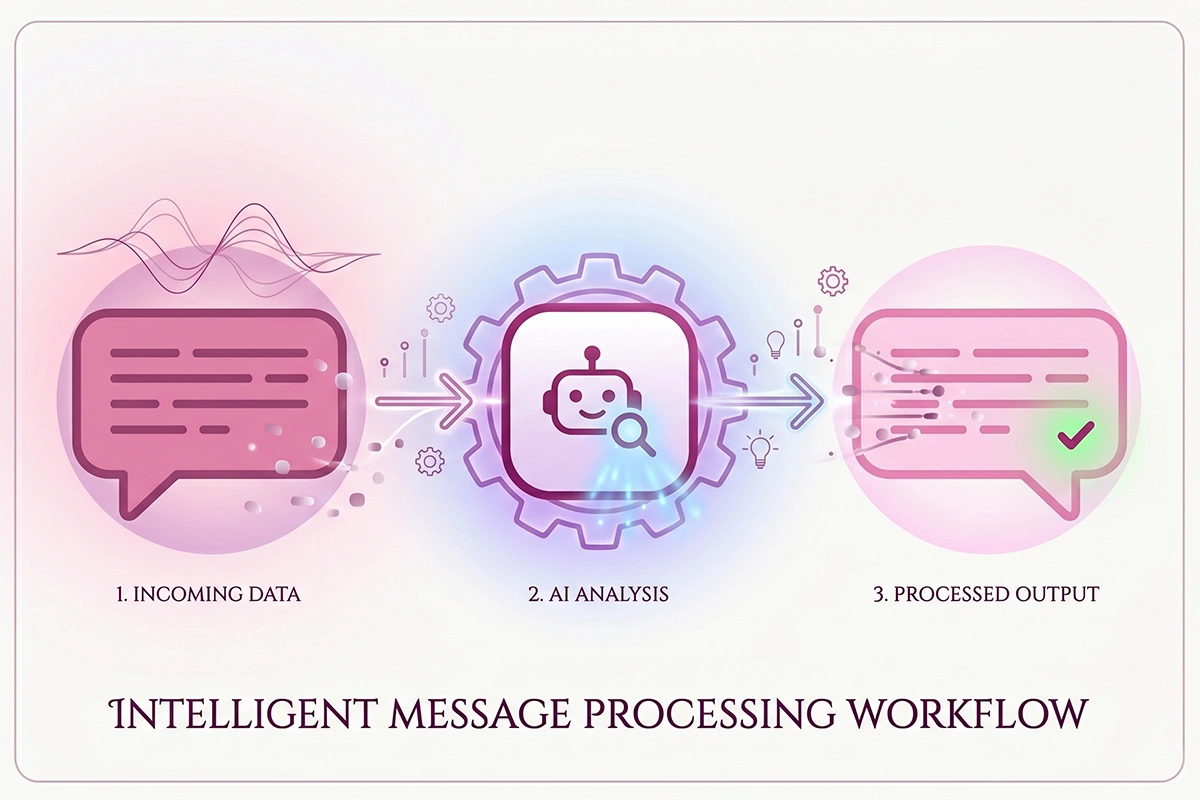
How AI language detection works
The model looks at the words, characters, and patterns in a message and assigns the most likely language. For common languages with enough text to go on, it is accurate. Where it struggles is very short messages (a single "ok", a question mark, a bare tracking number), messages that mix two languages, and closely related languages or regional dialects.
The safe default, and the one a well-built bot uses, is to fall back to your main store language when its confidence is low. A bot that guesses wrong on a one-word message is worse than a bot that politely answers in English and offers to switch.
Translate-then-answer vs. answer-in-language
There are two ways to build this. Older setups translate the customer's message into English, run it through an English-only knowledge base, then translate the reply back. Every translation step is another chance to lose meaning. Newer setups built on large language models can read and respond in the target language directly, which usually reads more naturally.
Either way, the quality of your underlying answers still matters more than the translation layer. A bot that gives a vague answer in English will give an equally vague answer in five languages. Good translation cannot rescue a thin knowledge base.
Do you actually need multilingual support yet?
You need multilingual support when a real share of your support messages already arrive in languages you cannot answer well. Not before. If 95% of your inbound is in English, adding five languages is solving a problem you do not have yet.
Check your data before you decide. Open GA4 and look at sessions by country and language, then look at your actual support inbox. If you are getting steady messages in German, Spanish, or French and leaving them slow or unanswered, that is your signal. For a first-year founder, this usually shows up as a handful of awkward threads you keep putting off.
The preference behind those messages is well documented. In CSA Research's "Can't Read, Won't Buy" survey of shoppers across 29 countries, 76% said they prefer to buy with product information in their own language, and 40% said they will not buy from a site in another language at all. Even among people confident reading English, 60% still prefer to be helped in their first language. That preference does not stop at the product page. It carries straight into support.
If you are pre-100 orders and selling mostly to one country, you can skip this for now. Put the effort into your product pages and your Shopify SEO checklist instead, and add languages the month your data tells you to. Saying "not yet" is a real answer.
Where auto-translation goes wrong
Auto-translation goes wrong in three predictable places: idioms and tone, product specifics like sizing, and anything legal or binding like returns and refunds. General AI translation is good. It reaches around 90% accuracy on everyday text, by most industry estimates. The trouble is that the other 10% clusters exactly where customer support lives.
Idioms and tone
Machine translation takes figures of speech literally. A customer who writes a phrase that means "this is a rip-off" can come through as a flat, literal sentence that loses the complaint entirely. The most-cited example is a fast-food slogan that landed in another market as "eat your fingers off," documented among classic translation errors. Funny on a billboard. Not funny when a frustrated customer feels misread.
Sizing, fit, and product specifics
This one is quiet and expensive. Sizing language does not map cleanly across regions. "True to size," half sizes, EU versus UK versus US measurements, fabric and care terms: a literal translation can tell a customer the wrong thing and earn you a return.
If your bot handles sizing questions, the sizing logic needs to be built into your data per market, not left to on-the-fly translation. A size chart that is correct in English and machine-translated live is a size chart you are no longer sure about.
Returns, refunds, and consumer law (the dangerous one)
This is where a wrong word costs real money. Return windows, refund rights, and warranty terms are not the same in every country, and consumer law in places like the EU is strict. A bot that auto-translates a casual "no refunds after 14 days" into a market with a stronger statutory return right has just told a customer something that may not be legal where they live.
AI is specifically unreliable on this kind of statutory and legal nuance, even while it handles everyday text well. Binding statements should never ride on a live translation. Write them once, per market, and have the bot serve the approved version.
When should a human stay in the loop?
A human should stay in the loop for anything binding: refunds, returns disputes, billing, legal questions, and complaints that have turned emotional. Let the bot handle the routine, high-volume questions, and route the rest to a person.
The mechanism is an escalation rule plus a confidence threshold. When the bot is confident and the topic is low-stakes (order status, shipping times, product details it actually knows), it answers. When confidence drops or the topic is on your "humans only" list, it hands off to a live agent through a tool like Gorgias or Zendesk, or it takes a message and tells the customer when to expect a reply.
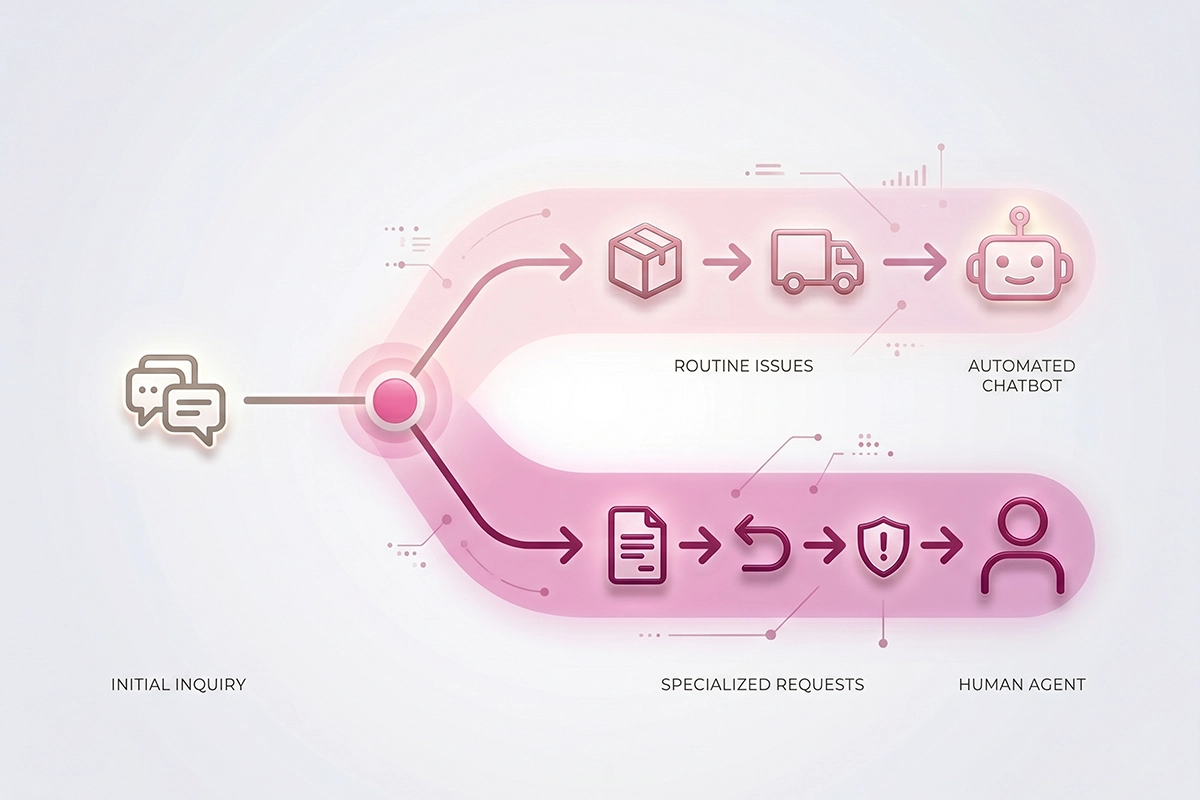
Here is a simple split most stores can start from.
| Message type | Let AI auto-translate | Route to a human |
|---|---|---|
| Order status and tracking (WISMO) | Yes | No |
| Shipping times and general policies | Yes | No |
| Product details the bot is trained on | Yes | No |
| Sizing and fit | Only with per-market data built in | If unsure |
| Returns, refunds, warranty terms | No | Yes |
| Legal, safety, or consumer-rights questions | No | Yes |
| Angry or emotional complaints | No | Yes |
| Payment or billing disputes | No | Yes |
This is why Studio Niza does not put multi-language on its public AI chatbot tiers as a one-click feature. It is quoted as an add-on, scoped per store, because doing it well means building the sizing and policy answers per market and setting these escalation rules, not flipping a switch. Honest scope beats impressive scope. A toggle that promises "speaks 50 languages" and then mistranslates a refund is worse than no toggle at all.
Multilingual storefront vs. multilingual support
Translating your storefront and translating your support are two different jobs, and doing one does not cover the other. Shopify Markets and the free Translate & Adapt app localize your product pages, checkout, and emails. They do not answer the live question a customer types into your chat at 11pm.
This trips up a lot of new cross-border stores. They set up Shopify's localization tools, watch the store switch languages, and assume support is handled. It is not. The storefront is static content translated ahead of time. Support is a live conversation, and that is the gap a multilingual chatbot fills.
Shopify's own tools are genuinely good for the storefront side, and they are free, so use them. Translate & Adapt handles content translation and visitor language detection for the store itself. If you translate your store, also translate the SEO fields so you actually rank in those markets, which is a multilingual SEO job, not a chatbot job.
One more piece people forget: reviews. If you sell cross-border, you will collect reviews in other languages too. Deciding whether to show them as written, translate them, or both is part of a complete reviews management setup, and it shapes the social proof international shoppers see before they ever open the chat.
A setup checklist for a multilingual Shopify chatbot
Setting up a multilingual Shopify chatbot well comes down to five steps: pick languages from real data, turn on detection with a safe fallback, build the high-stakes answers per market, set escalation rules, and review the logs.
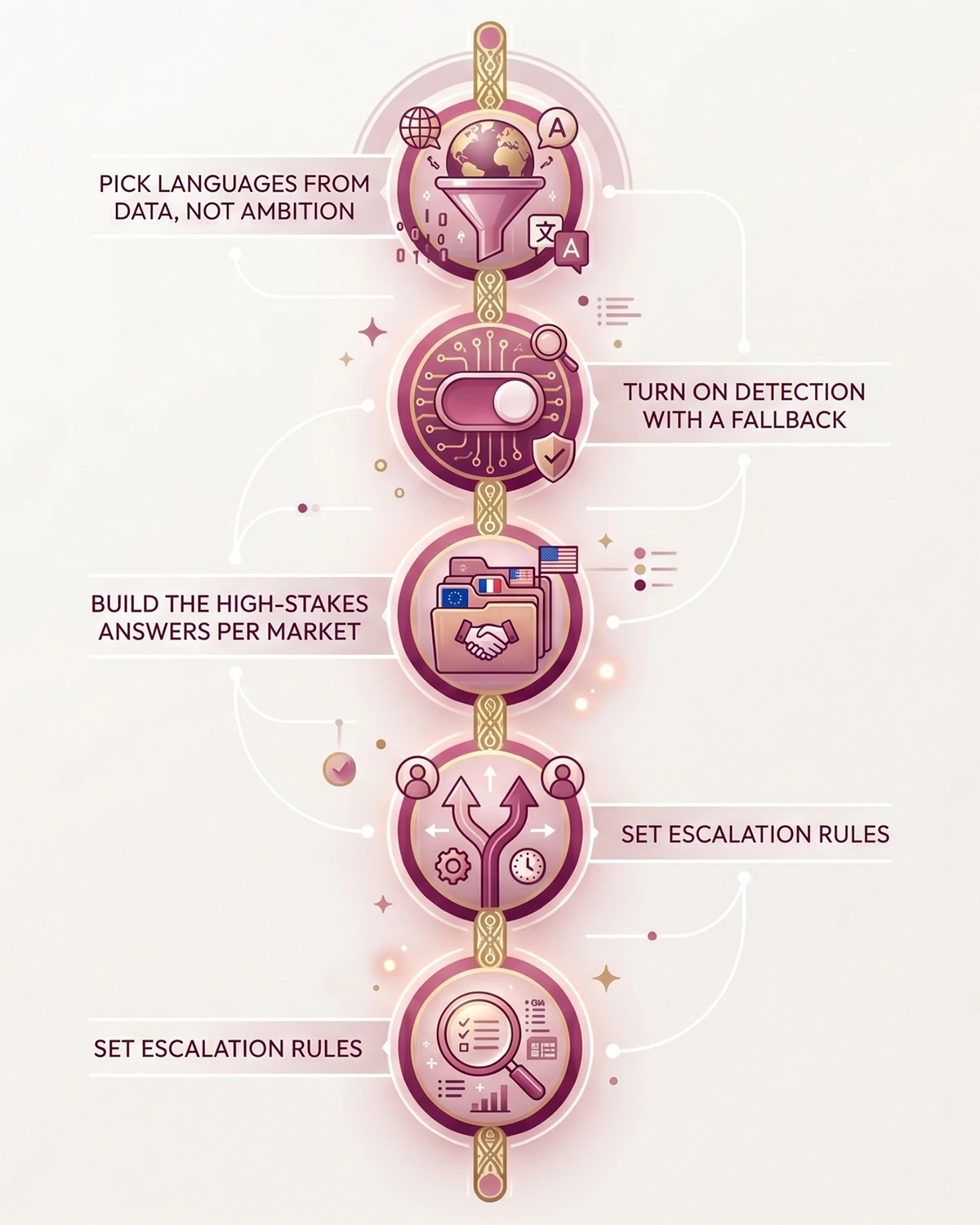
- Pick languages from data, not ambition. Start with the one or two languages your inbox and GA4 data already show. Add more only when the numbers justify the upkeep.
- Turn on detection with a fallback. Confirm the bot defaults to your main language when it is unsure, instead of guessing on a short message.
- Build the high-stakes answers per market. Return windows, refund rights, shipping policies, and sizing should be written and checked for each market, not auto-translated live.
- Set escalation rules. Define the topics that always go to a human (refunds, legal, billing, angry complaints) and connect a real handoff path.
- Review the logs weekly. Read real conversations in each language. This is where you catch a mistranslation before it becomes a pattern.
None of this is exotic. It is the same discipline as any good support setup, applied one layer deeper because a second language is in play.
Wrapping up
So, should you auto-translate customer support? Yes, for most of it. A multilingual Shopify chatbot will answer the routine, high-volume questions in your customers' languages, instantly, and that alone removes a real source of lost sales and slow replies.
The part to get right is the boundary. Let AI handle order status, shipping, and product questions it actually knows. Keep returns, refunds, legal questions, and anything binding on a short list that routes to a human or to pre-written, per-market answers. The 10% of translation that goes wrong is concentrated exactly in the messages where being wrong is expensive.
If you are not getting many non-English messages yet, you do not need this today. Watch your data, and add languages when it tells you to. When you do add them, treat it as a real setup with escalation rules and per-market answers, not a checkbox that claims to speak everything.
Get that boundary right and you get the upside (faster replies, more markets, more trust) without the downside (a confidently wrong answer about a refund). That is the whole game.
A chatbot that handles other languages without guessing
Studio Niza builds AI chatbots trained on your store, with language handling scoped honestly as an add-on instead of a checkbox that overpromises. Setup from $599, then $99/month all-in.
See how the AI chatbot service works →Or email contact@studioniza.com if you have a specific question about your store. I read every one.
Frequently asked questions
If you're still unsure after reading these, just send the question.
Can a Shopify chatbot detect what language a customer is using? +
Yes. A multilingual Shopify chatbot reads the text of the incoming message, identifies the language automatically, and replies in that language. The customer does not pick anything. When a message is too short to be sure, a well-built bot falls back to your main store language.
Is Shopify Translate & Adapt enough for multilingual customer support? +
No. Translate & Adapt localizes your storefront content, product pages, checkout, and emails, but it does not answer live support questions. A storefront in five languages still leaves the chat conversation in one. A multilingual chatbot is what covers the live support gap.
How accurate is AI translation for customer support? +
General AI translation reaches roughly 90% accuracy on everyday text, which is good enough for routine questions like order status and shipping. The remaining errors cluster in idioms, sizing, and legal language, so high-stakes replies should be pre-written per market or routed to a human.
Which support messages should I never auto-translate? +
Anything binding: returns, refunds, warranty terms, billing disputes, and legal or consumer-rights questions. Return and refund rules differ by country, and a live mistranslation can state something that is not legal in the customer's market. Keep these on a human-only or pre-approved list.
How many languages should my multilingual Shopify chatbot support? +
Start with the one or two languages your support inbox and GA4 data already show. Adding languages you have no inbound for adds maintenance with no payoff. Expand when your real message volume in a language justifies it.
Does a multilingual chatbot replace a human support agent? +
No. It handles the routine, high-volume questions in multiple languages so a person does not have to, and it escalates complex, emotional, or binding issues to a human. The goal is to free up your time, not to remove the human from the messages that need one.