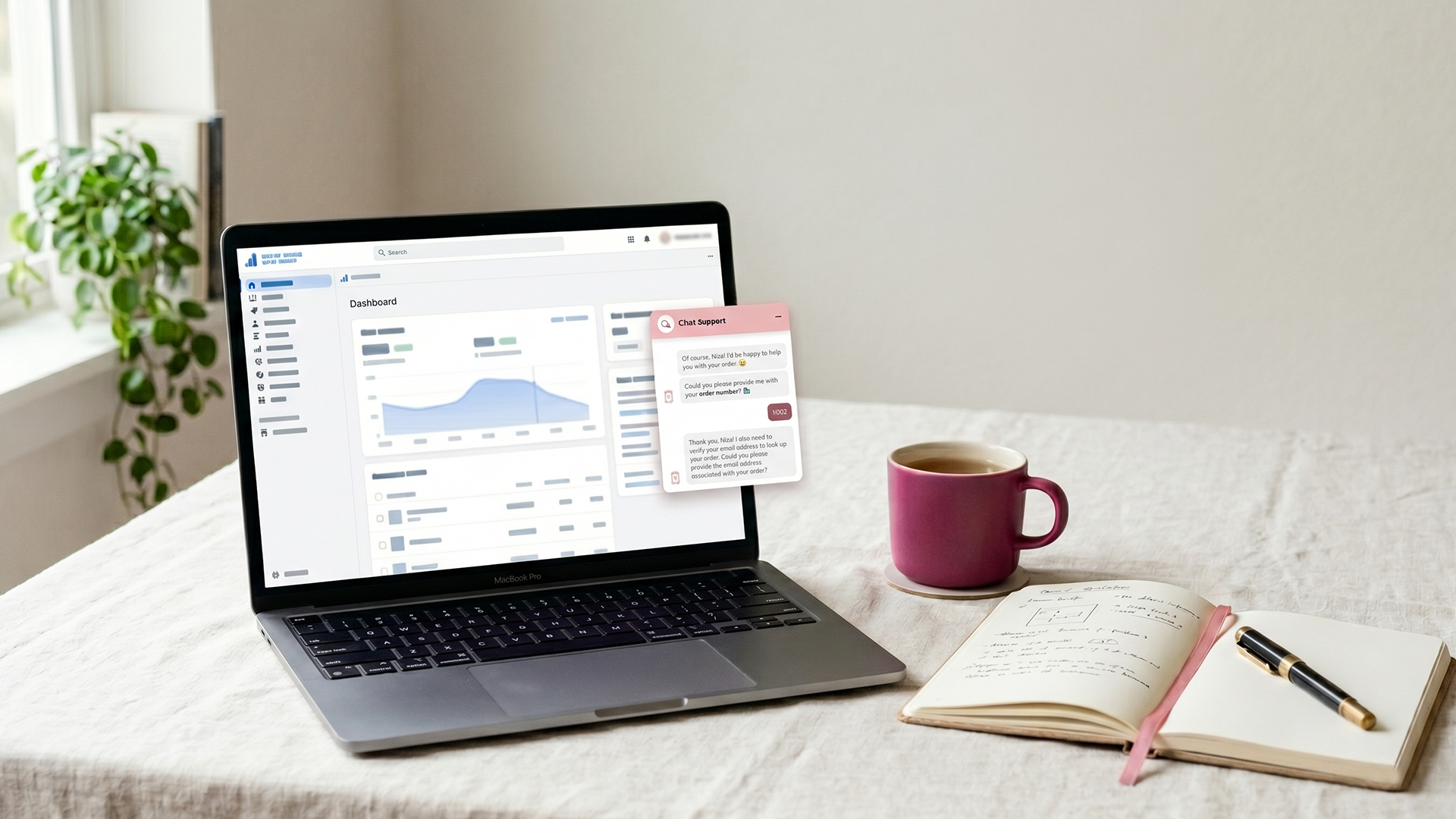
You've seen the pitch. A Shopify AI chatbot will answer your customers in seconds, recover abandoned carts, recommend products, and basically run your support so you can sleep. Some of that is true. Some of it is wishful copy on a sales page.
If you've shopped around for a chatbot in the last six months, you've probably noticed prices ranging from $19 a month to $2,000 a month for what sounds like the same thing. The reason is simple: the cheap options are software you operate, and the expensive ones are services someone else operates. Both work. They're just very different products with very different time costs to you.
This post is a plainspoken look at what a Shopify AI chatbot actually does for a small store, where it earns its keep, where it falls down, and how to know if you're ready for one. No hype. If your store isn't ready yet, I'll say so. If a free tool fits, I'll point at the free tool.
What a Shopify AI chatbot is (and isn't)
A Shopify AI chatbot is software that sits as a chat widget on your store, reads what a customer types, and responds in natural language. The good ones are trained on your specific products, policies, and order data. The bad ones answer from generic templates and hallucinate when they don't know.
Before you compare apps, it helps to understand the two categories you're actually choosing between.
AI chatbot vs rule-based chatbot
Rule-based chatbots follow a decision tree you build. Customer taps "Track my order," bot asks for order number, bot returns status. They work fine for predictable flows. They break the moment a customer phrases something the script didn't anticipate.
AI chatbots use natural language understanding to interpret what a customer means, not just what they typed. As Shopify's own documentation puts it, AI-powered bots are "constantly processing new information, learning from it, and growing in their ability to handle a given situation." That's the real difference. Rule-based bots react. AI bots reason (within limits we'll get to).
For most small Shopify stores, the question isn't AI vs rule-based. It's whether you want any chatbot at all yet. We'll come back to that.
Self-serve vs managed
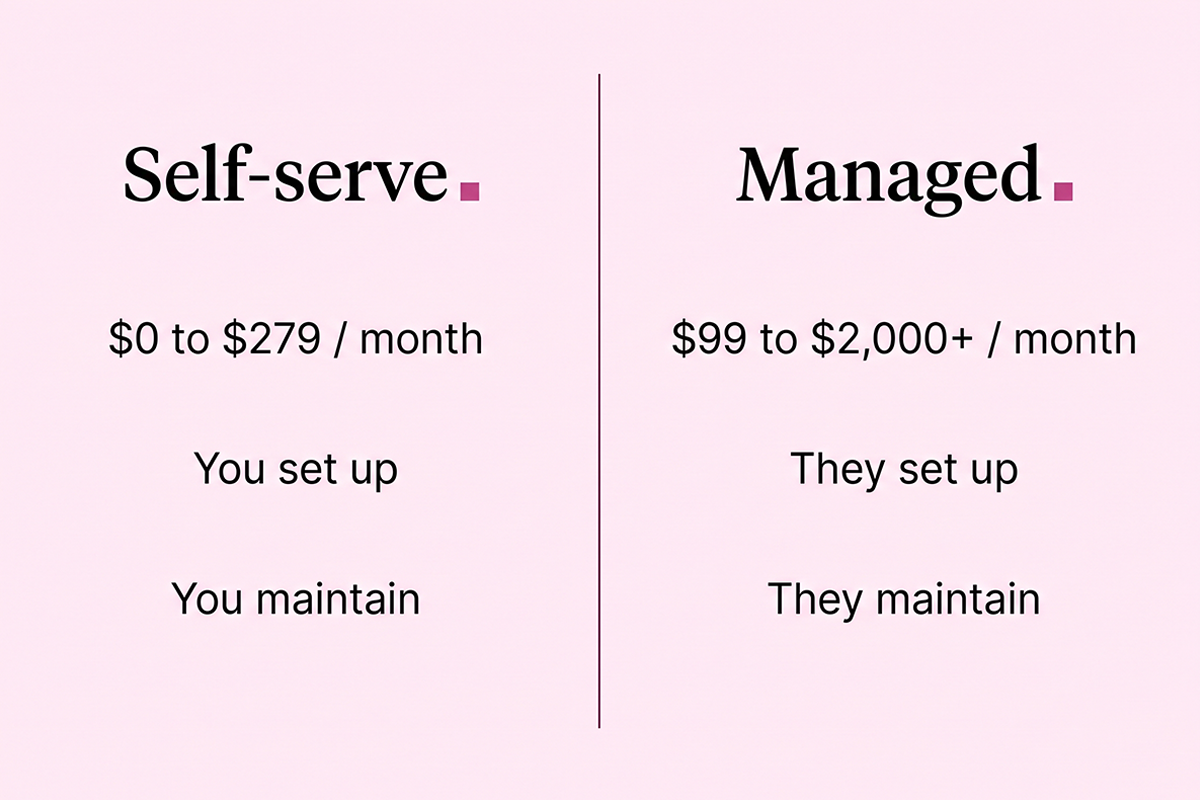
The other split is who maintains the bot after launch. Self-serve chatbot apps like Tidio, Shopify Inbox, and SmartBot let you install, configure, and run the bot yourself. Pricing typically runs $0 to $279 a month depending on conversation volume.
Managed chatbot services build, host, monitor, and tune the bot for you. Pricing runs $99 to $2,000 a month. The work is the same in both cases. The question is whether you do it or someone else does. Most founders underestimate how much weekly tuning a chatbot actually needs to stay accurate as products change.
What a Shopify AI chatbot actually does well
Across hundreds of Shopify stores running AI chatbots today, four use cases come up over and over. These are the things a properly trained bot handles cleanly. Everything else is either premature, optional, or better done by a human.
Answers "where is my order?" (WISMO)
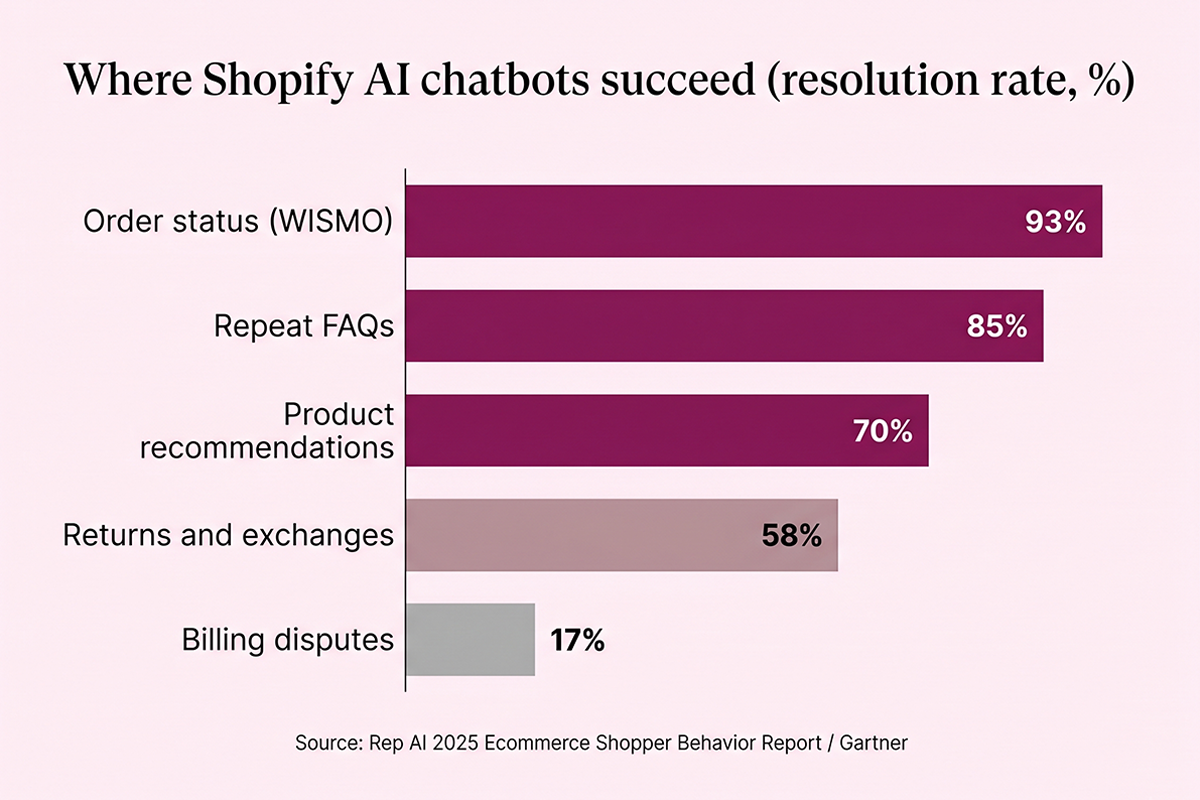
WISMO (the industry term for "Where Is My Order") is the single highest-volume question every Shopify store receives after about 50 orders a month. A bot connected to your Shopify order data can answer it instantly with a real tracking number and status.
This is where chatbots quietly earn their keep. Rep AI's 2025 ecommerce report found that 93% of routine customer questions can be resolved by AI without human intervention. Most of that 93% is WISMO and basic FAQs. Done well, this single use case is enough to justify a chatbot.
Handles repeat FAQs and policy questions
The five questions your customers ask in some form every single day: shipping times, return policy, sizing, materials, restocks. A chatbot trained on your actual policies (not a generic FAQ template) handles these without bothering you.
The catch is "trained on your actual policies." A bot that's grounded in real store data answers correctly. A bot that runs on a generic large language model with no grounding will sometimes invent shipping windows that don't exist or quote return policies you don't have. This is the single biggest failure mode in cheap chatbot installs.
Recommends products and reduces cart abandonment
Cart abandonment is the biggest leak in ecommerce. The Baymard Institute's 2025 update puts the global cart abandonment rate at 70.19%. Roughly 7 out of every 10 shoppers who add to cart leave without buying.
A chatbot can intervene at two points. First, on the product page, by answering the question that's making the shopper hesitate ("does this run small?"). Second, during checkout, by surfacing shipping information or a missing discount code. Shopify cites research suggesting AI chatbots can increase conversions by around 23% when deployed thoughtfully. Real-world results vary by category and traffic quality. The mechanism is sound: answering objections at the moment of hesitation is more effective than chasing the customer with a discount email three hours later.
Captures leads and contact info during conversations
This is the least-discussed but highest-margin use case. A chatbot that asks for an email at the right moment ("want me to email you when we restock?") quietly builds your list while doing other work. The newsletter capture happens inside a conversation the customer already started, which converts much better than a homepage pop-up they were trying to dismiss.
What a Shopify AI chatbot doesn't do
This is the part most chatbot vendors skip. A chatbot is a tool with limits. Pretending otherwise leads to bad installs and frustrated customers.
It doesn't replace human support for complex issues
Returns disputes, damaged shipments, custom orders, sensitive complaints. These need a person. The best bots know this and hand off cleanly to email or to a live agent platform like Gorgias or Zendesk. The worst bots try to handle everything and loop the customer through three rounds of "I'm sorry, I didn't understand that" before giving up.
Gartner research cited in the same Rep AI report found that only 17% of billing disputes were resolved by customers who used a chatbot at any point. Transactional questions are where bots shine. Emotional or contested questions are where they fail. Plan for both.
It doesn't make up answers (when it's grounded correctly)
This is the one most cheap installs get wrong. An AI chatbot built on a general large language model with no connection to your actual store data will confidently invent answers when it doesn't know. It will quote shipping times that don't exist. It will describe products you don't sell. It will reference a return policy that contradicts yours.
A properly built Shopify AI chatbot is "grounded" in your real data: your Shopify products, your policies, your order information. When it doesn't have the answer in its trained scope, it should say so and hand off, not invent. If a vendor can't explain how their bot avoids hallucination, that's a red flag worth taking seriously.
It doesn't "sell harder" the way a good salesperson can
Chatbots are not closers. They're assistants. They can answer the question that unblocks a sale, but they can't read a hesitating customer's emotional state and respond with the right reassurance the way a human can. For high-consideration purchases (anything over a few hundred dollars), expect the bot to assist sales, not drive them. The conversion lift comes from removing friction, not from persuasion.
How much a Shopify AI chatbot actually costs
The pricing landscape is wider than almost any other Shopify service. Here's what you're actually looking at.
| Type | Monthly cost | Setup | Who does the work |
|---|---|---|---|
| Shopify Inbox (native) | Free | You | You |
| Self-serve app (Tidio, SmartBot, etc.) | $19 to $279 | You | You |
| Managed service (entry) | $99 to $300 | $500 to $1,500 | Vendor |
| Managed service (enterprise) | $300 to $2,000+ | $2,000 to $10,000+ | Vendor |
Self-serve software ($0 to $279/mo)
Self-serve apps look cheaper because the monthly fee is lower. The hidden cost is your time. Expect 5 to 10 hours of setup, then 2 to 5 hours a month of ongoing tuning as your products change and customers ask in ways you didn't anticipate. If your hourly rate is meaningful, the "cheap" option is often the expensive one.
Self-serve is a real fit for: founders who genuinely enjoy this work, stores with very stable product catalogs, and stores small enough that the bot only needs to answer 30 to 50 conversations a month.
Managed services ($99 to $2,000+/mo)
Managed services bundle hosting, weekly conversation review, prompt tuning, integration maintenance, and email or live-agent support into the monthly fee. The lower end of this range ($99 to $300) is where Shopify-specialist solo studios and small shops live. The upper end ($500+) is enterprise platforms built for stores doing 10,000+ orders a month.
The honest math on the $99-a-month floor: the underlying AI platform costs about $15 per client when shared, plus another $5 to $15 in usage credits, plus weekly monitoring time worth $30 to $60. That's $65 to $105 of real cost per client per month. Anyone charging $19 a month for a "managed" service is either taking a loss or not actually doing the maintenance.
When your store is ready for a chatbot (and when it isn't)
Most "do I need a chatbot" articles answer yes regardless. That's because they're written by chatbot vendors. Here's the honest version.
The order-volume floor most stores miss
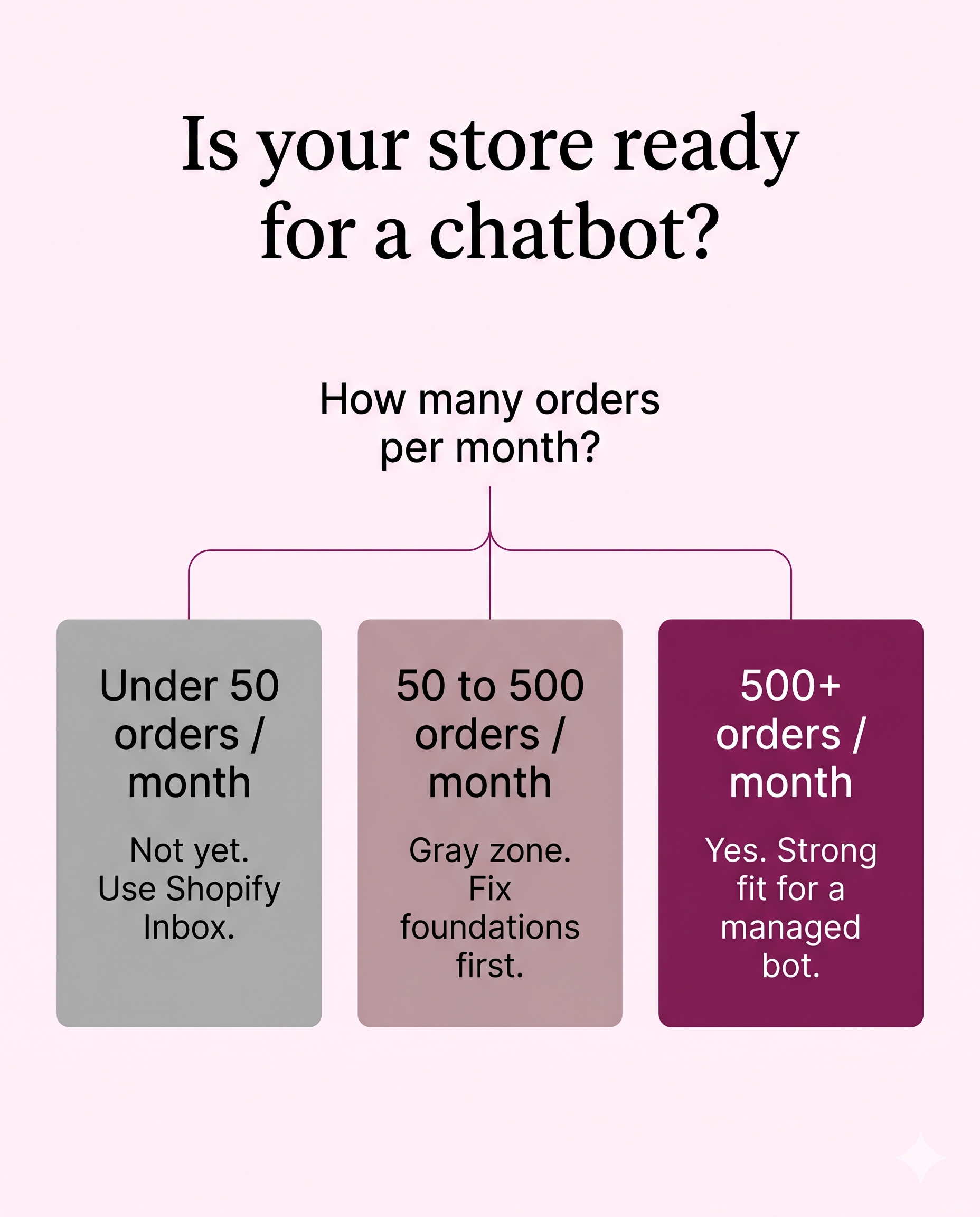
Below roughly 50 orders a month, a chatbot is almost always premature. You're not getting enough WISMO questions to justify the setup, and your time is better spent on traffic, conversion, and reviews. Shopify Inbox (free, built-in) handles whatever support volume you have at this stage.
Between 50 and 500 orders a month is the gray zone. A chatbot can help here, but only if your other foundations are solid. If your SEO checklist for new stores isn't done, your product pages aren't converting, or your reviews are thin, a chatbot is the wrong investment. Fix the leaky bucket first.
Above 500 orders a month, the math almost always works. Support volume is real, WISMO is constant, and the time saved is meaningful. This is where a managed chatbot service becomes a near-obvious yes.
Signs you're ready
You're answering the same 5 questions every day. You're losing weekend hours to "where is my order" emails. You have a stable product catalog with policies you've actually written down. You can name your top 10 customer questions without thinking. These are the signs.
Signs you're not
Your product catalog changes weekly. You haven't written your shipping or return policies yet. You're not yet hitting 50 orders a month. You're chasing chatbots because a competitor has one. Wait. Spend the money on Shopify SEO or reviews management first. Those compound. A chatbot installed on a store with weak foundations just makes the foundations more visible.
How to pick the right Shopify chatbot
If you've decided your store is ready, the choice between platforms and providers is the next question. A short list of things worth asking.
Questions to ask before signing up
How is the bot grounded in my actual store data? (If the answer is vague, walk away.) What happens when the bot doesn't know an answer? (Hand off to email or live agent, not invent.) Who maintains the bot as my products change? (You, or them?) What's included in the monthly fee? (Hosting, monitoring, tuning, support? Or just access?) What happens to the bot if I cancel? (For managed services, the bot stops. That's standard. Just know it upfront.)
Red flags
Vendors who promise "100% automation" or "fully replaces your support team." Setup fees that seem suspiciously low (real custom training is 10 to 50 hours of work). Monthly fees under $50 for a service that claims to do weekly monitoring (the math doesn't work). No transparent pricing on the website. Refusal to show you a live demo on a store like yours.
The best chatbot vendors will tell you when their service isn't a fit. That honesty is usually the strongest signal you'll get.
Wrapping up
A Shopify AI chatbot is a useful tool for the right store at the right time. It answers WISMO questions instantly. It handles repeat FAQs without your involvement. It nudges cart abandoners back into checkout. It captures leads while it works. Done well, it's quietly one of the best uses of $99 to $300 a month a small Shopify store can spend.
Done badly, it makes your store worse. A chatbot that hallucinates policies, loops customers in dead ends, or pretends to handle complaints it should hand off, actively damages trust. The cheap version of this service is rarely worth the savings.
If your store is doing under 50 orders a month, you almost certainly don't need a chatbot yet. Shopify Inbox is enough. Focus on traffic, on conversion, on getting your first 100 reviews. The chatbot conversation gets interesting when you're losing weekend hours to "where is my order" emails. Until then, save the budget for something with faster payback.
And if you do install one, install it on a store with the foundations already in place. A chatbot is amplification. It makes a good store better and a leaky store leakier.
Want a chatbot built and managed for you?
The Studio Niza AI Chatbot service builds a custom chatbot trained on your products, hosts it on a managed platform account, and tunes it weekly. Setup from $599, $99 a month all-in. No platform fees billed to you.
See chatbot pricing & scope →Or email contact@studioniza.com if you have a specific question about your store. I read every one.
Frequently asked questions
If you're still unsure after reading these, just send the question.
How much does a Shopify AI chatbot cost? +
Pricing ranges from free (Shopify Inbox) to over $2,000 a month (enterprise managed services). The two main categories are self-serve apps at $19 to $279 a month, where you do the setup and ongoing maintenance, and managed services at $99 to $2,000 a month, where the vendor builds and maintains the bot for you.
Will a Shopify AI chatbot work on the free Shopify plan? +
Shopify Inbox (the native option) is free and works on every Shopify plan. Most third-party chatbot apps also work on Basic Shopify and up. Some advanced features like custom API flows or live-agent handoff to Gorgias may require a higher-tier Shopify plan or paid app integrations.
Is Shopify Inbox enough or do I need a real AI chatbot? +
For stores doing under roughly 50 orders a month, Shopify Inbox is genuinely enough. It handles basic FAQs and gives you a chat presence without ongoing cost. Beyond 50 to 100 orders a month, the value of a properly trained AI chatbot (real WISMO automation, abandoned cart recovery, deeper product recommendations) starts to compound, and Inbox alone leaves money on the table.
Can a Shopify AI chatbot handle returns and refunds? +
Premium-tier managed bots with custom Shopify API flows can process simple returns and exchanges end-to-end. Most starter and mid-tier bots flag the return request, capture the relevant details, and hand off to your support email or live agent platform. Complex or contested returns should always go to a human, regardless of tier.
How long does it take to set up a Shopify AI chatbot? +
A properly trained chatbot, grounded in your actual products, policies, and order data, takes 2 to 4 weeks to set up for a managed service. Self-serve apps can technically be installed in an hour, but expect 5 to 10 hours of your own setup time plus several weeks of tuning before the bot answers reliably. Anything claiming a fully ready Shopify AI chatbot in under a day is template-only.
Do I lose my chatbot if I cancel the managed service? +
For most managed services, yes. The chatbot configuration, hosting, and platform access typically sit on accounts the vendor owns. When you cancel, the bot stops. This is by design: the monthly fee covers continuous maintenance, not a one-time build you keep forever. Self-serve apps work differently. You own the configuration but you also own all the ongoing maintenance work.