You launched your Shopify store. You added a blog because every guide told you to. Now you are staring at a content service offering "30 blog posts a month for $99" and another offering "daily blogs for $499" and you cannot tell which one will actually move your rankings.
The short answer: neither one, probably. Shopify blog SEO is a depth game, not a volume game. The stores that actually rank from blogging publish 2 to 3 thoughtful posts a week, not 30 thin ones a month. Google itself has said for years that frequency is not a ranking signal, and the data backs that up.
This post is for the solo Shopify owner who is trying to figure out a content cadence that actually works without burning out at week three. We will cover what Shopify blog SEO actually is, why daily posting fails for most stores, what Google and AI search reward instead, and a practical 2 to 3 posts a week rhythm you can run yourself starting Monday.
What Shopify blog SEO actually is (and what it isn't)
Shopify blog SEO is the practice of writing blog posts on your store that target search queries your buyers are typing into Google. Each post is structured to rank for one main keyword and a handful of related ones, links internally to your products and collections, and is marked up with proper schema so Google understands what the post is about.
That is the whole definition. It sounds boring because it is boring. Most of what makes blog SEO work is the same kind of patient, structural work that makes product page SEO work.
What Shopify blog SEO is NOT:
It is not social media frequency. Shopify's own guidance recommends posting on Instagram three to five times a week for engagement. That cadence does not transfer to your blog. Instagram rewards top-of-mind frequency. Google rewards depth and topical authority. Different game, different rules.
It is not content marketing for SaaS or media. HubSpot famously publishes 23+ posts a week, but they are a content-led marketing company with a 20-person editorial team. A Shopify store selling ceramic mugs is not HubSpot. The strategy that works at scale for a media business actively burns out a solo founder.
It is not AI-generated posts at volume. Google's helpful content guidelines explicitly flag content "produced primarily for search engines, not humans." The $19 AI content services produce exactly that kind of post, and Google has gotten very good at spotting them.
Why daily posting fails for most Shopify stores
The math is the easiest place to start. Orbit Media's annual blogging survey found that the average blog post takes around 4 hours and 10 minutes to write. That includes research, drafting, editing, sourcing, and the small considered choices that make a post readable.
Multiply that by 30 posts a month. That is 125+ hours of writing time. For a solo Shopify founder who is also doing fulfillment, customer service, product photography, ads, and the inbox: that math does not work. Something has to give. Almost always, what gives is the depth of each post.
What thin posts actually look like
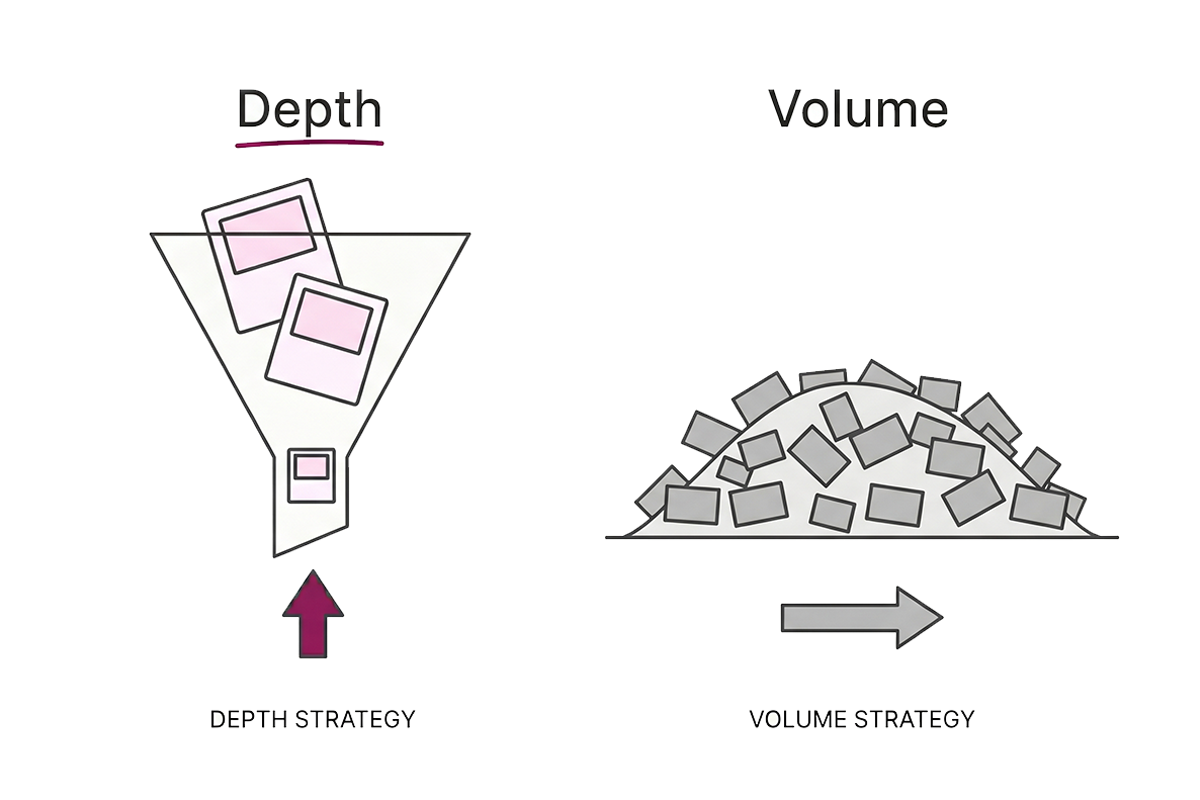
You can spot a thin post by what is missing. A thin post has a vague title like "Top 5 Things to Know About Ceramic Mugs." It has no real research, no internal links to actual products, no schema markup, no original photos, and no opinion. It reads like it was written by someone who has never used a ceramic mug.
Google sees these. The 2024 Google API leak (covered extensively in the SEO press) confirmed what most working SEOs already suspected: Google measures user satisfaction signals like dwell time, return-to-search behavior, and content originality. Thin posts fail every one of those tests.
The honest math on volume content
Most content services that pitch "30 posts a month" are running prompts through ChatGPT, lightly paraphrasing, and publishing. The cost per post on their side is maybe $2 to $5 in AI credits. At $99 a month for 30 posts, that is a 70 to 80 percent margin on automated output. The output is functional. It is also indistinguishable from every other store on the same service.
Studio Niza's view on this is the position the studio leads sales conversations with: 30 thin posts are worse than 12 thick ones. Quietly opinionated, backed by what actually ranks.
What Google and AI search actually reward
John Mueller, Google's longtime Search Advocate, has been blunt about this. In a widely shared LinkedIn exchange in 2024, he said nobody at Google counts the words or links on your blog posts, and even if they did, he would still recommend writing for your audience. Frequency is not a direct ranking factor. Topical depth and helpfulness are.
What does that look like on the ground? Three things Google consistently rewards on blog content:
Topical authority over scattered coverage
A store that publishes 12 deep posts about ceramic dinnerware will outrank a store that publishes 30 shallow posts spread across "ceramics," "kitchen decor," "Instagrammable home goods," and "lifestyle tips." Google connects depth in a single topic cluster to authority. Shallow breadth signals the opposite.
This is the principle behind topic clusters: one pillar page covering a broad topic, surrounded by supporting posts that go deep on subtopics, all linked together. It also happens to be the principle behind Shopify SEO and GEO done well at the page level.
Helpful content as defined by Google
Google's own helpful content guidelines spell out what they mean. Content should be written for humans first. It should demonstrate first-hand experience or expertise. It should leave the reader feeling satisfied, not needing to run another search. Thin posts fail the last test almost every time.
Citation-readiness for AI search
This part is genuinely new. ChatGPT, Claude, Gemini, Perplexity, and Grok now answer a meaningful share of buyer queries directly. A Semrush study cited by Shopify found AI Overviews appear on around 16 percent of Google queries already, and the share is growing.
These AI engines cite blog posts that answer specific questions in clear, structured language with verifiable claims. They do not cite thin posts. A deep, well-sourced post on "ceramic mug glazing methods" gets cited when a buyer asks ChatGPT "what is the difference between glazed and unglazed ceramic mugs?" A 600-word fluff post on the same topic does not.
This is what Generative Engine Optimization actually looks like at the blog level: write deep enough that an AI engine can lift a confident answer from your post, and your post becomes the source.
The 2 to 3 posts a week cadence, explained
2 to 3 posts a week is the cadence that consistently works for small Shopify stores. It comes out to 8 to 12 posts a month. Each post in the 1,200 to 1,800 word range, written for one specific buyer question, with proper schema and internal links.
The reason this cadence works is structural. It is enough volume for Google to read your blog as actively maintained (which the 2024 API leak confirmed feeds priority indexing). It is small enough that each post can be genuinely good. And it is sustainable for a solo founder or a one-writer studio over months and years, which is the timeline blog SEO actually runs on.
What 2 to 3 posts a week actually looks like
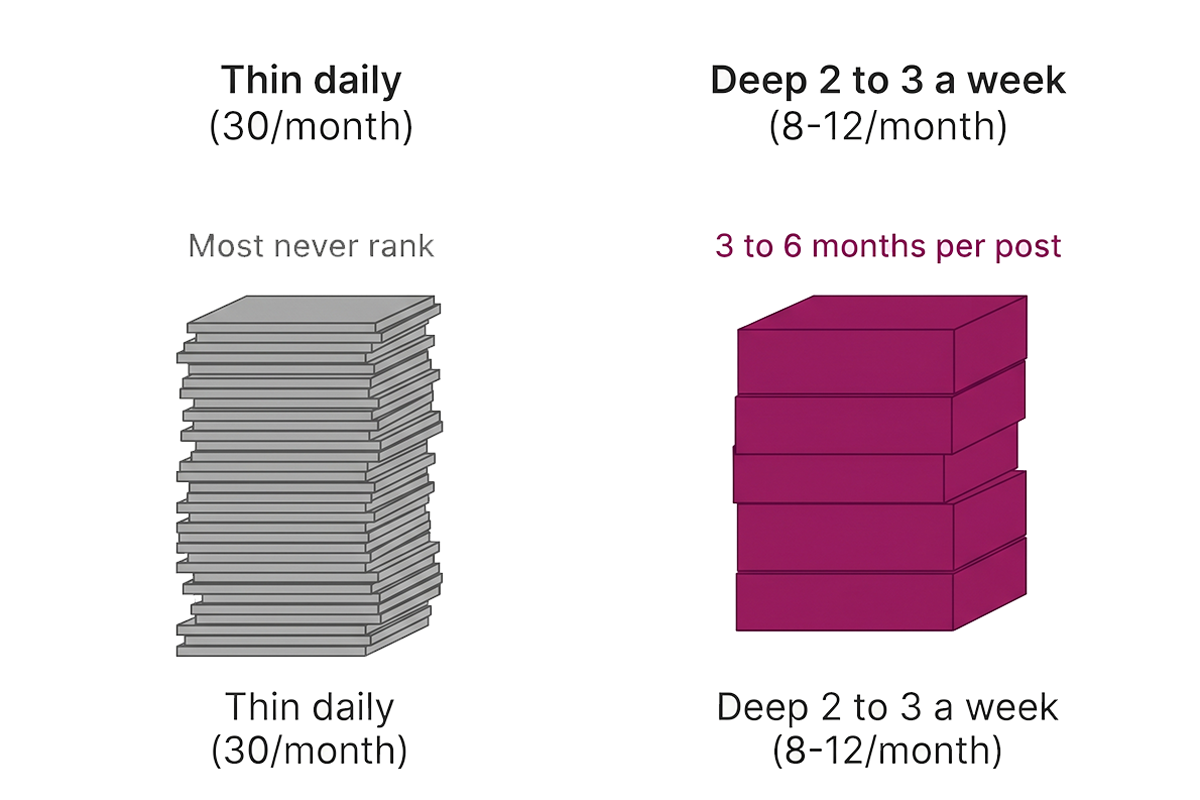
Here is the honest comparison, side by side. The "thin daily" column is what most $99 to $299 a month content services deliver. The "deep 2 to 3 a week" column is what actually ranks.
| Element | Thin daily (30/month) | Deep 2 to 3 a week (8 to 12/month) |
|---|---|---|
| Post length | 400 to 700 words | 1,200 to 1,800 words |
| Keyword research per post | None or tool-default | 1 primary + 2 to 3 secondary keywords |
| Internal links per post | 0 to 1 | 2 to 4 (products, collections, related posts) |
| Schema markup | Usually missing | Article and FAQ schema applied |
| FAQ section for AI citations | Rare | Standard, with schema |
| Editing pass by a human | Usually skipped | Required |
| Realistic ranking timeline | Most never rank | 3 to 6 months per post |
A working weekly rhythm
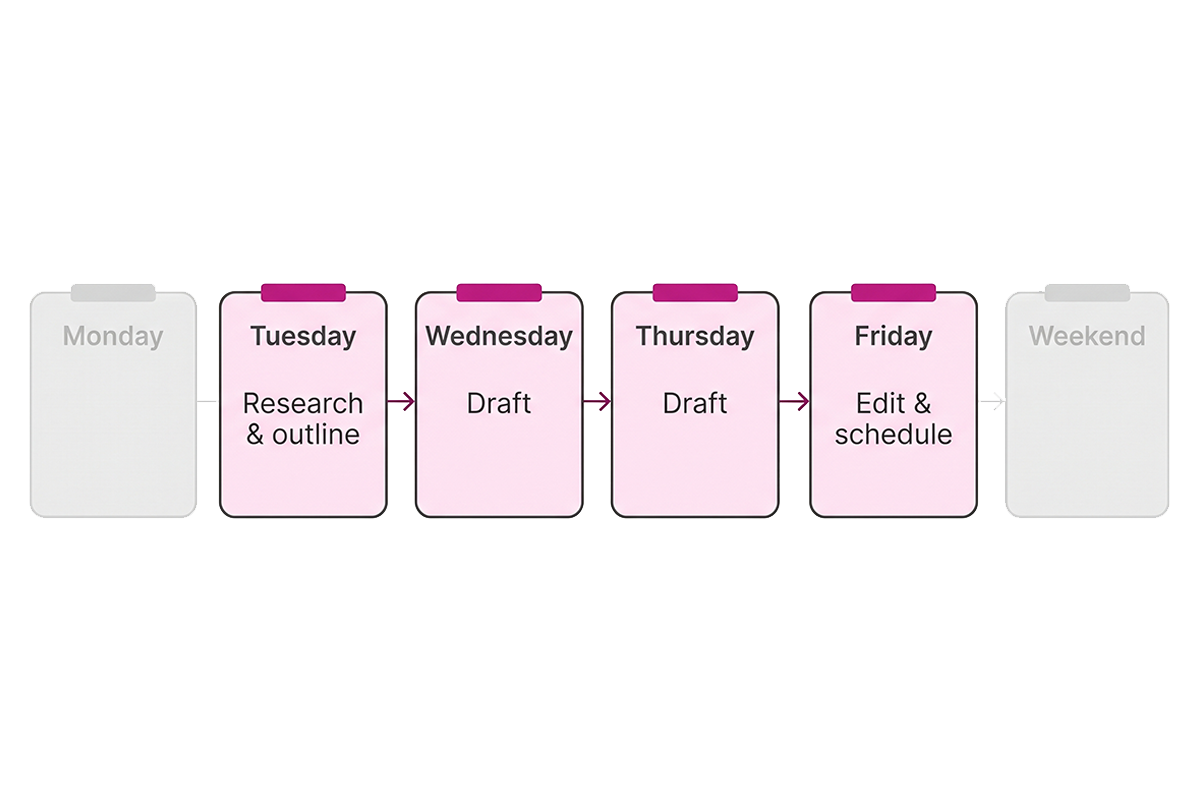
For a solo founder writing the posts yourself, the rhythm that holds up over months looks something like this. Tuesday: research and outline the week's posts. Wednesday and Thursday: draft. Friday: edit, format in Shopify, schedule for publication early the following week.
Two posts a week is the realistic baseline. Three is the stretch goal. Below two and the blog stops compounding fast enough. Above three, you start sacrificing depth, which is the whole point.
When daily posting does work (the honest exception)
Daily posting is not always wrong. There are three situations where it is the right call, and being honest about them matters.
Content sprints around launches. If you are launching a new collection in 30 days and want to seed the blog with 15 buyer-research posts before the launch, a 15-posts-in-15-days sprint can work. The trick is that this is a one-off, not a sustained rhythm. You spend the sprint on volume and then revert to 2 to 3 a week.
Established stores with editorial teams. A store doing $5M a year with a dedicated content manager and two writers can absolutely sustain daily posting at decent depth. That is not most Shopify stores. That is not the reader of this post.
Very narrow, high-search-volume niches. If you sell one type of product in a category where there are hundreds of long-tail buyer questions a month, you can run higher volume. Most stores do not have that profile. The category is too broad or too narrow.
For everyone else, the 2 to 3 a week cadence is the working answer. Daily is a trap that sells well because volume sounds impressive. It rarely outperforms over 12 months.
How to start this week if you are a solo Shopify owner
If you are reading this and your blog has 4 posts on it (or zero), here is the most useful starting move. Do not start with a content calendar. Start with the foundation. The blog only works if the rest of your store is set up to receive the traffic the blog will eventually drive.
Get the on-page basics in order first
Before writing post 5, walk through the 25-page Shopify SEO checklist. Your homepage, top 5 collection pages, top 15 product pages, and three policy pages need real titles, meta descriptions, and body copy. Without that, blog traffic lands on pages that do not convert.
Pick three pillar topics, not thirty
List the three buyer questions you hear most often. "How do I care for X?" "What is the difference between X and Y?" "Is X worth it for [specific use case]?" Each of those becomes a pillar topic. You will write 4 to 6 supporting posts under each, totaling 12 to 18 posts. That is your first six months.
Commit to two posts a week, not three
Starting at three a week is how solo founders burn out at week four. Start at two. If two becomes easy after a month, add a third. The blog that compounds is the one you are still writing in month nine, not the one you stopped publishing in month two.
Track impressions in Search Console, not rankings
For the first 8 to 12 weeks, your blog will get faint impressions and almost no clicks. That is normal. Watch impressions trend up over 6 to 12 weeks. Real position changes show up around month three, real traffic shows up around month six. The founders who quit at week four are the ones who quit just before the work would have started paying off.
Wrapping up
Shopify blog SEO is the channel where patience compounds. The stores that win at it are not the ones publishing daily. They are the ones publishing 2 to 3 deep, keyword-researched, properly structured posts a week for 12 to 24 months without quitting.
The data backs this up. Google has said it directly. The cadence is sustainable for a solo founder. The math on cost per post works out in your favor. And the depth you can fit into a 1,500-word post is what gets you cited in AI search, which is the next decade of organic traffic.
If you take one thing from this post: pick a cadence you can sustain for a year, not one that sounds impressive on paper. Two posts a week, every week, for 12 months beats 30 posts a month for 6 weeks before you stop.
Want this done for you?
Studio Niza's Blog Content service is built around the 2 to 3 posts a week cadence. Keyword-researched, 1,200 to 1,800 words, internal links, schema markup, and indexing follow-up. Plans from $449 a month.
See pricing & services →Or email contact@studioniza.com if you have a specific question about your store. I read every one.
Frequently asked questions
If you're still unsure after reading these, just send the question.
How many blog posts should a Shopify store publish per week? +
For most solo Shopify owners, 2 to 3 posts a week is the working answer. That comes out to 8 to 12 posts a month at 1,200 to 1,800 words each. Shopify blog SEO rewards depth over frequency, so two strong posts almost always outperform five thin ones.
Is daily blogging bad for Shopify SEO? +
Daily blogging is not inherently bad, but it usually leads to thin posts that do not rank. The only Shopify stores that sustain daily posting well are large stores with dedicated content teams. For solo founders, daily is a trap that burns you out in weeks four to six.
How long should a Shopify blog post be for SEO? +
The working range for Shopify blog SEO is 1,200 to 1,800 words. Long enough to cover the topic with real depth, short enough to stay readable. Premium long-form posts in the 1,800 to 2,500 word range can rank better in competitive niches, but anything under 1,000 words rarely competes for buyer-intent keywords.
Does Google rank blogs based on how often you post? +
No. Google's John Mueller has confirmed that frequency is not a direct ranking factor. Google measures content quality, topical depth, helpfulness, and user satisfaction signals. A blog that publishes 12 deep posts a month consistently outranks a blog that publishes 30 thin ones.
Can I use AI to write Shopify blog posts? +
Yes for research, outlining, and first drafts. No for unedited output published directly to your store. Google's helpful content guidelines flag AI content that has not been reviewed and shaped by a human. The posts that rank are the ones where AI is part of the workflow, not the whole workflow.
When will my Shopify blog start driving traffic? +
Honestly, 3 to 6 months for individual posts to rank, 6 to 12 months for compounding traffic. Track impressions in Google Search Console weekly for the first 8 to 12 weeks. Real position changes show up around month three. The trade-off is that organic traffic from blog content keeps coming for years.