
If you logged into Google Search Console recently and noticed your FAQ rich results vanished, your store is not broken. On May 7, 2026, Google quietly added a deprecation notice to its developer docs and stopped showing FAQ rich results in search entirely. No email. No blog post. Just a one-line update.
The reaction from a lot of Shopify owners has been to rip the FAQ schema off their store as fast as possible. That is the wrong move, and it is going to cost some stores visibility in the place that actually matters now.
Here is the short version. Google removed the display feature, not the markup. The Shopify FAQ schema sitting in your page code still does a job. It is just a different job than it was doing in 2023, and a more important one. This post explains what changed, why FAQ schema now matters more for AI search than for Google, and how to use it without making the same mistake that got the rich result killed in the first place.
What actually changed in May 2026
Two things have been getting blurred together for years, and the only way to make sense of this update is to pull them apart.
FAQ schema is the code. It is a small block of JSON-LD that tells search engines and AI systems: this page has a list of questions and answers, and here is exactly which answer goes with which question. FAQ rich results were the display feature. That was the expandable Q&A panel Google used to show under your listing, built from that code.
Google switched off the display feature. It did not delete the code from your site, and it did not declare the markup invalid. Google's own FAQPage documentation now carries a deprecation banner stating that as of May 7, 2026, FAQ rich results no longer appear in Google Search.
The rollout has three dates worth knowing, reported by Search Engine Journal. The rich results stopped showing on May 7. The Search Console report and Rich Results Test support for FAQ get removed in June 2026. The Search Console API stops returning FAQ data in August 2026. If you ever exported FAQ performance data into a dashboard, grab the history you want before June.
This is not a surprise if you have been watching Google's pattern. Back in August 2023, Google had already restricted FAQ rich results to well-known government and health sites only, which means most commercial stores lost the feature almost three years ago. Google did the same thing to HowTo rich results in 2023. May 2026 is just the final step of a phase-out that was already most of the way done.
Is FAQ schema dead on Shopify?
No. The rich result is dead. The schema is not. Those are two different things, and the difference decides what you should do this week.
FAQPage is still a valid Schema.org type. Google has confirmed that valid structured data left in place does not cause problems for Search, and it does not trigger a penalty or a manual action. Your rankings are not affected by the deprecation either. Google has been clear that this is a search-appearance change, not an algorithm change. Your page positions stay exactly where they were.
So the panic-removal instinct is backwards. Pulling the markup off your store gains you nothing on Google, and it throws away a signal that other systems still use. The only good reason to remove FAQ schema is if it is describing content that is not actually visible on the page, which we will get to in the "what not to do" section.
For a brand-new Shopify store, the practical takeaway is simple. Keep the FAQ schema you have. If you do not have it yet, you have not missed anything on Google, because the rich result has been gone for commercial sites since 2023. What you might be missing is somewhere else.
Why AI search engines still read FAQ schema
Here is the part most of the panic coverage skipped. While Google was retiring the FAQ display feature, a different set of engines was learning to lean on the exact format that markup describes.
ChatGPT Search, Perplexity, Google's AI Overviews, and Microsoft Copilot all work by reading pages, extracting the parts that directly answer a question, and stitching them into a synthesized answer. A clean question paired with a direct answer is the single easiest thing for those systems to lift and cite. FAQ schema is a machine-readable way of handing them that pairing on a plate.
This matters because ranking on Google no longer guarantees you show up in the AI answer. An Ahrefs analysis found that the share of AI Overview citations coming from pages that also rank in the top 10 of normal search fell from 76% in mid-2025 to 38% by early 2026. The gap between "ranks well" and "gets cited by AI" is widening fast, and structured, answer-shaped content is one of the things that closes it.
There is real data pointing the same way for stores specifically. One analysis from AirOps found that pages with clean structure paired with schema earned roughly 2.8 times the AI citation rate of poorly structured pages. Reporting on ecommerce specifically has put the figure for stores with complete Product, Review, and FAQ schema at about 3.2 times the citation rate of stores with thin or missing structured data. Treat the exact multipliers as estimates, because this data is young and the measurement methods are still settling, but the direction is consistent across every source.
This is the GEO angle, short for generative engine optimization, and it is genuinely the next decade of organic traffic. Most Shopify stores have not started on it. The ones that read this update as "FAQ schema is dead" and delete their markup are walking away from a cheap signal right as it becomes useful. That is the opposite of what a store getting found in Shopify SEO and GEO wants to do in 2026.
What FAQ schema does for your store now
Strip away the Google rich result and FAQ schema still earns its place on a Shopify store in a few concrete ways.
It feeds AI engines answer-shaped content
When a shopper asks ChatGPT or Perplexity "is the X material safe for sensitive skin" or "does this brand ship to Canada," the engine wants a clean question-and-answer pair to pull from. If your product or policy page carries that exact pairing in FAQ schema, you have made yourself the easy source to cite. No markup, and the engine has to guess from your prose, or skip you for a competitor who made it easy.
It helps Bing and other crawlers, not just Google
Google removing its rich result is a Google decision, not an industry-wide one. Bing, DuckDuckGo, and the various AI crawlers still parse FAQ markup. Since Perplexity and ChatGPT Search both pull from search APIs that include Bing, the markup keeps working for the engines that route through it.
It still structures your page for shoppers
FAQ schema only works correctly when it describes a real, visible Q&A section on the page. That visible section does its own job: it answers the objection a shopper has before they email you, which cuts pre-sale questions and quietly lifts conversion. The schema and the visible content are two halves of one thing.
It pairs with the schema types that still earn rich results
FAQ is one piece of a store's structured data, not the whole thing. Product, Review, AggregateRating, Article, and BreadcrumbList all still produce rich results in Google. The star ratings under a product listing come from review schema, which is exactly why losing or orphaning your reviews hurts more than losing the FAQ panel ever did. A store doing structured data properly uses all of these together.
How to add FAQ schema to Shopify the right way
FAQ schema lives in two places that have to agree with each other. Getting this part right is what separates markup that helps from markup that gets flagged.
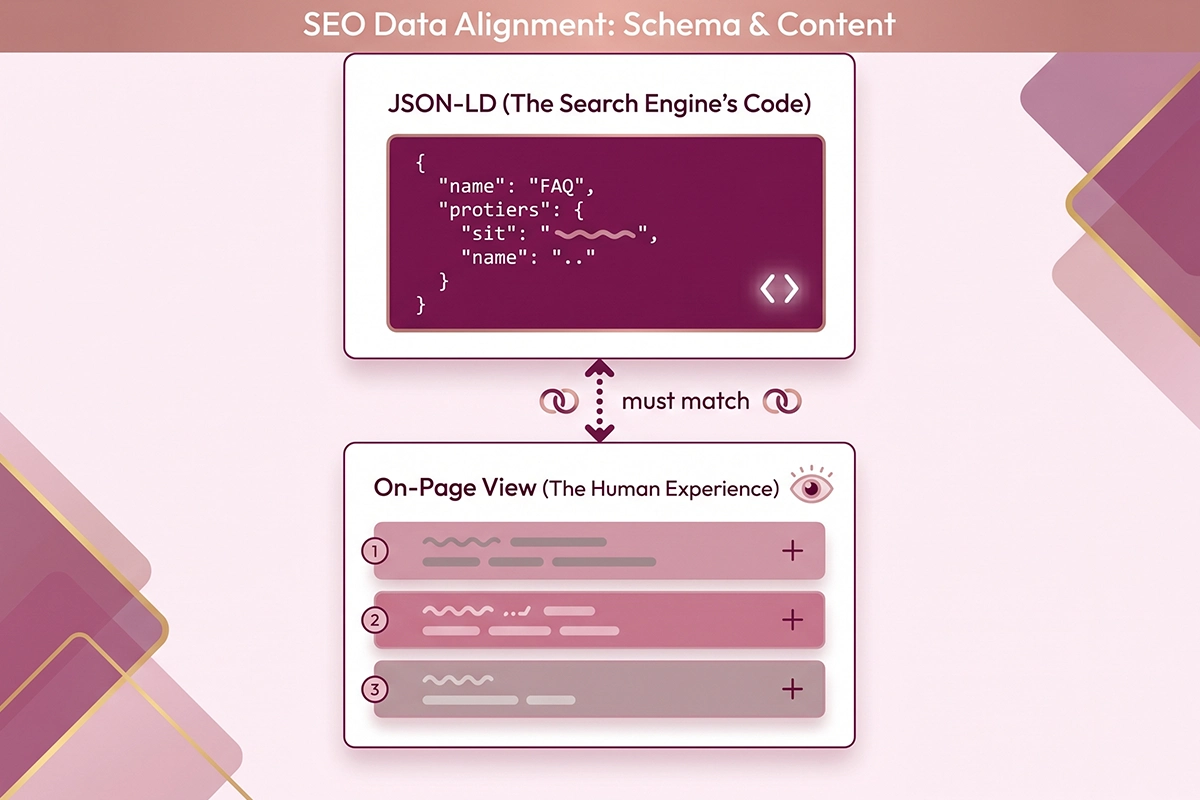
The JSON-LD goes in the page head. That is the machine-readable block search engines and AI systems parse. The visible questions and answers go in the page body, in plain HTML the shopper actually reads. The text in both has to match. If the schema claims an answer the page does not show, that is the problem case.
One important detail: use JSON-LD only. Do not also add microdata attributes (the itemscope and itemprop tags) to your visible HTML. If JSON-LD already describes the FAQ in the head, adding microdata in the body creates duplicate structured data, which Google reports as a warning. One source of truth, in the head.
App versus manual
You do not strictly need an app. An FAQ app is the easy route if you are not comfortable in theme code: it manages the visible accordion and the JSON-LD together, so the two stay in sync automatically. The trade-off is another monthly app fee and another thing slowing your page down.
Doing it manually means adding a JSON-LD block to your theme (often through a metafield or a snippet) and building the visible Q&A in the page content. It is more work up front and zero cost after, and it gives you full control over what each page declares. For a store with a handful of key pages, manual is usually the better long-term call. For a store adding FAQs to dozens of products, an app saves real time.
Where to put it
Do not paste the same generic FAQ block onto every page. Put FAQ schema where it answers a real question for that specific page: pre-sale objections on a product page, shipping and returns on a policy page, topic questions on a blog post. The questions should be ones shoppers actually type, phrased the way they would say them. That is the same discipline that makes a page citable by AI, so it is worth doing once and doing properly. If you want the broader picture of where schema fits in your setup order, the Shopify SEO checklist walks through the pages to handle first.
What not to do with FAQ schema in 2026
FAQ rich results were not killed at random. The feature got abused, and understanding the abuse tells you exactly what to avoid now.
The old playbook was to cram keyword-stuffed questions into FAQ schema on every page, whether or not the page had a real FAQ section, purely to grab a bigger slice of the search results. Google removing the feature is, in part, a response to that. So the rules for 2026 are the inverse of the abuse.
Do not mark up questions that are not visible on the page. Schema is supposed to describe real, visible content. Hidden or schema-only FAQs are the practice Google has spent years discouraging, and they are no help to AI engines either, which read the visible page.
Do not stuff keywords into your questions. "Best cheap affordable Shopify dress for women buy online" is not a question anyone asks. Write the question a real shopper would type. AI engines reward natural, answer-shaped phrasing, not keyword salad.
Do not paste one FAQ block across the whole store. Generic, duplicated FAQs add no value to any single page. Each page's FAQ should answer something specific to that page.
Do not keep FAQ schema that points at content you have since removed. If you delete a visible Q&A section, delete its schema too. Markup describing content that is not there is the one case where removing it is the right call.
The discipline that makes FAQ schema work in 2026 is the same discipline that should have governed it all along: the markup describes real answers to real questions that are actually on the page. Do that, and the schema helps you. Skip it, and you are recreating the exact problem that got the rich result deprecated.
Should a new store bother with this yet?
Honest answer: it depends on where your store is, and it is not the first thing you should spend a weekend on.
If you launched in the last few months and you are still fixing product titles, meta descriptions, and basic indexing, do those first. FAQ schema is a refinement, not a foundation. A store with no Product schema and no review stars should sort those out before touching FAQ markup, because those still produce visible rich results and FAQ no longer does.
If your foundations are in place and you are starting to think about how shoppers find you through ChatGPT or Perplexity, then FAQ schema is a cheap, sensible thing to add to your highest-intent pages. Not all of them. The product pages and policy pages where real pre-sale questions cluster. That is where the markup pays off, for the shopper reading it and the AI engine citing it.
And if you are doing under $200K a year and weighing whether this is worth your limited time at all, it is fine to put it on the list rather than at the top of it. The markup is not going anywhere. The window to use it for AI visibility is opening, not closing. You can add it the week your foundations are solid and lose nothing by waiting that long.
Wrapping up
Google killing FAQ rich results sounds like the end of FAQ schema. It is not. It is the end of one display feature that had already disappeared for commercial stores three years ago. The markup itself is still valid, still parsed, and now more useful for AI search than it ever was for Google.
So keep your Shopify FAQ schema. Make sure every question it declares is a real question, visibly answered on the page, phrased the way a shopper would actually ask it. Use JSON-LD in the head, skip the microdata, and do not paste the same block everywhere. That is the whole job.
The stores that win in AI search over the next few years are not the ones with the most schema. They are the ones whose pages give clear answers to clear questions, marked up cleanly so a machine can find them. FAQ schema is one of the cheapest ways to start doing that. The work that is left is making your answers genuinely worth citing, and that part was always the real job.
Want your schema done right the first time?
Studio Niza sets up FAQ, Product, and Review schema across your store so AI engines can actually read and cite it. Custom per page, real markup, no template fill-ins. Pricing starts at $499 one-time.
See how Shopify SEO works →Or email contact@studioniza.com if you have a specific question about your store. I read every one.
Frequently asked questions
If you're still unsure after reading these, just send the question.
Does FAQ schema still work on Shopify after Google's 2026 update? +
Yes. Google removed the FAQ rich result display feature on May 7, 2026, but FAQPage is still a valid schema type that Google and other engines continue to parse. On Shopify it still helps AI search engines like ChatGPT and Perplexity find and cite your answers, even though it no longer produces a Google dropdown.
Will FAQ schema hurt my Shopify SEO now that rich results are gone? +
No. Google has confirmed that valid structured data left in place does not cause problems for Search, and the deprecation does not affect rankings at all. Keeping clean, accurate FAQ schema on your Shopify store is safe and still useful for AI search.
What's the difference between FAQ schema and FAQ rich results? +
FAQ schema is the code that tells search engines a page has questions and answers. FAQ rich results were the expandable Q and A panel Google used to display from that code. Google switched off the display feature in 2026 but left the markup valid, so the schema still does a job while the panel is gone.
Do I need a Shopify app to add FAQ schema? +
No, but an app makes it easier. An FAQ app manages the visible questions and the JSON-LD together so they stay in sync, for a monthly fee. Adding it manually through your theme code is free and gives you more control, which works well for a store with a handful of key pages.
Does FAQ schema help my products get recommended by ChatGPT? +
It can. AI engines pull clean question-and-answer pairs directly into their responses, and FAQ schema hands them that pairing in a machine-readable format. Pages with structured content and schema have been measured earning meaningfully higher AI citation rates than pages without, though exact figures vary by source.
How many FAQ questions should a Shopify page have? +
There is no fixed number. Add the questions a shopper for that specific page would actually ask, usually three to eight, and make sure each one is visibly answered on the page. Quality and relevance matter far more than quantity, and a generic block copied across every page adds no value.