
If you've spent a week getting cold-pitched Shopify SEO services, you've already seen quotes that don't make sense together. Fiverr gigs at $50. A specialist at $899 a month. An agency that won't talk to you under $3,000. Same words on every pitch deck. Wildly different numbers.
This post breaks Shopify SEO cost into three real pricing brackets, what each one actually buys, and where the honest floor sits for a new store. You'll also see the red flags that almost always show up just before someone overpays for template work. The goal is simple: by the end, you should be able to look at any Shopify SEO quote and know what you're really paying for.
Most of this is written for solo founders in their first year on Shopify. If you're doing under $200K a year in revenue, you have specific constraints that change the math, and the brackets below are scoped accordingly.
What "Shopify SEO cost" actually means in 2026
The phrase covers four very different products. One-time projects (an audit, a fix-everything sprint, a migration cleanup) are billed as a flat fee, usually $500 to $15,000 depending on site size. Monthly retainers are recurring work, typically $499 to $5,000 a month for a new-to-midsize store. Hourly consulting runs $100 to $300 an hour and is mostly useful when you have an in-house person to implement. Per-task or per-page pricing is the newer model: you pay $89 to $499 for a specific deliverable instead of a vague retainer.
Most agencies still push retainers because ongoing work matches how SEO actually behaves. Specialists and freelancers increasingly offer per-page or per-project pricing, which is more honest about scope but less honest about how long results actually take.
Why prices look so wildly different
Two quotes labeled "Shopify SEO" can mean two completely different products. One might be a template fill-in: someone runs your store through an audit tool, exports the same meta description format across 200 products, and calls it done. The other might be 12 hours of human work on product page copy, schema markup, internal linking, and image alt text per page.
Both get called SEO. Neither is the same product. Optimum Web's 2026 retainer breakdown puts it bluntly: anything under $500 a month is usually outsourced or templated work that won't move rankings. The pricing pages don't tell you that, so you have to ask scope questions.
One-time projects vs monthly retainers vs hourly
For a new Shopify store with 20 to 100 products, a one-time per-page project is usually the right starting point. You pay once, you get a clean foundation, and you can decide later whether you want ongoing work. Monthly retainers make more sense after the foundation exists, when you're doing content, internal linking growth, and link building.
Hourly consulting is for stores that already have someone executing in-house. If you don't have that person, hourly is the most expensive way to buy nothing.
The three real pricing brackets
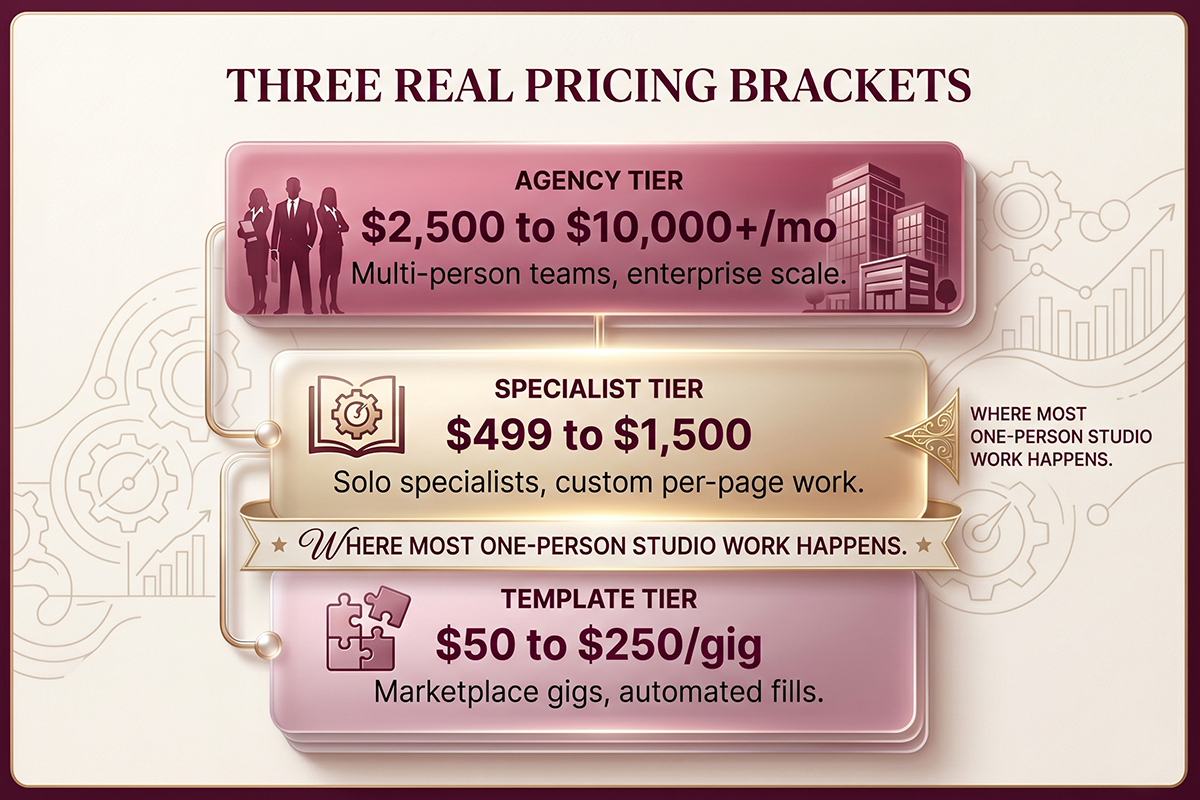
Stripping out the noise, Shopify SEO in 2026 lands in three brackets. The middle bracket is where most legitimate solo-founder work happens. The top and bottom each exist for reasons, but most new stores shouldn't be in either.
| Bracket | Price range | Typical seller | What you actually get |
|---|---|---|---|
| 1. Template tier | $50 to $250 per gig, or $99 to $399/mo | Marketplace freelancers, app installers | Bulk meta descriptions, automated alt text, an SEO app install. No custom strategy, no real schema, no follow-up. |
| 2. Specialist tier | $499 to $1,500 one-time, or $499 to $1,500/mo | Solo specialists, small studios | Custom keyword research per page, real schema markup, image SEO, internal linking, indexing follow-up, monthly reporting. |
| 3. Agency tier | $2,500 to $10,000+/mo | Multi-person agencies, enterprise SEO firms | Full team coverage: technical SEO, content production at volume, link building, CRO alignment, dedicated account manager. |
Bracket 1: $50 to $250 per gig (the template tier)
This is the bracket most new founders run into first because it's the loudest. A gig on a marketplace says "complete Shopify SEO for $99" and includes "200 keywords, meta titles, meta descriptions, alt text, and a sitemap submission." Marketplace data shows average Shopify SEO gigs land around $89 to $99, which is why this bracket exists.
Here's the math on why these gigs are usually template work. If a seller charges $99 and SEO specialists in 2026 earn around $70,000+ a year per Glassdoor, that's about $35/hour. Your $99 buys roughly two to three hours of attention. Two to three hours is enough time to run your store through an audit tool, run a template generator, and click submit. It is not enough time for actual per-page keyword research, schema, or copy.
This bracket has a place. If you have 5 products, $99 in available cash, and you want surface-level fixes before you launch ads, it's better than nothing. But it does not replace real SEO and it should not be confused with one.
Bracket 2: $499 to $1,500 (the specialist tier)
This is the middle bracket where most one-person Shopify SEO work happens. A specialist (often a solo operator, sometimes a small studio) charges $499 to $1,500 either as a one-time per-page project or as a monthly retainer. The deliverables are scoped per page, not per template, because there isn't enough volume to template across 50 clients.
According to Ahrefs' 2026 survey of 439 SEO professionals, the most common monthly cost falls between $501 and $2,000. Roughly 43% of all respondents land in that range. That's not a coincidence. It's where one person can do real work on a store and still pay themselves.
Studio Niza's Shopify SEO service sits in this bracket on purpose. The Starter tier is $499 one-time for a tightly scoped foundation project. The Growth tier is $899 a month for ongoing per-page work and reporting. The pricing isn't a marketing number. It's the floor at which custom per-page work stays sustainable for a solo studio, which we'll come back to in the next section.
Bracket 3: $2,500 to $10,000+ per month (the agency tier)
This is where multi-person agencies start. The team typically includes a strategist, a content producer, a technical SEO person, sometimes a link builder. Industry benchmarks put small-business agency retainers at $2,500 to $5,000 a month, with the average around $3,209 per month. Enterprise stores spend $10,000 to $50,000+.
If you're doing $500K+ a year in revenue, competing in a crowded category, or running a Shopify Plus store, this bracket starts to make sense. The agency brings team depth, process, and accountability. You also pay for project management overhead you don't need at smaller scale.
For most new stores, this bracket is overkill. Paying $3,000 a month when your store does $15K a month in revenue isn't an SEO problem. It's a budget mismatch.
What real Shopify SEO actually includes (and what cheap SEO leaves out)
Past a certain price floor, every legitimate Shopify SEO engagement covers a similar list. The differences are scope, depth, and whether the work is custom or templated. Use this as a checklist when you're reading a quote.
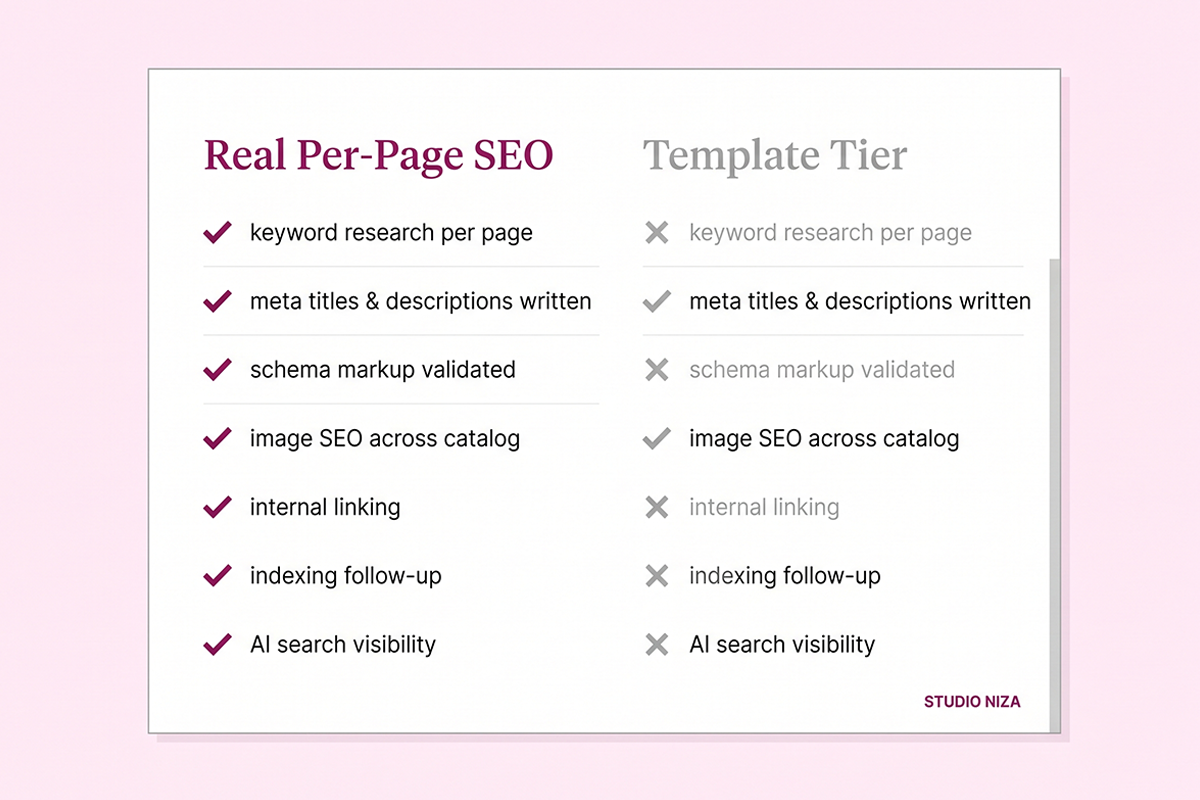
Custom keyword research per page. Real SEO assigns a unique primary keyword to each product, collection, and key landing page. Template SEO uses the same keyword cluster across an entire collection.
Meta titles and descriptions written, not generated. Real SEO writes each meta description as copy that earns the click. Template SEO uses a formula like "Buy {Product Name} at {Store}. Free shipping on orders over $50."
Schema markup that's actually validated. Shopify's own SEO guide calls out Product, Organization, FAQPage, and BreadcrumbList schema as the minimum. Real SEO writes these as JSON-LD blocks, tests them in Google's Rich Results Test, and watches them index. Template SEO installs an app that auto-generates schema and never checks if it validates.
Image SEO across the whole catalog. Descriptive alt text on every product image, plus compressed file sizes for page speed. The Shopify SEO checklist of 25 pages new stores should optimize first covers the exact image-by-image scope.
Internal linking that connects products to collections to content. This is the part most cheap SEO skips entirely because it's slow human work and doesn't scale.
Indexing follow-up. Submitting the sitemap to Google Search Console and Bing Webmaster Tools, then checking back two to four weeks later to see what actually indexed. If your SEO provider doesn't mention indexing follow-up, they're not doing it.
AI search visibility. The 2026 addition. Optimum Web reports that 73% of businesses are completely invisible in ChatGPT results, and most traditional SEO retainers don't include GEO (Generative Engine Optimization). Getting cited by ChatGPT, Claude, Gemini, and Perplexity needs different inputs: structured Q&A content, FAQPage schema, llms.txt files, and clear factual statements that AI engines can quote.
If a quote covers everything above, you're paying for real SEO. If it covers two or three items and gestures at the rest, you're paying for template work at a real-SEO price.
Why $499 is the honest floor for real per-page work
The number isn't arbitrary. Here's the math, working backward from what a per-page SEO project actually takes.
A custom Shopify SEO foundation for a 25-page store (homepage, key collections, top products, About, Contact) involves real time per page: 30 to 45 minutes of keyword research, 20 minutes writing the meta title and description, 30 minutes on schema markup, 15 minutes on alt text and image work, and 10 to 15 minutes on internal linking. That's roughly 90 minutes per page, plus the audit, sitemap submission, and follow-up. Total: 35 to 45 hours of focused work.
At a sustainable rate of $30 to $40 an hour after platform costs, taxes, and overhead, that's $1,050 to $1,800 in raw time. A solo studio offering $499 for a 25-page foundation is taking a smaller margin on a smaller scope (typically the top 10 to 12 pages, not 25), or batching multiple stores to amortize the audit work. Below $499, the math collapses.
That's why a $99 gig can't be the same product. It's not a discount on real work. It's a different product running on automation, sold at a price that signals scale-of-attention. Boulder SEO Marketing's pricing analysis puts it directly: at $300 a month, an agency can give your store maybe 2 to 3 hours of attention. The math doesn't change just because the price tag does.
Studio Niza's $499 Starter tier exists at this floor because that's where one person can confidently deliver real per-page work and still be a sustainable business. The principle from how I scope and price every engagement is the same: only advertise what you can confidently deliver, and price it at the floor where that's possible.
Red flags that mean you're about to overpay for template work
The pricing isn't the only signal. Some quotes are reasonably priced but still template work, and some are agency-priced but still vague on deliverables. Here are the signals that almost always mean you should ask harder questions before paying.
"AI-powered meta description generation." This is software running on your products at scale, not a person writing copy. It's fine as a tool inside a real workflow. It is not a service you should pay $500 for.
No specific deliverables in the proposal. A legitimate Shopify SEO quote names the exact pages being optimized, the exact schema being added, and the exact reporting cadence. If a proposal says "comprehensive SEO services" with no specifics, the seller can deliver almost nothing and call it done.
12-month minimum contracts with no opt-out. Some retainers genuinely need 6 to 12 months to compound. But a 12-month contract with no performance benchmarks and no out clause is a structure that benefits the seller, not you. Search Scale AI flags this as one of the most common 2026 industry rip-offs.
"Guaranteed first-page rankings." Nobody can guarantee specific Google rankings. Anyone who does is either lying or planning to rank you for keywords with zero search volume so they can claim success.
The same proposal as five other Shopify stores. Ask the seller what they'd do differently for your store specifically. If the answer is the same as the boilerplate, you're paying for template work.
No mention of GEO or AI search visibility. In 2026, this is a real gap. If your provider doesn't have a position on getting cited by AI engines, they're optimizing for half the search landscape.
How much should a new Shopify store actually budget?
The honest answer depends on three things: revenue, time-to-results expectation, and whether you have an in-house person to do the work yourself.
If your store is doing under $50K a year in revenue: a one-time $499 to $899 per-page project is the right scope. You don't yet need a monthly retainer. Get the foundation right, drive some traffic, and revisit in 3 to 6 months.
If your store is doing $50K to $200K a year: a $499 to $1,500 monthly retainer makes sense once the foundation exists. You're paying for ongoing optimization, content, and link building. RankAI's pricing analysis notes the most common price point in this range is $500 to $1,000/month, with 64% of agencies charging under $1,000.
If your store is doing $200K+ a year: agency-tier retainers ($2,500 to $5,000/month) start to pencil out. You have enough revenue to justify the overhead, and the team depth pays off in execution speed.
If you have an in-house person: hourly consulting at $100 to $250/hour can be the cheapest way to get expert direction. Pay for a strategy call, pay for a quarterly audit, and let your person execute.
One more reality check. Zero-click searches now account for roughly 60% of all Google queries, which means SEO in 2026 is also about earning citation in AI Overviews, ChatGPT, and Perplexity, not just blue-link rankings. Budget for a provider who acknowledges this. The ones who don't are pricing yesterday's product.
Wrapping up: what to spend, what to skip
The short version: Shopify SEO cost in 2026 is honest somewhere between $499 and $1,500 for a solo founder, and the price reflects scope, not quality of seller. Below $499, you're almost always buying template work. Above $2,500/month, you're paying for team and process you probably don't need yet.
The work itself isn't mysterious. It's custom keyword research per page, real schema markup, image SEO, internal linking, indexing follow-up, and AI-search visibility. Every quote you receive should name those deliverables specifically. If it doesn't, ask for the specifics in writing before you pay.
You can also do most of this yourself if you're willing to put in 35 to 45 hours on a small store. The Shopify platform gives you all the SEO fields you need built-in. The honest reason most founders eventually hire someone is not that the work is too hard. It's that it's too slow when you're also running everything else. If that's where you are, the brackets above tell you what real help should cost. If you'd rather send a brief on what you actually need, that works too.
Want a real quote without the template-fill markup?
Studio Niza's Shopify SEO service starts at $499 for one-time per-page work and $899/month for ongoing growth. Custom keyword research, real schema, image SEO, and indexing follow-up. No 12-month lock-ins, no AI-generated meta descriptions.
See SEO pricing & scope →Or email contact@studioniza.com if you have a specific question about your store. I read every one.
Frequently asked questions
If you're still unsure after reading these, just send the question.
Is $99 per month enough for real Shopify SEO? +
No, but it depends on what you mean by SEO. A $99 service can install an SEO app, generate bulk meta descriptions, and submit a sitemap. It cannot do custom keyword research per page, write real schema, or follow up on indexing. The realistic floor for custom per-page work in 2026 is around $499 one-time or $499 monthly.
What's the difference between a $500 SEO project and a $3,000 one? +
Scope and ongoing time. A $500 one-time project usually covers the top 10 to 15 pages on your store with custom work. A $3,000 monthly retainer covers ongoing optimization across the whole catalog, plus content, link building, and team coverage. Both can be honest. The question is whether you need the team or just the foundation right now.
Do I need a 12-month SEO contract? +
Not usually. SEO does take 6 to 12 months to compound, but a 12-month minimum contract with no performance benchmarks is mostly a seller-friendly structure. Look for month-to-month retainers with a 60 or 90-day minimum, which protects both sides without locking you in.
Can I do Shopify SEO myself for free? +
Yes. Shopify's built-in SEO fields cover the basics, Google Search Console is free, and there's plenty of documentation. The honest constraint is time: a foundation project on a 25-page store takes 35 to 45 hours of focused work. Most founders eventually hire someone not because the work is too hard, but because it's too slow.
How long until I see results from Shopify SEO? +
Indexing changes show up within 2 to 4 weeks of submitting the sitemap. Position changes start moving between week 8 and week 12. Meaningful traffic growth typically lands at the 6 to 12-month mark. Anyone promising results in 30 days is either ranking you for low-volume keywords or selling you something else.
Should new Shopify stores pay for monthly SEO or one-time work? +
One-time per-page work first, then monthly later. A new store needs the foundation right (keyword research, schema, image SEO, internal linking) before recurring work pays off. Once the foundation exists and you're driving some traffic, a monthly retainer for ongoing content and optimization becomes worth the spend.