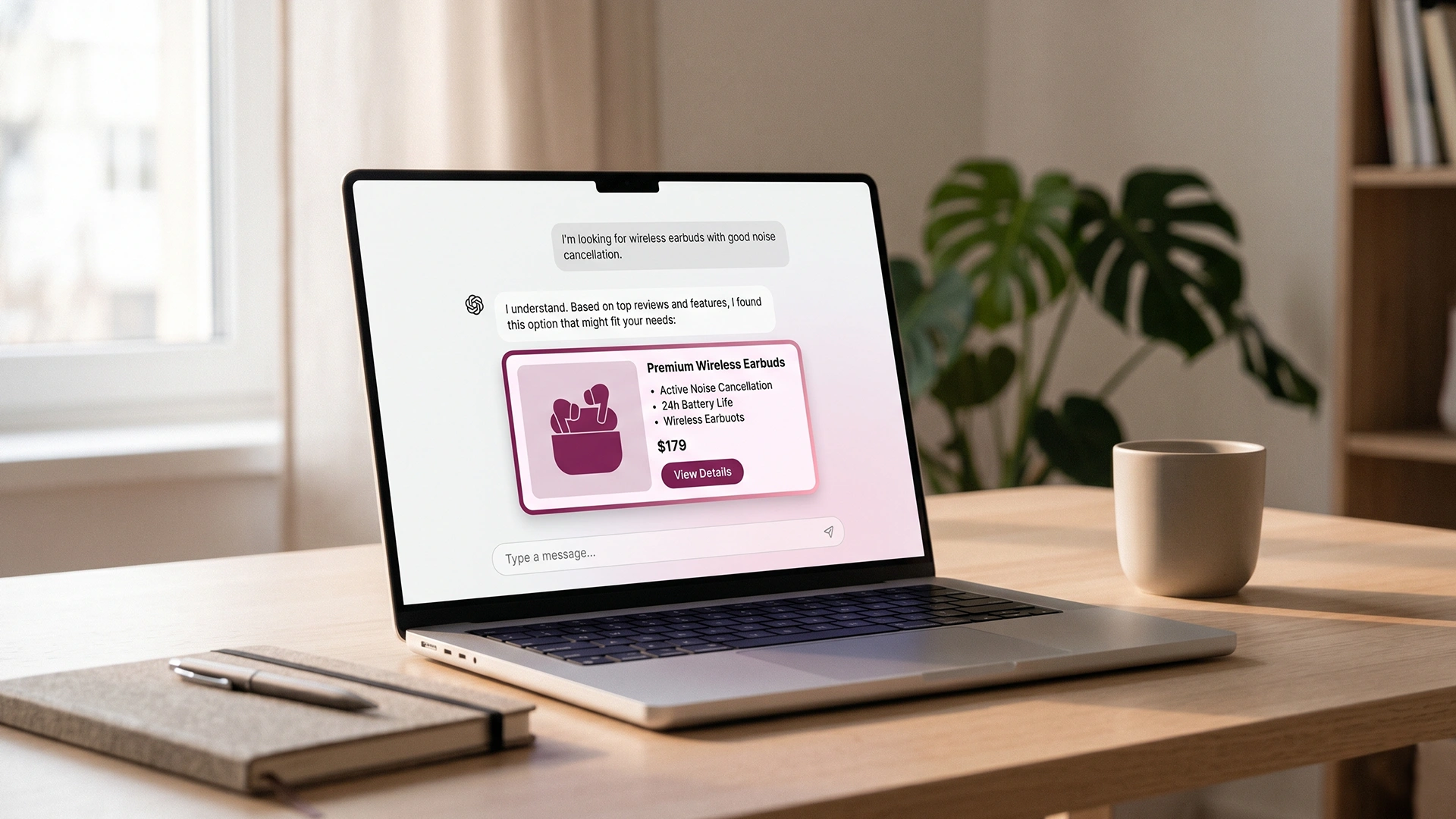
You typed your own product category into ChatGPT. Something like "best [your category] under $50." You waited for your store to come up. Instead, a competitor did. That sinking feeling is why you are here, and the good news is that Shopify ChatGPT visibility is usually a fixable problem, not a verdict on your store.
Here is the part most owners do not realize yet. As of March 2026, your products are almost certainly already inside ChatGPT through Shopify's Agentic Storefronts rollout. Being inside the system and being the store it recommends are two completely different things. The stores that get picked are not the biggest brands. They are the ones with clean, machine-readable data and an open door for AI to walk through.
This post covers the three reasons a Shopify store stays invisible to AI: blocked crawlers, unstructured data, and no citable facts. Then a 10-minute self-test you can run right now, and the order to fix things in. No app to buy. Most of this is configuration and content, not money.
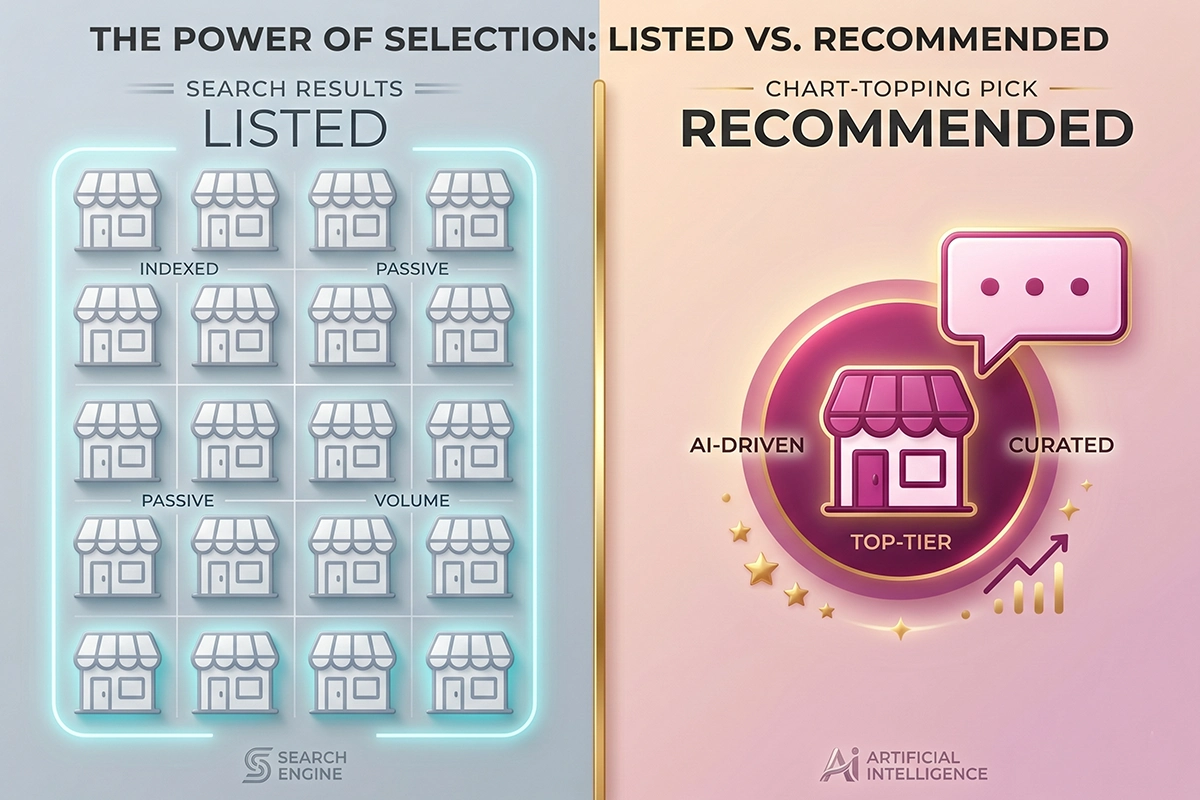
Being Listed in ChatGPT Is Not the Same as Being Recommended
On March 24, 2026, Shopify activated Agentic Storefronts for eligible merchants as part of its Winter '26 Edition. Your product catalog became automatically discoverable inside ChatGPT, Perplexity, Microsoft Copilot, Google AI Mode, and Gemini. No app to install, no opt-in to click. If you run an eligible store, you are in.
So why the competitor? Because there are two separate systems at work, and owners conflate them constantly.
Listed means your products are syndicated through the Shopify Catalog and technically eligible to appear. Recommended means the AI actually chose to surface your store when someone asked a question. The first is automatic. The second is earned, and it depends on how well an AI can read, verify, and trust your store's information.
This is genuinely different from Google, where a competitor can outbid you tomorrow and rankings shift constantly. AI recommendations are unsponsored. You cannot pay to be featured in the organic suggestion. That cuts both ways: nobody can buy their way past you, but you cannot shortcut your way in either. You earn it with data quality.
Reason 1: AI Crawlers Cannot Reach Your Store
The cheapest, most common, most invisible failure is a locked front door. If an AI crawler cannot fetch your pages, none of your content matters. You can write perfect product descriptions and add every schema type that exists, and it changes nothing if the crawler gets a "no entry" at the gate.
There is one technical distinction that trips up almost everyone, and it is worth slowing down for.
OAI-SearchBot is not GPTBot
OpenAI runs two crawlers that do completely different jobs. GPTBot collects data to train OpenAI's models. OAI-SearchBot indexes pages for live use inside ChatGPT, including shopping responses. Blocking one has zero effect on the other.
Back in 2023 and 2024, a lot of advice told store owners to block AI crawlers so their content would not be used for training. Reasonable at the time. The problem is that blanket advice often blocked both bots. If OAI-SearchBot is disallowed, your store is structurally invisible to every ChatGPT recommendation, and that block does not show up in any analytics report. Traffic just quietly never arrives.
The configuration most stores actually want: block GPTBot if you do not want your pages in training data, but allow OAI-SearchBot, PerplexityBot, ClaudeBot, and Google-Extended so the live AI search tools can find you. You keep your content out of model training while staying fully visible in the answers shoppers see.
The good news for most new Shopify stores
By default, Shopify allows AI crawlers. If you have never touched your robots.txt file and have not installed an app that manages crawler access, you are probably fine on this front. The crawler block tends to bite stores that either edited robots.txt years ago on old advice, added a security or "AI protection" app, or sit behind a CDN rule that blocks bots. It is still the first thing to check, because it takes ten seconds and it is the one failure that makes everything else pointless.
If you do need to change it, Shopify lets you edit the file through a robots.txt.liquid theme template. Shopify is clear that this is an unsupported customization their support team will not help with, and a wrong edit can block your whole store from search. If you are not comfortable in theme code, this is a reasonable thing to hand to someone who is. The same crawler access that gets your pages into Google is the foundation under the checklist that gets your core pages indexed in the first place.
Reason 2: Your Data Is Not Structured for Machines
AI agents do not see your beautiful theme. They do not read your hero banner or admire your font pairing. They parse structured data and metafields. If the information an AI needs lives only inside HTML paragraphs and a pretty layout, the AI has to guess, and it would rather recommend a store it does not have to guess about.
Two gaps matter most for new Shopify stores.
The Organization schema Shopify does not generate
Shopify auto-generates basic Product schema, which is helpful. What it does not generate is Organization schema: the structured data that tells an AI your business name, what you sell, where you are based, your social profiles, and how to reach you. Without it, AI has to assemble your brand identity from scattered text, and a half-assembled identity is a weak one. A store with clear Organization and Brand schema reads as a real, confirmable business. That is exactly the kind of work the Shopify SEO and GEO service handles page by page.
Specs in descriptions versus specs in metafields
If your material, dimensions, fit, and use case live only inside an HTML description paragraph, an AI agent struggles to extract them cleanly. Move the critical facts into metafields with standard namespaces. A product titled "Classic Tee" gives an AI almost nothing. "Heavyweight Cotton Unisex Graphic Tee" communicates material, fit, and audience in the title alone, before the AI even reaches the structured fields. Specific, structured data is what gets matched to a shopper's question.
Reason 3: You Have No Citable Fact Patterns
AI engines recommend what they can confirm. They are built to give a confident, specific answer, so they reach for stores that hand them confirmable facts and skip the ones that offer persuasion. Most product copy is written to sell, which means it leads with mood and benefit. "Handcrafted in small batches using ethically sourced materials" is lovely, and it gives an AI nothing to cite.
A citable fact pattern is plain and checkable. "Ships in 2 to 3 business days." "Made from 100% organic cotton, 180 GSM." "Free returns within 30 days." "Rated 4.8 from 240 reviews." These are the sentences an AI can lift into an answer and stand behind.
Why a small store can beat a big one here
This is the part that should make you a little hopeful. AI citations do not go to the largest brand. They go to the store with the cleanest, most confirmable data. A small specialty store with complete schema and clear, specific facts can out-cite a large retailer whose product pages run on vague copy and thin markup. Real SEO has never been template fill-ins, and AI search rewards that difference more than Google ever did.
Trust signals AI can verify
Consistency across the wider web matters too. When your business name, what you sell, and your details line up across your site and third-party sources, an AI trusts the picture. Reviews are a strong, confirmable trust signal here, which is one more reason managing your reviews properly pays off in AI search and not just on the product page. The same goes for content: blog content that answers buyer questions directly, leading with the answer in the first line, is exactly the format AI tools pull from when they build a recommendation.
The 10-Minute AI Visibility Self-Test
You do not need a paid tool to find out where you stand. Four quick checks tell you most of what you need to know.
1. Check your robots.txt (60 seconds)
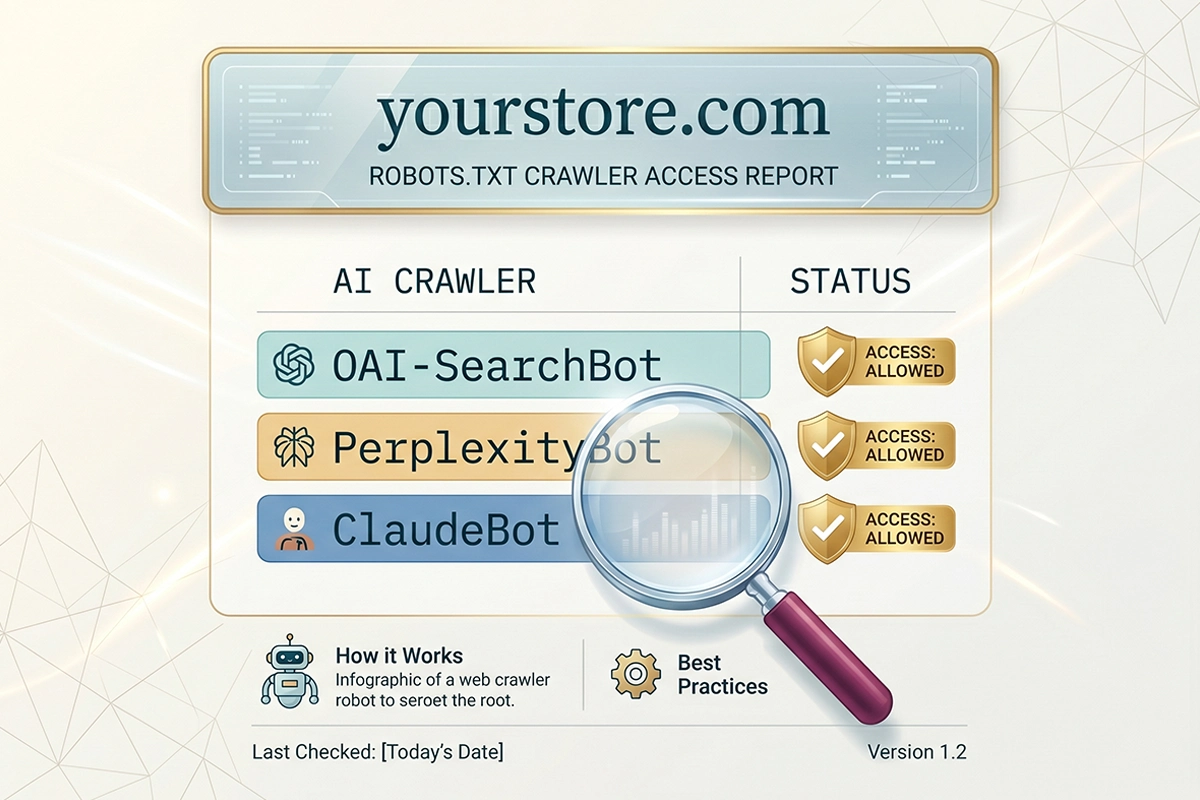
Open your store's robots.txt by adding /robots.txt to your domain, like yourstore.com/robots.txt. Scan for the crawler names: OAI-SearchBot, ChatGPT-User, PerplexityBot, ClaudeBot, Google-Extended. If any of them sits under a Disallow: / rule, that crawler cannot see you. If you do not find the names at all, you are open by default, which is the state you want.
2. Run the recommendation prompt (3 minutes)
Ask ChatGPT the question your ideal customer would ask. Not your brand name, your category. "Best affordable [your product] for [use case]." See whether you appear, who appears instead, and what the AI says about those competitors. The reasons it gives you for their recommendation are a free competitive brief.
3. Check for Organization schema (2 minutes)
Paste your homepage URL into Google's Rich Results Test or Schema Markup Validator. Look for an Organization block. If you only see Product and Breadcrumb markup, that is your gap. This is the single most common structured-data hole on new Shopify stores.
4. Check your external consistency (4 minutes)
Search your brand name and confirm your business details match across your site, your social profiles, and anywhere else you appear. Mismatched names, old addresses, and inconsistent descriptions make your brand harder for an AI to verify, which makes it less likely to be cited.
The Fix Order: What to Do First
Order matters here, because the cheap fixes unlock the expensive ones. There is no point writing citable content for a crawler that cannot reach the page. Work top to bottom.
| Priority | Fix | Effort | Why it comes first |
|---|---|---|---|
| 1 | Confirm AI crawler access in robots.txt | Minutes | Nothing else works if the door is locked. Cheapest, highest-stakes fix. |
| 2 | Add Organization and Brand schema | A few hours | Establishes a confirmable brand identity AI can trust and cite. |
| 3 | Move product specs into metafields | Ongoing | Lets AI extract facts cleanly instead of guessing from prose. |
| 4 | Rewrite copy to lead with citable facts | Ongoing | Gives AI specific, checkable sentences it can lift into an answer. |
| 5 | Build trust signals (reviews, consistency) | Ongoing | Compounds over time. This is the trust ramp, not a one-time task. |
The first two are close to one-time setup. The bottom three are habits. None of them require a subscription to a magic AI visibility app, whatever the ads tell you.
How Long Until You Show Up?
Not overnight, and anyone promising otherwise is selling something. AI search works on a trust ramp, the same way Google does. After you unblock a crawler, the live search bots tend to start fetching pages within a week or two. Actual citations in AI answers usually follow a few weeks after that, once the system has seen your pages consistently and built some history.
Stores that stay blocked for months are the cautionary tale. Even with objectively better content, they keep losing to stores that were consistently reachable, because the AI built its patterns around the doors that were open. Accessibility compounds. So does neglect.
For stores doing under $200K a year, this is unusually good news. You are not competing on ad budget. You are competing on whether your data is clean and your door is open, and both of those are within your control this week.
Wrapping Up
If a competitor showed up in ChatGPT instead of you, it almost certainly is not because they are bigger. It is because one of three things is true for your store: a crawler is blocked, your data is not structured for machines, or your pages offer persuasion where an AI needs plain, citable facts.
Run the 10-minute self-test today. Check your robots.txt first, because it is free and it gates everything else. Then work down the fix order: schema, metafields, citable copy, trust signals. The early wins are quick. The compounding part takes a few weeks of being consistently visible.
This is real work, and some of it gets technical fast, especially the schema and the theme-code edits. That is the point where most stores either learn it the hard way or hand it to someone. Either way, the channel is real now, the door is cheap to open, and the stores moving early are building an advantage that gets harder to displace the longer they hold it.
Want your store cited instead of your competitor?
The Studio Niza SEO and GEO service handles the crawler access, schema, and citable content that get AI assistants pointing shoppers to you. Page by page, no template fill-ins. From $499.
See how the SEO & GEO service works →Or email contact@studioniza.com if you have a specific question about your store. I read every one.
Frequently asked questions
If you're still unsure after reading these, just send the question.
Does Shopify automatically put my store in ChatGPT? +
Yes. Since the Agentic Storefronts rollout in March 2026, eligible Shopify stores are automatically syndicated into ChatGPT, Perplexity, Copilot, Google AI Mode, and Gemini with no app to install. But being listed is not the same as being recommended. Recommendation depends on your crawler access, structured data, and citable content.
Should I block GPTBot but allow OAI-SearchBot? +
For most stores, yes. GPTBot collects data to train OpenAI's models, while OAI-SearchBot indexes your pages for live use inside ChatGPT, including shopping answers. Blocking GPTBot keeps your content out of training data, and allowing OAI-SearchBot keeps you visible in the answers shoppers actually see. The two are separate, so blocking one has no effect on the other.
Do I need to pay for an app to show up in ChatGPT? +
No. Shopify ChatGPT visibility comes from crawler access, structured data, and citable content, none of which requires a paid app. Most of the work is configuration and copywriting. Apps can help with schema or audits, but they are not required to get recommended.
Why is a competitor recommended in ChatGPT instead of me? +
Usually because their data is cleaner and more confirmable, not because their brand is bigger. AI engines recommend stores they can verify through structured data and specific, checkable facts. If a competitor has clear schema and you do not, they get cited even if your products are better.
Does my store size or revenue affect whether AI recommends me? +
Not directly. AI citations go to the store with the cleanest, most confirmable data, not the largest one. A small specialty store with complete schema and specific product facts can out-cite a much bigger retailer that relies on vague descriptions and thin markup. This is one of the few channels where small stores are not at a structural disadvantage.
How do I check if my Shopify store is blocking AI crawlers? +
Open your store's robots.txt by adding /robots.txt to your domain. Look for the crawler names OAI-SearchBot, ChatGPT-User, PerplexityBot, ClaudeBot, and Google-Extended. If any of them appears under a Disallow rule, that crawler cannot reach your store. If the names are not listed at all, you are open by default, which is what you want.
Is showing up in ChatGPT the same as ranking on Google? +
Related but separate. They use different systems, though many of the same signals help both: structured data, clear content, and trust signals like reviews. A store can rank well on Google and still be invisible in ChatGPT if an AI crawler is blocked or its Organization schema is missing. It is worth checking both.
How long until my Shopify store shows up in AI search? +
After you unblock crawlers, the live AI search bots usually start fetching pages within one to two weeks, and citations in answers tend to follow a few weeks after that. AI search runs on a trust ramp, so consistent accessibility over time matters more than any single change. Stores blocked for months struggle to catch up even with better content.