
You've published a few posts on your Shopify store. Maybe five. Maybe ten. Some are 800 words, some are 1,500, and one ran to 2,800 because you got carried away. None of them rank yet, and you're starting to wonder if length is the variable you got wrong.
The honest answer about Shopify blog post length in 2026 is that it depends on the post type, but not in the hand-wavy way most SEO guides mean it. There are real ranges by intent, real data on what gets cited by AI engines, and one rule that decides everything. This post covers all three, with numbers, so you stop guessing.
If you also haven't decided on cadence, the companion post on Shopify blog SEO frequency answers that side of the question. Length and frequency are the two execution decisions most solo founders second-guess for months.
The blog post length myth most Shopify owners inherit
The "2,000 words minimum" rule comes from a real study, but it's been quoted out of context for almost a decade. Backlinko's analysis of 912 million blog posts with BuzzSumo found that long-form content earns 77.2% more backlinks than posts under 1,000 words. That finding got compressed into "longer posts rank better," which is not what the data said.
Backlinks correlate with ranking. Length correlates with backlinks. Length does not directly cause better rankings. The distinction matters because it changes what you should optimize for. You're not trying to hit a word count. You're trying to earn the links and citations that long posts tend to attract because they cover a topic thoroughly.
Google's official position has stayed the same for years. Google Search Central's helpful content guidance says nothing about word count. It says content should be written for people, demonstrate experience, and leave the reader satisfied. A 600-word post that nails the intent beats a 3,000-word post that pads.
The myth survives because it's easier to write a brief that says "make it 2,500 words" than "make it complete." Most cheap content services template-fill to a word count because that's the only deliverable they can measure. Studio Niza's 25-page Shopify SEO checklist is 2,400 words because that's what 25 pages with practical instructions take to cover. It would be worse at 3,500.
The working baseline: 1,200 to 1,800 words
For most Shopify blog posts in 2026, the working baseline is 1,200 to 1,800 words. This is the range where you can answer a buyer question completely, include the FAQ schema that AI engines now pull from, link to two or three relevant products or collections, and still finish writing in one focused afternoon.
The number isn't arbitrary. Ahrefs analyzed 174,048 pages cited in Google AI Overviews and found the average cited page was 1,282 words. The average page ranking in the top 10 organic results was 1,188 words. So the working range for both classic search and AI search clusters in the 1,200 to 1,800 zone, with the cited average sitting right at the bottom of that range.
Within this range, you have room to:
Cover the primary buyer question fully. The reader landed on your post because they typed a specific query. The post should answer it within the first 200 words, then justify itself with the next 1,000.
Add the two or three secondary questions that come up immediately after the primary one. These are the "people also ask" queries. Each gets a section.
Embed real internal links to product pages, collection pages, and adjacent journal posts. Two to four links per post is the standard, and 1,200+ words gives them somewhere natural to live.
Going below 1,000 words usually means you've skipped one of these. Going above 2,000 usually means you've padded with context the reader didn't ask for. Both are signals to Google's helpful-content systems that the post wasn't written for the reader.
Real length ranges by post type
The 1,200 to 1,800 baseline is the average. Specific post types have different intent loads, and intent decides length. Here's the working range for the five post types most Shopify stores publish, with the reasoning behind each.
| Post type | Word count range | Why this range |
|---|---|---|
| Quick-answer / FAQ posts | 500 to 900 | Single-question intent, common for "what is X" or "is X worth it" queries. Featured-snippet candidates. |
| How-to walkthroughs | 1,200 to 1,800 | Step-by-step content with screenshots or examples per step. Sweet spot for solo founders. |
| Buyer guides | 1,800 to 2,500 | Multiple criteria, considerations, and comparisons. Reader is in active decision mode. |
| Product or tool comparisons | 1,800 to 2,500 | 3 to 5 options compared across pricing, features, and use cases. Each option needs 400 to 500 words. |
| Listicles (10+ items) | 1,500 to 2,200 | 150 to 200 words per item to be useful. Less, and the list feels thin. |
| Evergreen explainers | 1,400 to 2,000 | Conceptual posts. "What is GEO?" or "How Shopify schema works." Needs depth without padding. |
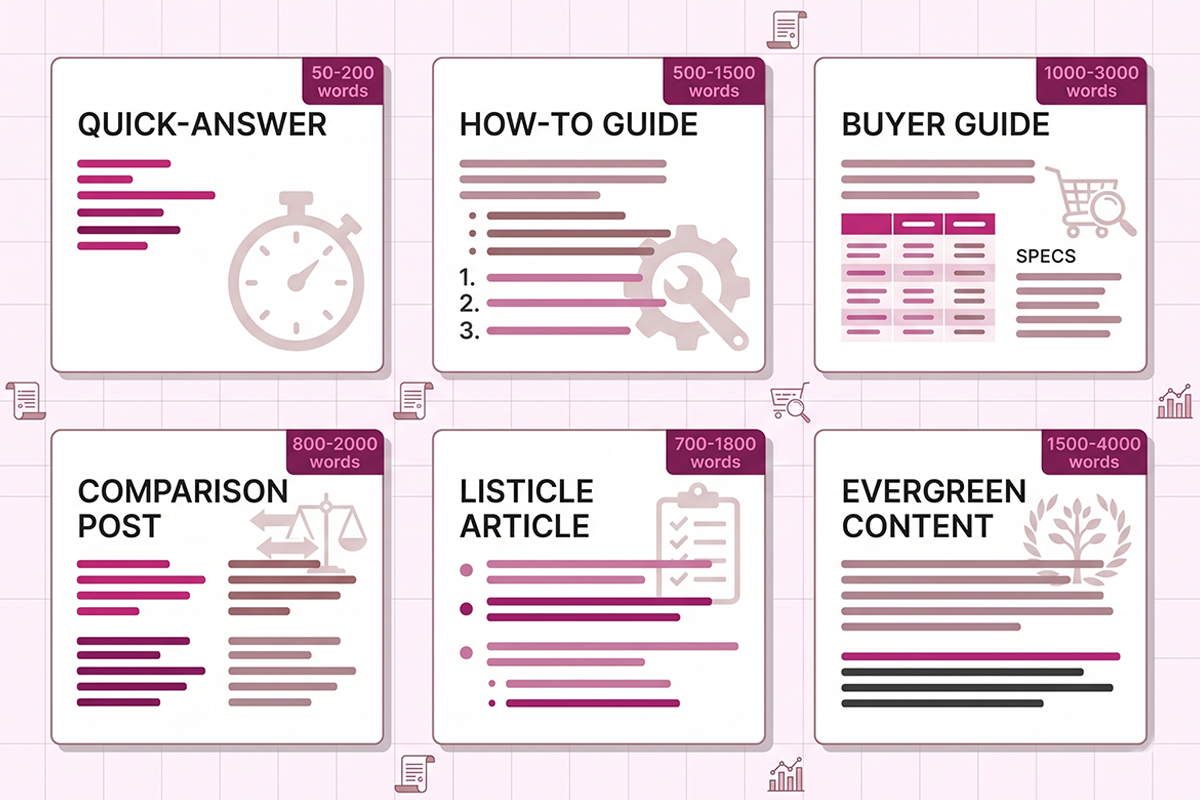
A few notes on the table. The ranges are starting points, not rules. If your buyer-guide topic only needs 1,500 words to answer the question completely, write 1,500. If your listicle covers 25 items, you're going to land closer to 3,000 because each item still needs 120 to 150 words.
The 500 to 900 range for quick-answer posts surprises most founders. They're convinced short content is dead. It isn't. Ahrefs found that 53.4% of pages cited in AI Overviews are under 1,000 words. Quick-answer posts win when the query is genuinely a quick question. The trick is not pretending a quick-answer topic is a guide.
When to go 2,500+ words (and when not to)
Some posts earn the longer length. Most don't. Here are the three scenarios where 2,500 to 3,500 words is the right call, and the trap to avoid in each.
1. The topic genuinely covers multiple sub-questions
A post titled "How to set up Google Merchant Center for Shopify" can run to 3,000 words because the setup actually has 12 steps, and each one needs its own paragraph plus a screenshot. The length is earned by the work, not invented to hit a target.
The trap: taking a quick-answer topic and inflating it with history, context, and unrelated tangents. If a section starts with "but first, a brief history of..." it should usually be cut.
2. You're targeting a high-competition keyword
If the top 5 results for your target keyword all sit between 2,500 and 3,500 words, you'll struggle to rank with 1,200. Search-intent matching is part of how Google decides what to show. Going significantly shorter than the top results signals a mismatch.
The trap: chasing length without adding new value. Hitting 3,000 words by repeating what the top 5 posts already say is the worst outcome. Either find a new angle (a different audience, a more recent data point, a specific subset of the topic) or pick a less competitive keyword.
3. The post is a pillar piece for a topic cluster
A pillar page is the central post in a cluster, linked to from every supporting article in that topic. These earn longer treatment because they're the entry point for the whole cluster. A pillar on "Shopify SEO for new stores" might run 3,500 words and link to eight shorter supporting posts.
The trap: writing a pillar before you have supporting posts to link to and from it. A 3,500-word pillar with no supporting content is just a long post. The pillar model works because of the internal-link density, not the length.
One honest observation from running content for Shopify stores: more words is also a trap when the words aren't earning their place. Daily blog sprints fail because the math doesn't work for solo founders. Padded long-form posts fail for the same reason, and Google increasingly catches them. Orbit Media's annual survey puts the average blog-post writing time around 3 hours and 48 minutes. A genuinely good 2,500-word post takes 5 to 8 hours of real work. A thin one takes 90 minutes and never ranks. Choose accordingly.
AI search rewards citation density, not word count
This is the part most Shopify owners get wrong, because the advice changed in the last 18 months and most blog-length guides haven't caught up.
AI search engines (ChatGPT, Claude, Gemini, Perplexity, Grok, and Google's AI Overviews) cite content based on how cleanly it answers a specific question, not how long it is. The Ahrefs study of 174,048 cited pages found a Spearman correlation of 0.04 between word count and citation position. That's statistically zero. More than half of cited pages were under 1,000 words.
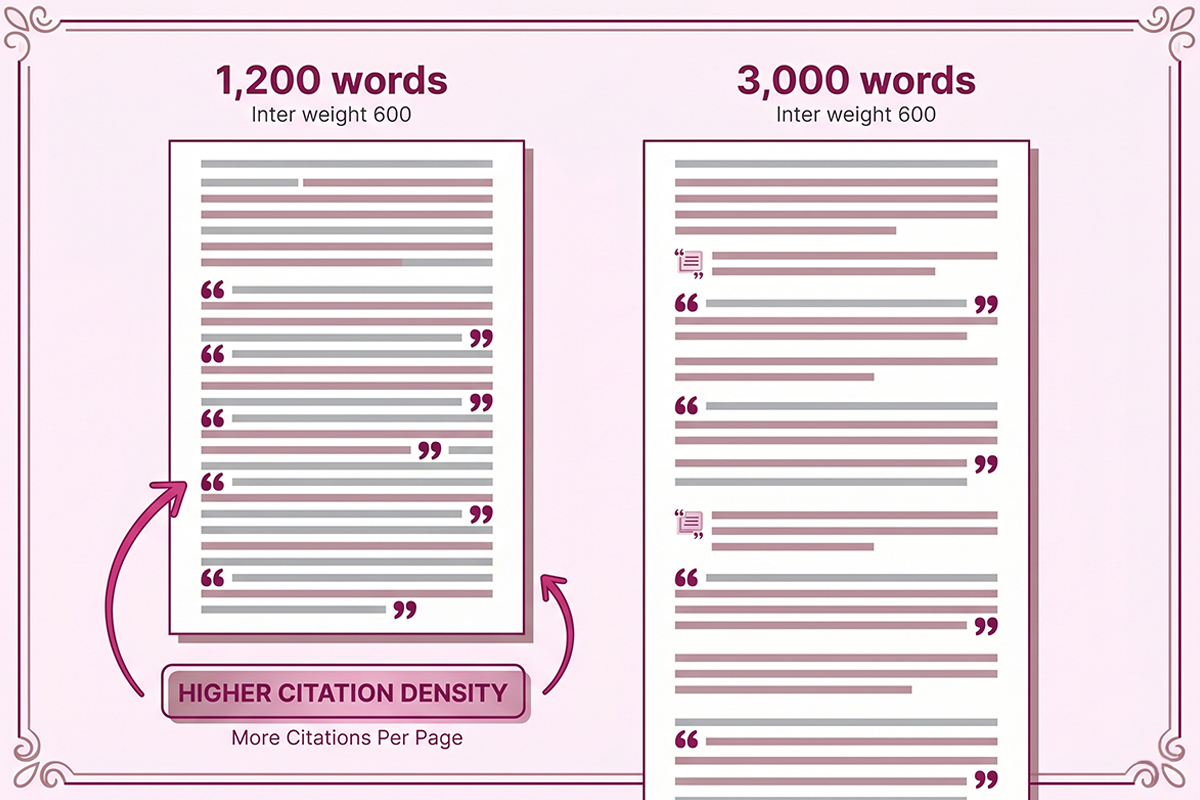
What does correlate with AI citation? Citation density. This means the number of clearly-answerable sub-questions per 1,000 words. A tight 1,200-word post with eight specific sub-questions answered (each one extractable, each one with a clean answer) outperforms a padded 3,000-word post that buries the same answers in narrative.
Three things actually drive AI citations in 2026:
Direct answers in the first 200 words. The Ahrefs guide to ranking in AI Overviews is explicit on this: don't bury the lede. Lead with the answer. Justify it after.
Clean section structure. H2s phrased as questions. Short paragraphs. Tables where they help. FAQ schema at the bottom. AI engines parse structured pages 3 to 5 times faster than wall-of-text pages.
Verifiable claims. Numbers, named tools, real prices, dated statistics. AI engines preferentially cite content with specifics they can quote without rewriting. This is part of why the Studio Niza SEO and GEO service includes schema markup and FAQ structure on every page, not just blog posts. Citation-ready content compounds across the whole site.
The practical implication for length: if you're between 1,200 and 1,800 words and you've answered 6 to 10 sub-questions cleanly, you've built a citation-dense post. Adding 800 more words of context dilutes it. AI engines see less signal per scanned token. You lose the citation to the shorter, denser competitor.
How to decide your length before you write
Three methods, in order of how much time each takes. Use the first one most of the time.
1. The top-5 competitor check (5 minutes)
Google your target keyword. Open the top 5 ranking posts. Skim each one and note the word count (most browsers' "find on page" search will roughly count if you select-all). Average them. Aim within plus or minus 20% of that average.
This is the method most professional content writers actually use. It works because the top 5 posts already match Google's read of search intent. If they're all 1,500 to 2,000 words, that's the intent zone. Yours should sit in it.
2. The intent check (2 minutes)
Read your target keyword and ask: is this a quick answer, a how-to, a comparison, or a buyer guide? Map to the table in section three above. If the keyword is "what is shopify GEO," that's a quick-answer or explainer, not a 3,000-word guide.
This method works on its own when you're confident about the intent. Pair it with the top-5 check when you're not.
3. The honest-paragraph test (continuous, while writing)
For every paragraph you write, ask: would the reader skip this without losing the point? If yes, cut it. If you can't cut it without breaking the post, keep it.
This is the only quality control that actually matters once you've started drafting. Word count is a starting target, not a finish line. The post is done when every sentence earns its place, not when the counter hits 2,000.
Wrapping up
The honest take on Shopify blog post length in 2026: aim for 1,200 to 1,800 words on most posts, go to 2,500+ only when the topic earns it, and stop worrying that 800-word quick-answer posts are killing your SEO. They aren't. Padded 3,000-word posts are.
The variable that actually moves the needle is citation density, not word count. A post that answers eight specific sub-questions cleanly in 1,400 words will out-rank and out-cite a post that buries the same answers in 3,000 words of context. Write tight. Cover the intent. Stop when the work is done.
If you're new to writing Shopify content, start with 1,400 words as your default target. Use the table above to adjust by post type. Use the top-5 check before each post. Edit ruthlessly. The first ten posts are the hardest. After that, the right length for each topic becomes obvious.
Want this written for you?
The Studio Niza blog content service handles keyword research, the right length per post type, schema, internal links, and indexing follow-up. No AI slop. Pricing starts at $449 a month.
See pricing & service details →Or email contact@studioniza.com if you have a specific question about your store. I read every one.
Frequently asked questions
If you're still unsure after reading these, just send the question.
Is 500 words too short for a Shopify blog post? +
Not always. For genuine quick-answer queries like "what is shopify schema" or "is judge.me free," posts in the 500 to 900 word range can rank and get cited. The problem is using 500 words for a topic that actually needs 1,500. If your post answers the buyer question completely at 500 words, leave it.
Does Google penalize short blog posts? +
No. Google has never published a minimum word count. The helpful content systems penalize posts that fail to answer the query, which often happens with thin posts, but length itself is not the trigger. A 600-word post that answers the question fully is treated better than a 2,500-word post that doesn't.
How long should a Shopify product comparison blog post be? +
Comparison posts comparing 3 to 5 options typically run 1,800 to 2,500 words. Each option needs 400 to 500 words covering pricing, features, fit, and a clear verdict. Going shorter usually means one of the options got short-changed, which kills the post's usefulness.
Will a 3,000-word post outrank a 1,500-word post? +
Not automatically. Longer posts tend to earn more backlinks over time, which correlates with ranking, but length alone is not a ranking factor. A 3,000-word post padded with filler will lose to a tight 1,500-word post that answers the same question better. Length is a byproduct of depth, not the cause of it.
Should I write longer Shopify blog posts to get cited by ChatGPT and Perplexity? +
No. The Ahrefs analysis of 174,000 AI Overview citations found a near-zero correlation between word count and citation, with 53.4% of cited pages under 1,000 words. AI engines reward clear, structured answers with specific claims and verifiable data. Citation density per 1,000 words matters more than total word count.
How long does it take to write a 1,500-word Shopify blog post? +
Three to five hours for a solo founder writing a quality post with real research, internal links, and an FAQ section. Orbit Media's annual survey puts the industry average at 3 hours and 48 minutes per post. AI-assisted drafts can cut writing time roughly in half, but editing and fact-checking still take the same number of hours.