
A shopper looking for "the best beginner espresso machine under $300" is not browsing. They have decided to buy. They just have not decided what. That moment is where ecommerce buying guide content earns its keep, and it is also the moment most Shopify stores leave on the table.
A buying guide is the page that answers "best X for Y" questions: best standing desk for small apartments, best running shoes for flat feet, best cat litter for odor. These searches carry high commercial intent, and they are now also the exact kind of question shoppers type into ChatGPT and Perplexity. Write the guide well and you get found in both places. Write it like a thin product roundup and you get ignored in both.
Here is the part most guides skip. You sell the products. That feels like a conflict, and a lazy guide makes it obvious. A good one does not. Credibility is a structure, not a disclaimer.
This post covers the buying-guide skeleton that ranks on Google and gets cited by AI tools, how to stay believable when you are also the seller, and how to format the page so an AI engine can lift your answer cleanly. None of it needs a bigger team. It needs one thick, careful page instead of ten thin ones. If you only have time to write a few posts this quarter, buying guides are the few to write.
What counts as ecommerce buying guide content?
A buying guide helps a reader choose between options and ends with a clear recommendation. That is the whole job. It is not a category page, not a single product review, and not a list of ten links with one sentence each.
The format that works has a recognizable shape: a short answer near the top, the criteria you used to judge, a comparison table, an honest breakdown of each pick, and a verdict for different types of buyer. A reader should be able to scan it in thirty seconds or read it in ten minutes and get value either way.
Most stores get this wrong in the same way. They publish a "top 10" post where every option is described as great, no option is ever criticized, and the store's own product happens to be number one. Readers can smell it. So can Google, which has spent years tuning for first-hand experience over recycled marketing copy.
The difference between the two is not length. It is judgment. A real buying guide takes a position. A thin roundup avoids one.
| Element | Thin product roundup | Real buying guide |
|---|---|---|
| Recommendation | Everything is "the best" | One clear pick per use case |
| Criteria | None stated | Stated up front, applied consistently |
| Tradeoffs | Hidden or skipped | Named for every option |
| Your own product | Always number one | Recommended only where it genuinely fits |
| Format | Wall of text | Scannable table plus short breakdowns |
| Who it helps | The store | The buyer first, then the store |
Aim for the right column. The rest of this post is how. If you are still choosing which guides to write, your best-selling category is usually the place to start, and there are more ways to pick in our post on blog topics that actually drive buyers.
Why do Google and ChatGPT favor buying guides?
Two things happened at once. Google kept rewarding pages that answer a question completely, and AI tools turned "best X for Y" into a primary way people shop.
Start with intent. Someone searching "best X for Y" has moved past research into decision. Comparison and "best of" content targets that commercial intent directly, which is why it tends to convert better than general how-to content. You are reaching people closer to checkout.
Now the AI side. When a shopper asks ChatGPT to help them choose, OpenAI's own description of its shopping research feature is telling: it builds side-by-side comparisons of price, features, and constraints, often as tables, by reading product pages directly and citing its sources. A well-structured buying guide is the cleanest possible source for that. It is already organized the way the AI wants to answer.
This is not a small channel. Pages that AI engines cite overwhelmingly include structured data. An SE Ranking analysis found that roughly 65% of pages cited by Google's AI Mode and 71% of pages cited by ChatGPT carried it. And the traffic converts. One analysis of the 2025 holiday season found shoppers arriving from ChatGPT converted at close to 1.7 times the rate of Google-referred shoppers, with higher average order value.
The takeaway is not "chase AI." It is that the same page, written once and well, now earns visibility in two places instead of one. If you want the deeper mechanics, we cover them in our guide to getting your store cited in ChatGPT, Perplexity, and Claude, and in why your store isn't showing in ChatGPT.
The buying-guide structure that ranks and gets cited
Every buying guide that performs uses roughly the same skeleton. You can reorder it slightly, but the parts do not change. Here is the shape, top to bottom.

Open with the answer
Put your top recommendation in the first two or three sentences. Name it, name who it is for, and move on. Readers who only want the answer get it immediately, and AI engines, which tend to lift the first sentence or two of a section, get a clean line to quote.
State your criteria
Before the picks, say how you judged. Three to five criteria is enough: price, durability, ease of setup, whatever actually matters for the category. Stated criteria do two things. They make the guide feel fair, and they give the reader a way to choose even when none of your picks fit them exactly.
Build a scannable comparison table
This is the part AI tools read most reliably and skimmers need most. One row per product, columns for the things buyers compare. Keep it honest by including the weak spots, not just the strengths.
| Pick | Best for | Standout strength | Main tradeoff | Price |
|---|---|---|---|---|
| Option A | First-time buyers | Easiest setup | Fewer features | $ |
| Option B | Heavy daily use | Most durable | Heavier and pricier | $$$ |
| Option C | Tight budgets | Lowest price | Shorter warranty | $ |
That structure works for almost any category. Swap the columns to fit what your buyers actually weigh, and use a real table, not a screenshot, so the data stays readable to both people and machines.
Break down each pick in two or three sentences
After the table, give each option a short, specific write-up: what it does well, who it is for, and the one thing that might make a buyer pass. Specific beats glowing. "Holds a charge for about two days of normal use" is more persuasive than "amazing battery life."
End with verdicts by buyer type
Close with a few one-line verdicts. "On a tight budget, pick A. If you will use it daily for years, pick B." This is where you guide the decision without forcing it, and it is the section AI tools quote when a user adds a constraint like "but I'm on a budget."
How do you stay credible when you sell the products?
This is the section most store owners worry about, and it is the one that decides whether the guide works. You are recommending products you profit from, and readers know it. The fix is not to hide that. The fix is to earn trust through what you are willing to say.
Name the tradeoffs. Every product has one. A guide that admits "this one runs small, order a size up" is more believable than one that pretends the product is flawless. Naming a weakness costs you nothing and buys the reader's trust for everything else on the page.
Tell people when not to buy. If one of your products is wrong for a certain buyer, say so. "If you need this for daily commercial use, this is not the one, look at the heavier-duty option." Recommending the right fit, even when it is the cheaper item or not your highest-margin one, is the single strongest credibility move you can make. I do this with clients constantly. When a free tool fits, I tell them to use the free tool. It costs a sale and earns a relationship.
Show first-hand experience. Google formally values content that demonstrates real use of a product. If you have used, tested, shipped, or handled returns on these items, that knowledge is your advantage over every affiliate blog guessing from spec sheets. Mention the detail only an owner would know.
Include options you do not sell. A guide that only lists your own catalog is a catalog. Adding one or two honest alternatives, even a competitor, signals that the guide exists to help the reader choose, not just to sell. You can still recommend your own product where it genuinely wins.
How to format a buying guide for AI extraction
Ranking on Google and getting cited by AI overlap, but AI extraction has a few extra rules. The goal is to make your answer easy to lift cleanly, without the engine having to untangle a paragraph first.
Write answer-first. Lead each section with a complete, quotable sentence. The difference shows up fast: a section that buries its answer three sentences deep gets skipped, while one that states the answer in the first line gets quoted.
Use questions as headings
Phrase some headings the way buyers ask them. "Which option is best for small spaces?" matches a real query better than "Spatial considerations." AI tools and Google both map plain questions to answers, so the closer your heading is to the search, the better.
Keep the comparison in a real table
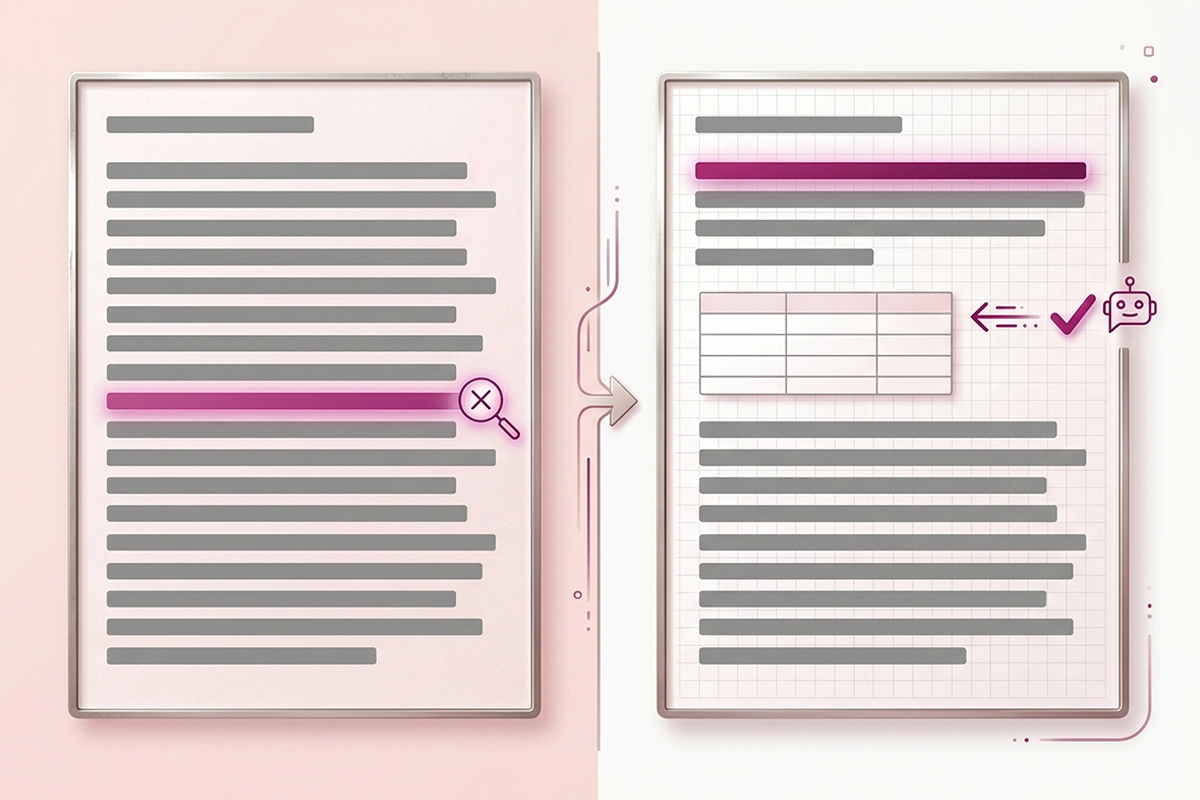
AI engines parse HTML tables more reliably than a list buried in prose. Use an actual table element, not an image of one. The data inside it is often exactly what gets pulled into a side-by-side answer.
Add the schema that matches the content
Mark up your products and reviews with structured data, and add FAQ schema for the question-and-answer section. This is the machine-readable layer AI crawlers read first. We cover the FAQ piece in detail in our post on FAQ schema, and the broader setup is part of ongoing SEO and GEO work. Structured data is no longer optional for AI visibility. It is the baseline.
A buying-guide template you can reuse
Here is the whole thing in one place. Keep it next to you the next time you write one.
1. Title it as a real query. "Best [product] for [specific buyer]" beats a clever headline. Match how people actually search.
2. Open with the answer. Top pick and who it is for, in the first two sentences.
3. State three to five criteria. How you judged, before you judge.
4. Drop in the comparison table. One row per product, honest columns, weak spots included.
5. Write two or three sentences per pick. Specific, not glowing. Name the tradeoff.
6. Close with verdicts by buyer type. Budget pick, long-term pick, small-space pick.
7. Add an FAQ. Answer the follow-up questions a buyer would ask next.
8. Mark it up. Product, review, and FAQ schema so AI tools can read it.
That is a guide you can write in an afternoon once you have used the products. It is also the kind of thick, durable page worth more than a stack of thin posts. One good buying guide can carry a category for a year. Most stores would rather publish ten forgettable posts. Write the one that lasts. If writing it yourself is the part you keep putting off, that is what the Studio Niza blog content service is for.
Wrapping up
Buying guides are one of the few pieces of content that pay off twice. They catch shoppers at the moment of decision on Google, and they hand AI tools a clean, structured answer to cite. The same page, two channels, written once.
The structure is not complicated: answer first, clear criteria, an honest comparison table, short specific breakdowns, and verdicts for different buyers. The hard part is not the format. It is the willingness to be honest when you are also the seller. Name the tradeoffs. Tell people when a product is wrong for them. Include an option you do not sell. That honesty is what makes the page believable, and believable is what gets recommended.
There is still work on your end. You have to actually know the products, which means using them, shipping them, and hearing what customers say after. You have to keep the guide current as your catalog changes. And you have to resist the pull toward a thin top-ten list that pretends everything is perfect. None of that is hard. It just takes care.
Start with one guide for your best-selling category. Write it the way you would explain the choice to a friend who asked. Put the table in. Say the honest thing. Then mark it up so the machines can read it too. One careful page is a better use of a busy week than five quick ones, and a year from now it will still be working while the quick ones are forgotten.
Want buying guides written for your store?
The Studio Niza blog content service researches and writes buying guides and comparison posts for Shopify stores, with the criteria, comparison table, schema, and internal links built in. Keyword-researched, no AI slop, from $449/month.
See blog content pricing →Or email contact@studioniza.com if you have a specific question about your store. I read every one.
Frequently asked questions
If you're still unsure after reading these, just send the question.
How long should an ecommerce buying guide be? +
Long enough to compare your options honestly and no longer. Most effective buying guides run 1,500 to 2,500 words, which is room for criteria, a comparison table, short breakdowns, and verdicts. Word count is not the goal; covering the decision completely is.
Can I write a buying guide if I sell the products I'm recommending? +
Yes, and some of the best guides come from sellers who actually use what they stock. Credibility comes from naming tradeoffs, telling readers when a product is not right for them, and including a few honest alternatives. Hiding that you sell the products hurts more than being upfront about it.
Does a buying guide need schema markup to get cited by AI? +
It helps a lot. Analyses of AI-cited pages consistently find that most carry structured data, so Product, Review, and FAQ schema make your guide far easier for AI engines to read and quote. In 2026 it is closer to a baseline for AI visibility than a nice-to-have.
How many products should a Shopify buying guide compare? +
Three to seven is the practical range for most categories. Fewer than three does not feel like a real comparison, and more than seven gets hard to scan and dilutes your recommendation. Include the options a real buyer would actually consider and leave out filler.
How is a buying guide different from a product roundup? +
A roundup lists products. A buying guide helps the reader choose one. The difference is judgment: stated criteria, named tradeoffs, and a clear recommendation for different types of buyer. Roundups inform; buying guides decide.
How long does it take for a buying guide to rank or get cited? +
Expect weeks, not days. New pages usually take a few weeks to index and a couple of months to settle into rankings, and AI citation behavior can lag behind that. Track impressions and AI referrals over several weeks rather than checking daily.