
The real question isn't VA or chatbot
If you're a Shopify owner doing 30 to 100 support tickets a week and you've just priced both a chatbot and a customer support VA, you're probably trying to choose between them. That's not quite the right frame.
The honest version of the question is: which one earns its place first, and when does the other one need to join. Almost every Shopify store that crosses 200 tickets a week ends up using both. The thing worth thinking about is which one you bring on first, given your specific ticket mix.
This post is the math behind that decision. It assumes you've already read the longer companion piece on when to add a chatbot vs hire customer support, or that you're past the "do I need any of this" stage and want to choose between the two paths now.
Three numbers shape the whole decision. Your ticket volume per week. The percentage of those tickets that are routine. And the real cost per ticket for each path. Get those three right and the answer is usually obvious. Get them wrong and you either overpay for a human or buy a chatbot that disappoints.
First, the ticket volume test
Before any cost math matters, the volume of tickets you handle each week tells you what's available to you. Most solo Shopify owners undercount their tickets because they don't include the messages on Instagram DMs and Facebook comments, only the email and contact-form ones.
Count everything for one week. Emails, contact form, Instagram, Facebook, TikTok, Shopify Inbox, SMS. That total is your real weekly ticket volume. Here's what the volume bands typically mean for stores under $500K a year in revenue:
| Weekly tickets | Who handles it | What changes |
|---|---|---|
| Under 30 | You, the founder | Neither path pays back yet. Focus on reducing tickets at the source (better product pages, clearer shipping copy, automated tracking emails). |
| 30 to 100 | The decision zone | One of the two starts to pay back. The ticket mix tells you which. |
| 100 to 200 | Chatbot first, VA next | Most stores at this band run a chatbot for routine and a part-time VA for the rest. |
| 200+ | Both, full hybrid | The chatbot handles 60 to 70 percent of routine. The VA handles complex and exceptions. |
This post is written for the 30 to 100 band specifically. If you're under 30 a week, hold off and read the section on what each tool can't do for you. If you're over 200 a week, skip to the hybrid section.
The cost per ticket math, both ways
Cost per ticket is the only number that lets you compare a fixed-cost service (chatbot, $99 a month) to a variable-cost one (VA, $20 an hour). Here's how each one actually breaks down.
What a Shopify customer support VA actually costs
The honest pricing range, by region, for a VA who can do customer support for a Shopify store in 2026:
- Philippines: $6 to $10 an hour. Shopify's own VA guide uses $8 an hour as a baseline for Philippines-based customer support.
- Latin America (nearshore): $15 to $25 an hour.
- US-based: $30 to $50 an hour. Rarely makes sense for stores under $500K a year.
For a Shopify store doing 30 to 100 tickets a week, 20 hours of VA time per week is the typical commitment. That's $480 to $800 a month at Philippines rates. Some stores stretch this to 25 hours at $200 to $250 a week, which lands at roughly $1,000 a month.
What you get for that: a real person handling tickets in their assigned hours, taking time off occasionally, ramping up over the first 30 days, and asking you questions when something is outside the documented process. They will not be working at 3am when your customer in Australia emails about a missing order.
What a chatbot actually costs
Three pricing patterns exist in the Shopify chatbot market:
- Self-serve software: $39 to $279 a month. You build, train, and maintain the bot. No setup, no monitoring, no human in the loop on your behalf.
- Managed AI chatbots: $99 to $300 a month, with a one-time setup fee from $400 to $2,000. The vendor builds it, trains it on your store, monitors performance, and tunes it monthly.
- Enterprise platforms: $500 to $2,000+ a month. Built for stores doing $1M+ a year. Out of scope for this comparison.
For a managed AI chatbot at $99 a month, the math behind that price is reasonable, not a loss leader. The honest breakdown is roughly: AI platform fee ($15), AI credits used ($5 to $15), studio monitoring time of 1 to 2 hours a month at internal rates ($30 to $60), plus tools and buffer (about $15). Total cost to deliver lands at $65 to $105 a month. Margin at $99 is 15 to 30 percent. That's typical of a managed software service, not extraordinary.
What you don't get for $99 a month: a custom integration to a non-standard fulfillment system, multi-language support (usually an add-on), or instant onboarding. Setup time is typically 7 to 14 days.
Cost per ticket comparison
The ecommerce industry baseline for handled tickets is $2.70 to $5.60 per ticket, according to MaestroQA's call center cost study. AI-handled tickets typically cost much less. Industry data compiled by Fullview puts AI chatbot interactions at around $0.50 each compared to about $6 for human-handled interactions. That's a 12x gap.
Plug your own numbers in. Here's what 60 tickets a week (260 a month) looks like both ways for a Philippines-based VA at $8 an hour and a managed chatbot at $99 a month:
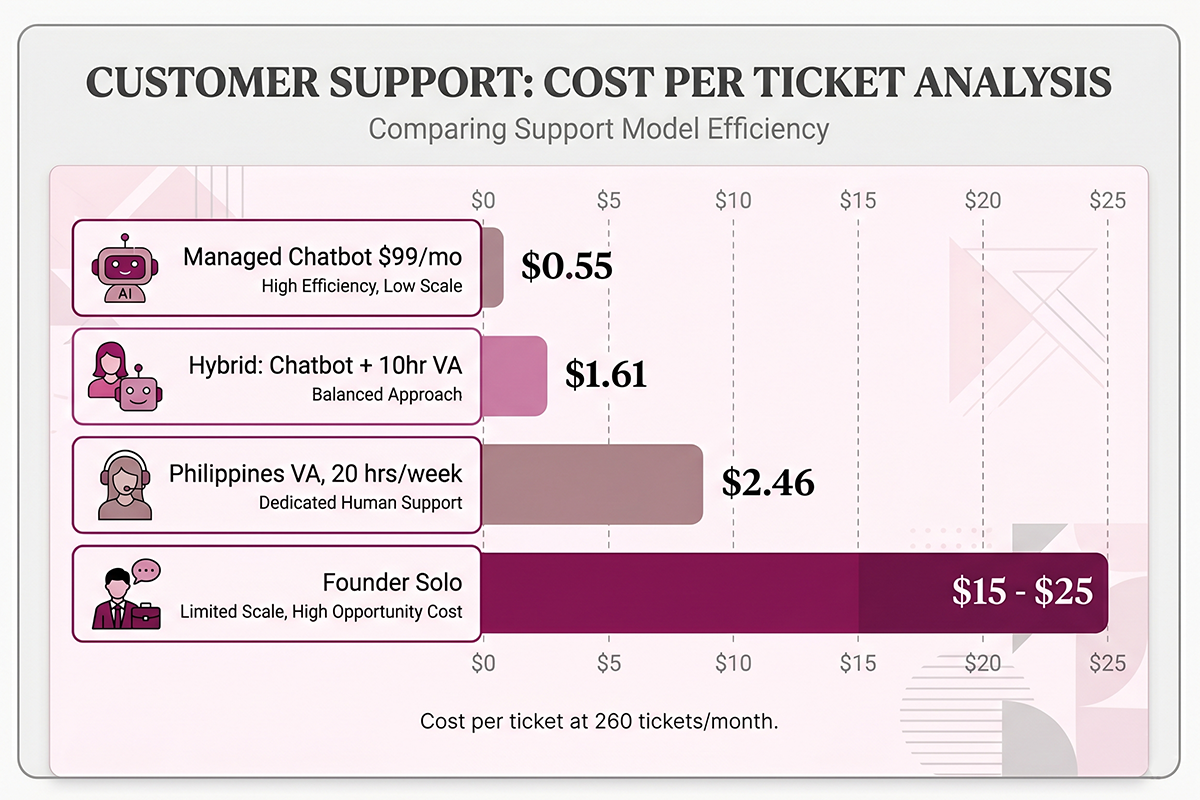
| Path | Monthly cost | Tickets handled | Cost per ticket |
|---|---|---|---|
| Founder handles it | $0 cash, 8 to 12 hours a week of your time | 260 | $15 to $25 at your real hourly value |
| Philippines VA, 20 hrs/week | $640 ($8/hr) | 260 | $2.46 |
| Managed chatbot ($99/mo) | $99 (after one-time setup) | ~180 routine, ~80 escalated | $0.55 on automated, escalations still need a human |
| Chatbot + VA (10 hrs/week) | $99 + $320 = $419 | 260 total, hybrid | $1.61 blended |
The chatbot wins on raw cost per ticket. But that comparison only matters if the chatbot can actually handle your tickets, which is what the next section is about.
The WISMO percentage breakdown
WISMO means "where is my order." It's the single biggest category of ecommerce support tickets, and it's also the easiest one to automate.
The data on WISMO share is consistent across studies, even if the exact numbers shift by source. Bitontree's 2026 analysis reports WISMO at 40 to 60 percent of ecommerce support tickets, with each one costing $3 to $8 to resolve manually. Shopify's own guidance frames WISMO as one of the most common post-purchase inquiries. Shippy Pro puts the range at 50 to 80 percent. Whatever the exact share, it's the largest category for almost every Shopify store.
For a typical Shopify store at 60 tickets a week, that means roughly 24 to 36 of those tickets are some version of "where is my order." Add to that:
- Returns policy questions (10 to 15 percent)
- Sizing or product fit questions (5 to 10 percent)
- Shipping cost and timeline questions (5 to 8 percent)
- Product availability and restock (3 to 5 percent)
That's the routine bucket. On a typical Shopify store, it's 60 to 75 percent of all incoming tickets. Every single one of those questions has a known answer. The customer just can't find it, or doesn't trust it, or finds it easier to ask a person.
Modern AI chatbots, when integrated with your Shopify order data, resolve about 70 to 75 percent of WISMO tickets without escalation. That number assumes good fulfillment tracking and reasonable shipping promises. If your tracking data is messy or your shipping timelines are wildly optimistic, the bot will pass more to humans. That's the chatbot doing its job, not failing.
The 60 percent rule: when to automate first
Here's the rule that actually decides this for most stores. If 60 percent or more of your tickets are routine, a chatbot pays back before a VA does. Below 60 percent routine, the math leans toward a human-first approach.
To use the rule, you need to count your tickets honestly. A simple one-week audit gets you most of the way there. Open a spreadsheet with three columns: type of question, channel, and time to answer. Fill it in as tickets come in for seven days.
Routine tickets, for this audit, include any of:
- "Where is my order" or any version of order tracking
- Shipping cost or timeline questions
- Returns policy or how-to-return questions
- Sizing, fit, or product specification questions
- Product availability or restock questions
- Discount or promo code questions
- Account login or password questions
Complex tickets are everything else. Refund disputes, damaged item complaints, custom order requests, B2B bulk inquiries, anything emotional, anything that mentions a person by name.
If the routine bucket is 60 percent or more of your week, a chatbot earns its place first. If it's under 60 percent, you're probably running a higher-touch store and a human (VA or in-house) will give you more value per dollar in month one.
What 60 percent looks like across store types varies. A fashion store with simple sizing and fast shipping typically lands at 65 to 75 percent routine. A skincare brand with ingredient questions lands at 50 to 60 percent. A custom jewelry store at 30 to 45 percent. A regulated supplement brand at 25 to 40 percent. Match yours to one of those mental models if a full audit feels too much to start.
What each one can't do for you
Both paths have honest limits. Knowing them protects you from buying the wrong thing first.
What a chatbot can't do
A chatbot is a copy-paste engine that's been trained to find the right snippet for a question and personalize it with order data. It does that very well for routine questions. It does not do:
- Anything emotional. An angry customer wants to talk to a human. A grieving customer who ordered a gift that didn't arrive in time wants a human. The chatbot should escalate these immediately, not try harder.
- Exception handling. Lost packages, carrier mistakes, damaged items, wrong items shipped. These need judgment on the resolution and authority to make it happen.
- Refund disputes. Even with a clear policy, a chatbot should not be making the call on a contested refund.
- Custom requests. "Can you ship without the gift receipt?" "Can you delay shipping by a week?" These are one-offs that need someone with access to the order to actually do the thing.
- Brand-defining conversations. A VIP customer reaching out, a press inquiry, a wholesale request. These deserve a person.
Plan for the chatbot to escalate 25 to 30 percent of conversations. That's normal. A chatbot that escalates fewer than 15 percent is probably making bad guesses on hard questions. A deeper look at what AI chatbots for Shopify actually do covers the integration patterns and the limits in more depth.
What a VA can't do alone
A customer support VA gives you a real person, with all the upsides and downsides of that. They cannot do:
- 24/7 coverage. One VA covers their assigned hours. Your customer in Sydney emails at 2am your time, you're waiting until tomorrow.
- Instant response. Even a fast VA averages 30 minutes to a few hours on reply time, depending on their workload and your timezone overlap. The average shopper expects 10 minutes or less for routine questions.
- Scaling with traffic spikes. When you run a sale or get on TikTok, your tickets can 5x in a day. A VA on a 20-hour-a-week contract cannot absorb that overnight.
- Zero ramp-up. A new VA needs 30 to 60 days to understand your products, your tone, and your edge cases. The chatbot is trained once and is done.
None of these are dealbreakers. They're just the honest tradeoffs. A solo VA is a good fit when your tickets need judgment more than they need speed.
The hybrid path most stores end up on
Past about 200 tickets a week, almost every Shopify store ends up on a hybrid setup. The math is just better.
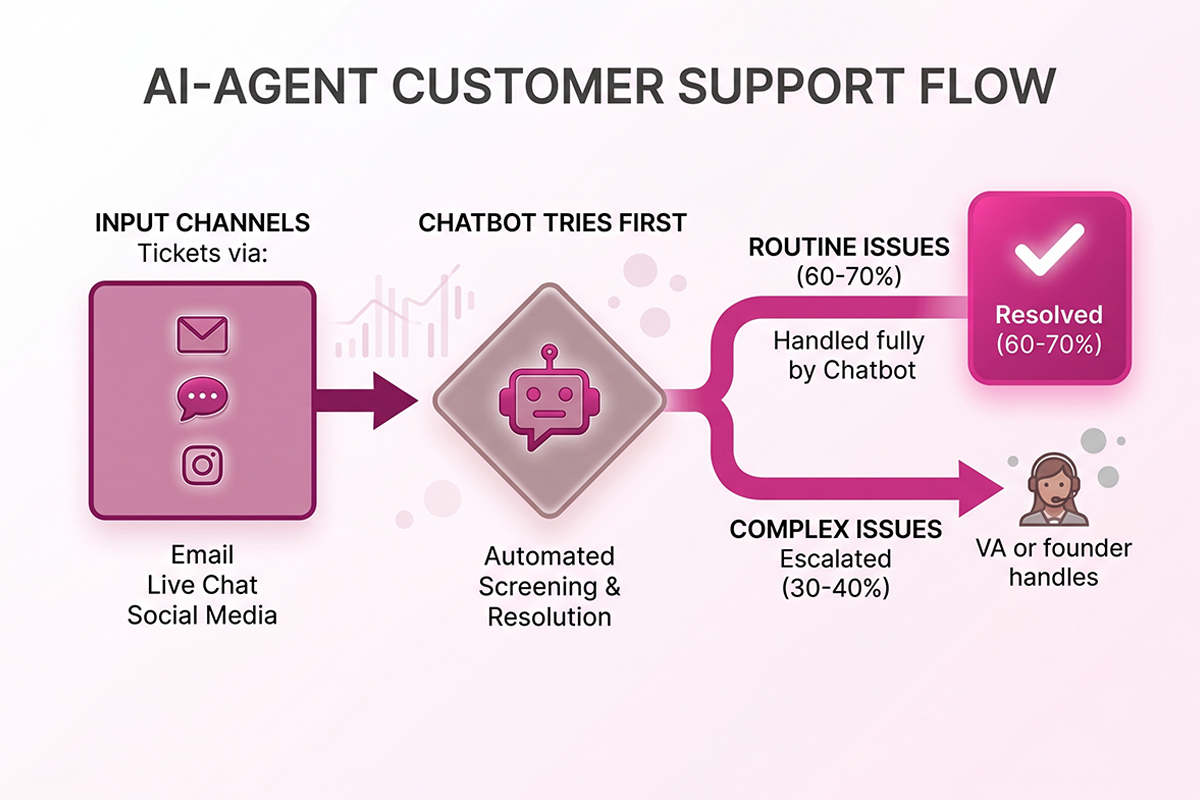
How the hybrid actually works:
- A ticket comes in (email, chat, Instagram DM, contact form).
- The chatbot tries first. If it's a routine question with a clear answer, it handles it and resolves the ticket. About 60 to 70 percent of total tickets get resolved this way.
- If the chatbot can't resolve it (low confidence, sensitive topic, custom request), it routes to a human queue. The human is your VA or you.
- The human handles the 30 to 40 percent that need judgment.
For a store doing 260 tickets a month, a chatbot at $99 + a 10-hour-a-week VA at $320 lands at $419 a month all-in. That's $1.61 per ticket blended. Compare that to a 20-hour-a-week VA alone at $640 a month ($2.46 per ticket) or a 30-hour-a-week VA at $960 ($3.69 per ticket). The hybrid wins on cost and also gives you 24/7 coverage on routine questions.
The order matters too. Most stores who hire a VA first then add a chatbot find the VA's hours can be reduced once the bot is live. Stores who add the chatbot first then bring on a VA find the VA spends their time on real problems instead of "where's my package." Both work. Chatbot first is usually less risky for stores in the 30 to 100 weekly band because the financial commitment is lower and the deflection rate is predictable.
Wrapping up: the honest call
For most Shopify stores doing 30 to 100 tickets a week, with 60 percent or more of those tickets routine, a chatbot first is the right call. It deflects the boring questions for $99 a month, you keep your time, and you wait to add a VA until ticket volume or complexity grows.
For stores with mostly complex tickets (custom orders, luxury, B2B, regulated products), a VA first is the right call. Get a real person who can build judgment for your store. Add a chatbot later, when routine ticket volume warrants the automation.
For stores doing 200+ tickets a week, run both. The hybrid setup costs less per ticket than either approach alone past about 200 tickets a week, and it gives you 24/7 coverage on routine questions without burning out a human.
Whatever you pick first, the rest of the time you spend should be on the source of tickets, not on handling them faster. Better product pages, clearer shipping copy, automatic tracking emails, an honest FAQ. Tickets you never get cost zero dollars and require zero judgment. That's still the best deal in customer support.
Want a chatbot scoped for your actual ticket volume?
Studio Niza's Basic chatbot tier covers Shopify-integrated WISMO, FAQ, and product-question handling, with weekly monitoring and tuning. Setup from $599, then $99 a month. No long contract.
See chatbot pricing & scope →Or email contact@studioniza.com if you have a specific question about your store. I read every one.
Frequently asked questions
If you're still unsure after reading these, just send the question.
Is a chatbot cheaper than a Shopify customer support VA? +
At similar coverage, yes for routine tickets. A managed chatbot at around $99 a month handles unlimited routine WISMO and FAQ tickets. A VA at $400 to $800 a month handles roughly 80 to 160 tickets at typical pace. Cost per ticket favors automation once you are past about 100 tickets a week and most of them are routine.
How many tickets a week justifies a Shopify chatbot? +
Roughly 30 or more tickets a week when at least 60 percent of them are routine, like order status, shipping cost, sizing, and returns policy. Below that, the founder can still handle it solo. Above 100 a week, both a chatbot and a human are usually needed.
Can a chatbot really handle WISMO tickets for Shopify? +
Yes, when it is integrated with Shopify order data and your fulfillment tracking. Modern AI chatbots resolve roughly 70 to 75 percent of WISMO tickets without escalation. They cannot handle messy ones like lost packages, carrier exceptions, or refund disputes. Those still go to a human.
What does a Shopify customer support VA cost per month? +
For 20 hours a week at Philippines rates of $6 to $10 an hour, expect $480 to $800 a month. Nearshore Latin America rates run $15 to $25 an hour, so $1,200 to $2,000 a month for the same hours. US-based VAs are $30 to $50 an hour and rarely make sense for stores under $500K a year in revenue.
Should I get a chatbot or VA first for my Shopify store? +
If 60 percent or more of your tickets are routine, a chatbot first usually pays back faster. If most of your tickets are complex (luxury, custom orders, B2B, regulated products), a VA first makes more sense. Most stores at 30 to 100 tickets a week start with the chatbot.
Do most Shopify stores end up using both a chatbot and a VA? +
Yes, past the first year. The chatbot handles 60 to 70 percent of routine tickets. The VA or founder handles the 30 to 40 percent that needs judgment. This costs less than either approach alone once volume passes about 200 tickets a week.