
You wrote your product descriptions off the spec sheet. The supplier sent a paragraph, you tidied it up, maybe added a line about free shipping, and moved on to the next SKU. It reads fine. It also reads like every other store selling the same thing.
Meanwhile, your customers have been writing better copy than you for months. It is sitting in your reviews: the exact words they use for what the product fixed, the worry they had before buying, the small thing that surprised them. Most store owners never read past the star rating.
This post is about closing that gap. You will learn how to use reviews in product descriptions the right way. How to mine your reviews for the precise phrases buyers use, where to weave them in without faking a testimonial (there is a real FTC line here, and it matters), and why borrowing customer language also helps your pages show up in AI search.
This is the review-led companion to the post on writing product descriptions that rank on Google. That one starts from keywords. This one starts from the words your customers already gave you.
You do not need 500 reviews to do this. If you have 20 on a single product, you have enough to start. The work is mostly reading, then rewriting a few lines. Let us get into it.
Why manufacturer-style descriptions quietly lose sales
Manufacturer-style descriptions lose sales because they answer questions nobody asked. A spec sheet tells the shopper what the product is. It rarely tells them what it does for someone like them, in the words they would use themselves.
"Moisture-wicking polyester blend" is accurate. "Stopped my back from sweating through on the bus" is what the buyer is actually worried about. The first is a fact about the fabric. The second is the reason someone clicks add to cart.
That gap costs you, because reviews are the strongest social-proof lever on a product page. Research summarized from the Spiegel Research Center found that products with five or more reviews are far more likely to be purchased than products with none, and the first handful of reviews carry the biggest lift because they remove doubt at the exact moment it matters. Shoppers read reviews because the brand's own copy is suspect by default. They trust other buyers more than they trust you.
Here is the part most stores miss. You can capture some of that trust inside the description itself, before the shopper ever scrolls to the review section, by writing in the same language your reviewers use. You are not replacing reviews. You are making the description sound like it was written by someone who actually owns the thing.
New stores fall into manufacturer-voice copy for a sensible reason: it is faster, and the supplier already wrote it. The problem is that hundreds of other stores got the same paragraph. Identical copy gives Google nothing to tell you apart, and it gives the shopper nothing that feels specific to their situation.
The fix is not to write more. It is to write from a better source. That source is your own reviews.
What is voice-of-customer copywriting?
Voice-of-customer copywriting means writing your copy using the actual words your customers use, pulled from reviews, support messages, and other real feedback, instead of words you invented at your desk.
Conversion copywriters have leaned on this for years. The method is sometimes called message mining: you read what real people say about a product or problem, find the phrases that repeat, and build your copy around them. The well-known example comes from CopyHackers founder Joanna Wiebe, who pulled a headline almost word for word from how people described a problem. A CXL case study on the same approach reported a rehab center headline that drove over 400% more clicks on its main call to action after it was rewritten in the audience's own language.
It works for product pages too. One conversion copywriter reported a roughly 30% sales lift on a best-selling product page after rewriting it in customer language and testing it against the old version. The mechanism is simple. When your copy uses the words already in the shopper's head, it feels less like a pitch and more like recognition.
You are not inventing claims. You are reflecting what buyers already say. That is the whole reason this is honest and effective at the same time. You cannot write "fits true to size if you have wide feet" unless customers actually told you that. When they did, using it is just accuracy.
The shift is small but real. Instead of starting from "what do I want to say about this product," you start from "what have my customers already said about it." The second question has better answers, and they are free.
How to mine your reviews for the exact words buyers use
To mine reviews for product copy, export your reviews, read 30 to 50 in one sitting, and tag the recurring phrases into four buckets: the job the product does, the objection people had before buying, the surprise after it arrived, and the exact nouns and verbs they reach for.
That is the whole method. The value is in doing it deliberately instead of skimming.
Where to pull review language from
Your product reviews are the first place to look. If you are on Judge.me, the free tier lets you export reviews to CSV, which makes them easy to read in bulk and search for repeated words. For most Shopify stores under $200K a year in revenue, Judge.me is the reviews app I recommend, partly for this reason.
Beyond product reviews, check your store's product Q&A, your support inbox, and any post-purchase survey replies. Pre-sale questions are especially useful, because they are objections stated out loud before anyone has bought.
The four buckets to tag as you read
Read with a notepad open and sort the phrases that repeat into four columns:
- The job: what the product actually did. "Kept my coffee hot until lunch."
- The objection: the worry before buying. "I was sure it would be too heavy."
- The surprise: the unexpected upside. "The packaging was nicer than I expected."
- The exact words: the nouns and verbs they use. If five people say "cozy" and nobody says "thermal-regulating," you write "cozy."
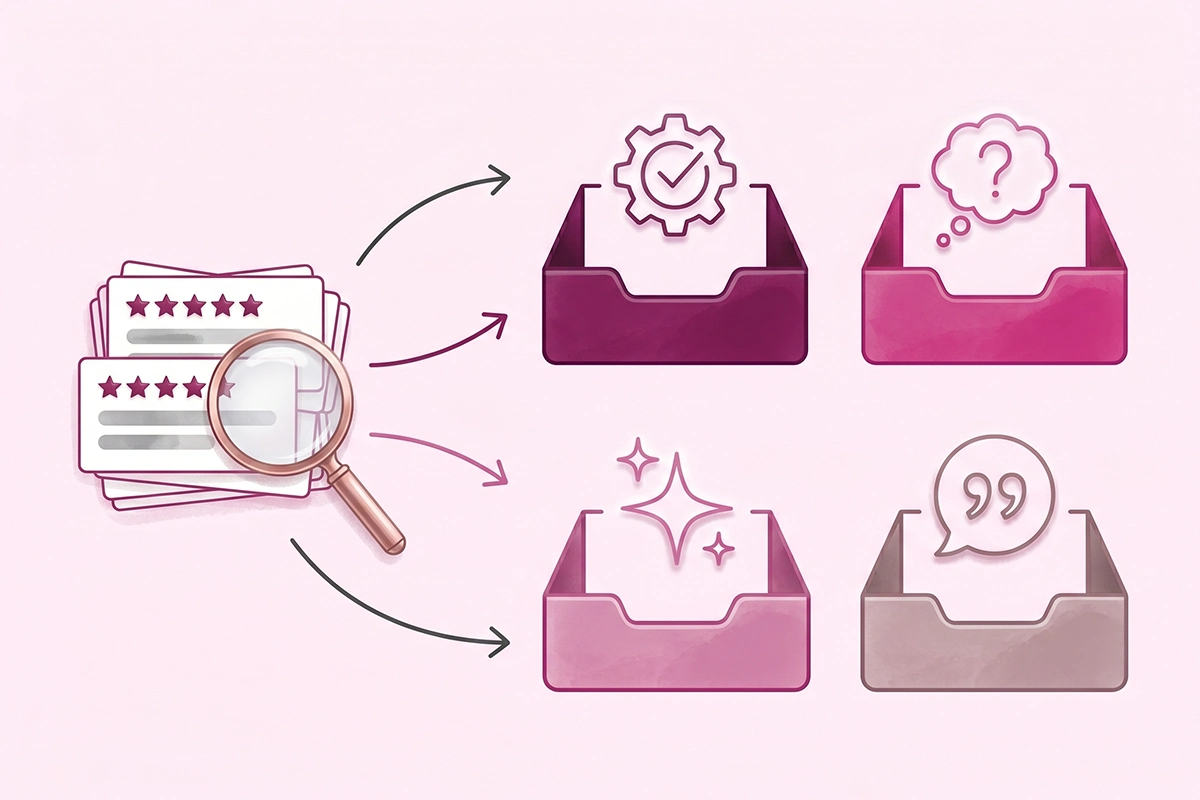
Set a realistic expectation. Reading 30 to 50 reviews and tagging them well takes 30 to 60 minutes per product. It is not instant, and anyone who tells you to automate the whole thing is skipping the part that creates the value. The upside: the patterns you find on your best seller often apply across a whole category, so the first product is the slowest one you will do.
The objection-to-bullet method
The objection-to-bullet method turns the hesitation a buyer had before purchasing into a description bullet that answers it, written in plain language drawn from your reviews.
This is the highest-return move in the whole process. Every product has two or three objections that quietly kill sales: too expensive, too complicated, will not fit, will not last, will not work for my situation. Your reviews tell you which ones are real, because relieved customers mention them. "I almost did not buy because of the price, but it has lasted two years" is an objection and its answer in one sentence.
Take that and turn it into a bullet near the top of your description. Not as a fake quote. As a plain line of copy that meets the worry head on.
| The buyer's worry | Example of what reviewers write | The bullet you write |
|---|---|---|
| It will run small | "Ordered my usual size and it was tight, get one up" | Runs small. Most buyers size up one. |
| Too expensive to justify | "Cost more than I wanted, but two years in it is still going" | Built to last. Owners report years of daily use. |
| Looks cheap in the photos | "Photos do not do it justice, feels solid in hand" | Feels more solid in person than the photos suggest. |
| Complicated to set up | "Thought I would need the manual, had it running in five minutes" | Sets up in about five minutes. No manual needed. |
The shift is easy to see side by side. A spec-sheet bullet says "Durable stainless steel construction." A review-informed bullet says "Still looks new after a year of daily commutes, going by what owners report." Same product. One answers a question the buyer was actually asking.
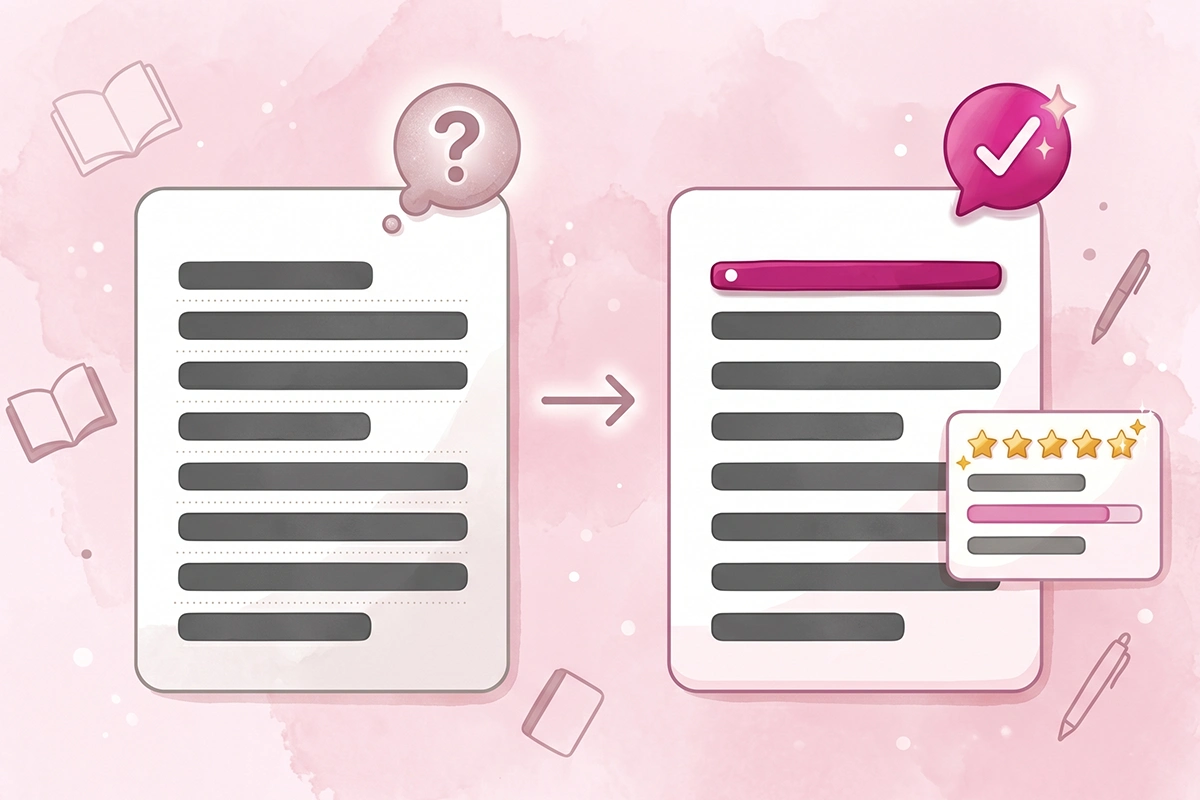
Two guardrails. Keep the bullet truthful to what reviews actually say. If only one person mentioned something, it is not a pattern yet. And do not dress it up as a direct quote unless it is one. The line you write is your copy, in your voice, informed by the pattern. That distinction is exactly where the next section comes in.
Where to weave review language in without faking testimonials
You can freely use the language and patterns from reviews to write your own product copy. What you cannot do is fabricate a quote, attribute words to a customer who never said them, or edit a real review so it means something different.
The rules here are not vague. The FTC's Rule on the Use of Consumer Reviews and Testimonials took effect on October 21, 2024, and it lets courts impose civil penalties of up to $51,744 per violation for practices like fake reviews and fabricated testimonials. The agency's Endorsement Guides, updated in 2023, add that any testimonial must reflect the honest experience of a real person.
There are three things people lump together. Separating them keeps you safe.
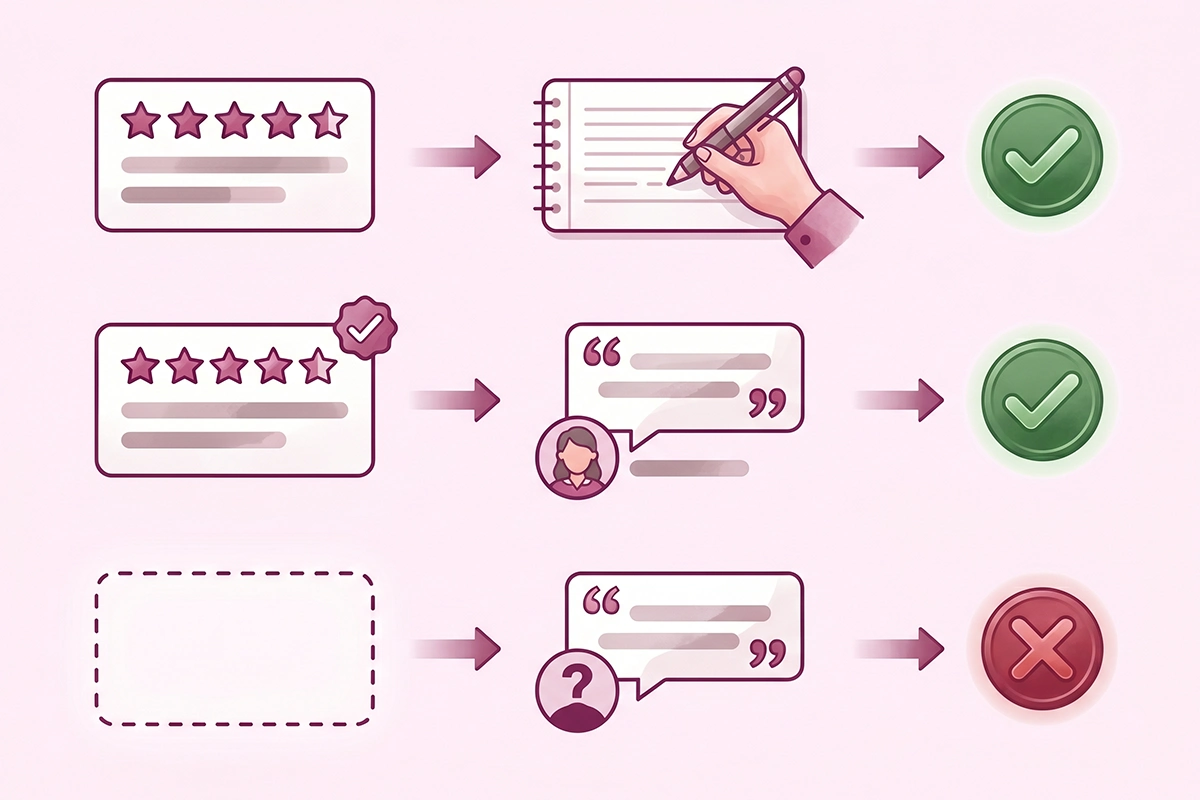
Using review language in your own copy. Fine. When you write "runs small, size up" because forty reviewers said so, that is your description in your voice. Nobody is being quoted. This is just accurate copywriting.
Quoting a real review with attribution. Fine, with care. If you pull a genuine review onto the product page as a quote, it has to be real, unedited in meaning, and something the customer actually wrote. Trimming for length is okay. Changing what they meant is not. Many stores sidestep the risk entirely by letting their reviews app display verified reviews automatically.
Writing a quote and attributing it to a customer. Not fine. Inventing "I love this!" and signing it "Sarah M." is exactly what the rule targets, even if a real Sarah would have agreed. Putting words in a customer's mouth is a fabricated testimonial, full stop.
The clean way to stay on the right side is simple. Use review language to inform your own description, and let real, verified reviews speak for themselves in the review widget. If you are also sending review requests, do it the compliant way, which I cover in the guide on asking customers for reviews without breaking the FTC rules.
How review language also helps you show up in AI search
Review language helps you in AI search because customers and AI assistants both describe products in natural, problem-first language, and your reviews are a free supply of exactly that phrasing.
When someone types into Google or asks ChatGPT, they rarely use your spec-sheet terms. They ask for "boots that keep your feet dry on a wet commute," not "waterproof footwear, men's." Your reviews are full of the first kind of language, because that is how people talk. Weaving it into your descriptions lines your pages up with how shoppers actually search.
This matters more every quarter. A 2026 Bain & Company survey found that about half of online shoppers now trust generative AI for initial product research and comparisons. AI assistants compose answers from content they can parse and match to a question, and they favor pages whose wording maps to the way the question was asked. Plain, customer-phrased copy is easier for them to use than marketing language.
This is where your reviews, your Reviews Management work, and your broader SEO and listing optimization meet. The same phrases that lift conversion also widen the set of queries your page can answer. For the full picture on getting cited by AI engines, see the guide on getting your store cited in ChatGPT and Perplexity.
One caution. This is not an excuse to stuff your description with every phrase you found. Use the language where it fits naturally, inside real sentences. Keyword-style repetition reads badly to humans and is not what AI engines reward. Natural beats dense. If you want the keyword-led side of this, writing descriptions that rank on Google covers the companion angle.
Where to start this week
Pick your best-selling product, the one with the most reviews. Read 30 of them in one sitting and tag the four buckets. Then rewrite three things: the opening line, the first two bullets, and one objection you keep seeing. That is an afternoon, not a project.
Three takeaways to keep. First, your reviews already contain better copy than you can invent, because they come from people who actually used the product. Second, using their language is honest and effective as long as you write it as your own copy and never fake a quote. Third, the same plain phrasing that nudges a hesitant shopper also helps your page get matched in Google and AI search.
What this will not do is fix a product people dislike, or manufacture reviews you do not have. The method depends on a steady stream of honest reviews to read. If you only have three reviews per product, the first job is collecting more, not squeezing the few you have. That part is a system, and it is worth setting up before you mine.
The good news is that the work compounds. The phrases you find on one product often apply to its whole category. Mine your best seller once, and you will move faster on the next ten. Your customers have been telling you how to sell to them. The least you can do is listen, and write it down.
Want a steady stream of reviews to mine?
You cannot pull language from reviews you do not have. The Studio Niza Reviews Management service keeps requests going out, every review answered, and your reviews attached to live listings so nothing gets orphaned. From $199/month.
See how Reviews Management works →Or email contact@studioniza.com if you have a specific question about your store. I read every one.
Frequently asked questions
If you're still unsure after reading these, just send the question.
Is it legal to use customer reviews in product descriptions? +
Yes. Using the language and patterns from your reviews to write your own product copy is legitimate copywriting, not a testimonial. The FTC line is about fabricated or misleading quotes: you cannot invent a review or attribute words to a customer who never said them. Write the description in your own voice and you stay well clear of any rule.
How many reviews do I need before I can mine them for copy? +
You can start with about 20 reviews on a single product, which is usually enough to spot phrases and objections that repeat. More is better for finding patterns, but you do not need hundreds. If a product has only three or four reviews, focus on collecting more before you mine.
Can I quote a customer review word for word in my product description? +
Yes, if the review is real, the customer actually wrote it, and you do not change its meaning. Trimming a long review for length is fine; editing it so it says something the customer did not is not. Many stores avoid the risk entirely by letting their reviews app display verified reviews automatically.
What is the difference between a review and a testimonial under FTC rules? +
A review is a customer's honest opinion posted where reviews are collected, like a product page review section. A testimonial is a marketing message you present as reflecting a customer's experience. Most reviews are not testimonials, but if you pay or give an incentive for a review, or feature it in your marketing copy, FTC rules treat it more like a testimonial.
Do I need a customer's permission to use their words in product copy? +
To borrow language patterns and rewrite them as your own description, no, because you are not quoting anyone. To publish a specific customer's words as a direct, attributed quote, it should be a review they genuinely submitted, and the safest practice is to rely on verified reviews from your reviews app rather than copying private messages.
What tools can I use to export my Shopify reviews for mining? +
Judge.me's free tier lets you export reviews to CSV, which makes reading them in bulk easy, and it is the default I recommend for most Shopify stores under $200K a year. Loox and Stamped also store review text you can read in their dashboards. Your Shopify product Q&A and support inbox are useful free sources too.