
You searched for a chatbot and half the results came back saying AI agent. You searched for an AI agent and the pricing pages looked almost identical to the chatbot pricing pages, except one bills per conversation and the other bills per resolution, and the gap between those two numbers is not small.
Here is what happened. Over the past year nearly every customer service vendor renamed its product an agent. Gorgias has an AI Agent. Shopify Inbox ships an Inbox agent. Fin, Chatbase, and Tidio's Lyro all use the word. Some of those renames describe a real change. Some are a new label on the same box.
The chatbot vs AI agent question matters for a Shopify store because the two tiers fail differently and cost differently. A chatbot that gets confused wastes a customer's time. An agent that gets confused can refund an order you did not want refunded, and Shopify will not hand your transaction fee back.
This post covers what the three tiers actually are, described by what they do to your store rather than by software architecture, what acting means when the store is a Shopify store, and which tier fits which situation.
The short version, if you want it now: most Shopify stores under 500 orders a month need tier two. Tier three is real and it works. It is also a cost and a risk that most stores buy before they need it.
Why every chatbot became an AI agent in 2026
Gartner put a name on this in June 2025. It called the practice agent washing: rebranding existing products, including AI assistants, robotic process automation, and chatbots, without substantial agentic capability. In the same release the firm estimated that only about 130 of the thousands of vendors selling agentic AI were building the real thing, and predicted more than 40% of agentic AI projects would be cancelled by the end of 2027 because of rising costs, unclear value, or weak risk controls.
That is the market you are shopping in. Not every product called an agent is a relabel. Enough of them are that the word on the page tells you nothing on its own.
There is a second reason the naming got messy, and this one is more sympathetic. The line genuinely moved. Two years ago the useful distinction was the older rule-based versus AI split: does the bot follow a script, or does it read what the customer wrote and answer from your own knowledge? That question is close to settled. Language models made answering cheap enough that a pure script bot is hard to justify.
So vendors needed a new word for whatever came next, and agent was sitting right there. The trouble is that it got applied to everything, including the products that had not changed.
The practical consequence for you: you cannot shop by the word. You have to shop by the verb list.
Chatbot vs AI agent: the three tiers, in plain terms
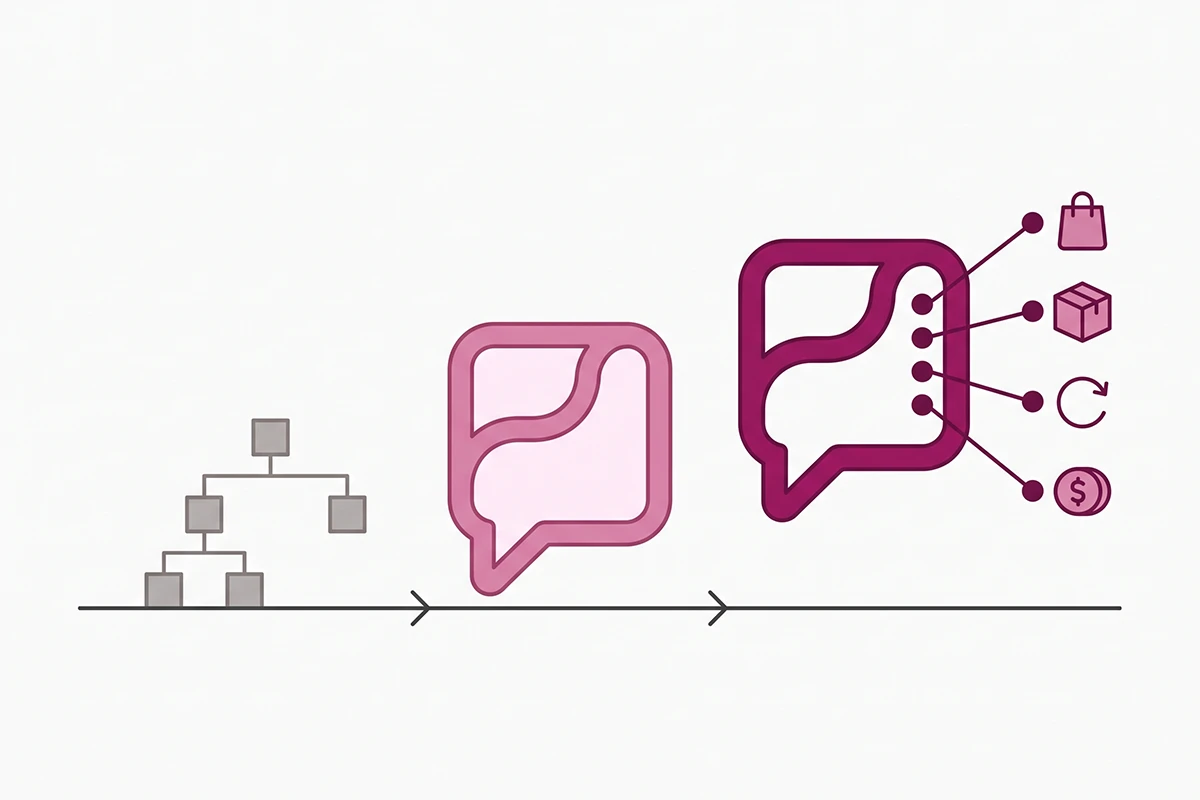
Tier one: the scripted bot
Buttons and a decision tree. The customer clicks Track my order, the bot shows a form, the form returns a status. Ask it anything the tree does not contain and it fails, usually by offering the menu again.
It has one narrow use left: a few quick-reply buttons sitting on top of something smarter. As the whole system, it is a 2019 product and you should not be paying for it.
Tier two: the AI chatbot that answers
This one reads the customer's actual question. It answers from your product data, your policies, and your published pages, and it handles phrasing it has never seen before. It can look things up, including order status, and show a customer a product.
What it does not do is change anything. Nothing in your admin is different after the conversation ends. No order is edited, no refund is issued, no address is changed. It reads and it replies.
That covers most of a small store's inbound: sizing, shipping times, return windows, is this coming back in stock, and where is my order. That last one is usually the biggest single category, which is why we broke it out in answering where is my order without a human.
Tier three: the AI agent that acts
Same reading ability, plus permission to change things. It decides a customer qualifies for a return under your policy and creates it. It cancels an unfulfilled order. It edits a shipping address before the label prints.
The architecture people write about, where the software plans, calls a tool, checks the result, and tries again, is real. But it is not the thing you are buying. What you are buying is write access to your store, exercised by software, with nobody in the room.
What acting actually means inside a Shopify store
Vendor pages say takes action. Here is what that list actually contains, roughly in order of how nervous each one should make you:
- Look up an order. Read-only. Safe.
- Add a product to a cart. The customer reverses it in one click.
- Change a shipping address. Free before the label prints. Expensive after.
- Create or approve a return. Starts a physical and a financial process.
- Cancel an order. Restocks inventory and often triggers a refund.
- Issue a refund. Moves money out.
- Modify a subscription. Changes revenue you had already counted.
Gorgias lists cancelling an order, processing a return, and modifying a subscription among the things its AI Agent can complete without a human stepping in. That is a genuine tier-three capability, described honestly. It is also a much larger decision than should I add a chat widget.
Is Shopify's free Inbox agent a real agent?
Partly, and the way it is only partly an agent is the clearest illustration of the whole problem.
Shopify's own documentation for the Inbox agent says it answers product questions, makes personalised recommendations, helps with order lookups once the customer signs in, and can add recommended products to a cart. That is tier two plus exactly one low-stakes write action.
It cannot refund, cancel, or edit an order, and it only operates inside your online store's chat widget. It is opt-in, and you can set it to handle every conversation or only the ones arriving outside your staffed hours. Shopify also puts accuracy squarely on you: the docs state that you are responsible for the information the agent gives your customers, and the notice telling shoppers they are chatting with AI is automatic and cannot be removed.
That is a sensible, well-scoped product. It is also proof that a company can ship something called an agent that performs one write action out of seven. Worth reading alongside our breakdown of Shopify's Sidekick and Magic, which are a different category again: those tools help you, not your customer.
What happens when a bot acts and gets it wrong?
There are two costs, and they compound. The first is trust, and there is fresh data on it. Gartner surveyed 3,566 customers in February and March 2026. Nearly half said they would have used a chatbot if one had been offered, but only 7% actually used one in their most recent service interaction. Only 27% said they would be willing to try a chatbot again after a negative experience. And 87% said access to a human agent is essential when a company uses generative AI in service.
Read that as a store owner rather than as an enterprise. You get roughly one attempt per customer. The Gartner analyst's phrasing is the right instruction to take away: prioritise reliability over reach. A bot that reliably handles six things beats one that attempts forty and misses.
The actions you cannot take back
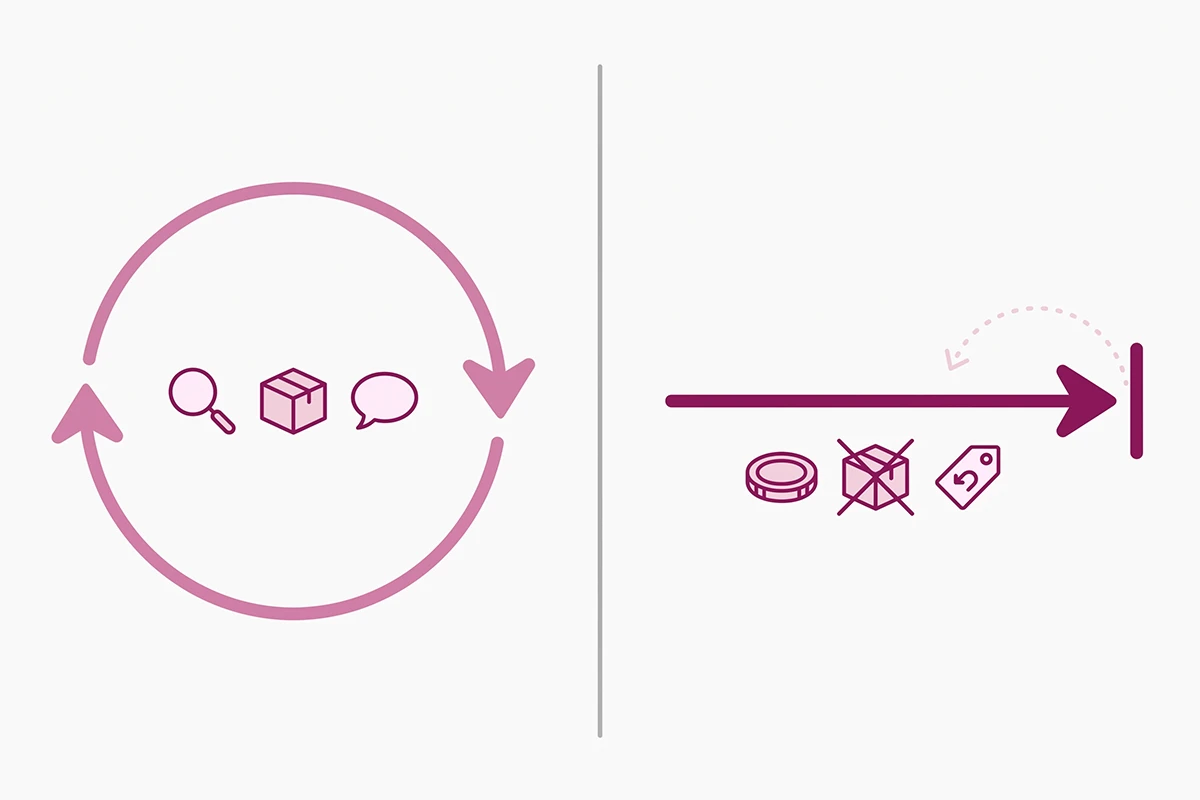
The second cost is operational, and it belongs entirely to tier three. A wrong answer is embarrassing. A wrong action is accounting. Three specifics, straight from Shopify:
- Refunds cost you the processing fee either way. Shopify's docs on cancelling orders state plainly that credit card transaction fees are not returned when you issue a refund. Every mistaken refund costs you that fee even if you recover the rest.
- Partially fulfilled orders cannot be cancelled. If your agent promises a cancellation on an order that has already partly shipped, you are in returns territory and the customer has been told something untrue.
- A completed refund does not reverse. If the agent over-refunds, recovering the money means asking the customer to pay you again. That conversation goes about as well as you would expect.
None of this means do not automate refunds. It means the guardrails are the actual product. Our post on what to automate in returns and refunds covers where those lines go: dollar ceilings, order-age windows, and the categories that always escalate to a person.
A tier-three agent without configured guardrails is not a more capable tier-two bot. It is a tier-two bot with a way to cost you money.
What a chatbot and an AI agent each cost in 2026
The billing model is the most reliable tell of tier. Better than any feature list, and faster to check.
Tier two is usually priced per month or per conversation. Tier three is usually priced per resolution, because the vendor is selling you an outcome rather than a seat.
Gorgias publishes its numbers, which is more than most do. Its AI Agent pricing page lists $0.90 per resolved interaction on most plans and $1.00 on Starter, with plans bundling anywhere from 90 to 2,500 or more automated interactions a month. Go past your bundle and overage runs $1.00 to $2.00 per interaction on monthly plans. All of that sits on top of the helpdesk subscription underneath it.
Run that for a real store. Say 300 support conversations a month and the agent resolves 60% of them on its own. That is 180 resolutions at $0.90, or $162, plus the helpdesk plan underneath. Call it $250 to $400 a month.
Shopify's Inbox agent, at the other end, is free. On Basic or above with new customer accounts turned on, it is the cheapest capable option that exists.
Studio Niza's own managed chatbot sits between those two: $599 to set up, then $99 a month. That covers hosting, monitoring, and ongoing tuning. The honest math behind the $99 is a platform cost of roughly $15 per client, $5 to $15 in AI credits, an hour or two of my monitoring time, and around $15 in tools and buffer. The margin is thin on purpose. I would rather tell you that than pretend $99 is generous.
The number that appears on nobody's pricing page is setup time for tier three: encoding your policies, scoping permissions, and testing every action path before a customer finds the gap.
Which tier does your store actually need?
| Your situation | What you need | Why | Rough monthly cost |
|---|---|---|---|
| Under 100 orders a month, you answer every message yourself | Tier two, free | The Shopify Inbox agent covers product and policy questions and lookups. Nothing to configure, nothing to break. | $0 |
| 100 to 500 orders a month, the same questions repeat, you are replying at 11pm | Tier two, managed | Same read-and-reply scope, tuned to your real policies with a clean handoff. Most stores should stop here. | $0 to $150 |
| 500 or more orders, order status dominates the queue, you have help | Tier two plus order lookup | Lookups are read-only, so you get most of the relief with none of the write risk. | $50 to $200 |
| High return rate category such as apparel or footwear, returns are the queue | Tier three, returns only | Scope the agent to one action with a dollar ceiling. Do not grant it the other six. | $200 to $500 |
| 1,000 or more orders and a support person or team in place | Tier three | The volume justifies per-resolution pricing and there is somebody to watch the output. | $400 and up |
| Subscriptions, high average order value, or made-to-order products | Tier two, humans for actions | A wrong action costs too much here. Keep the money decisions with a person. | $0 to $150 |
The honest verdict for most stores
If you are under roughly 500 orders a month, buy tier two and spend the difference on the knowledge behind it. Most of what feels like a chatbot problem is a policy problem: the return window nobody wrote down, the sizing guidance that lives in your head, the shipping estimate you improvise per customer.
Fixing that makes a tier-two bot noticeably better, and it makes any future agent safer, because an agent acting on vague policy is how the expensive mistakes happen. Then, when your queue is genuinely returns-shaped and a person is spending real hours on it, scope exactly one action. Not all seven. That is how the chatbot service here is built, and it is why the default is tier two. I would rather hand you something you can leave running than something you have to supervise.
Wrapping up
Three things worth keeping. The chatbot vs AI agent line is real, but it is not the line the marketing draws. It is not reasoning loops or memory architecture. It is whether the software can change something in your Shopify admin. Cost, risk, setup time, and whether anyone needs to watch it all follow from that single fact.
Second, the word on the vendor page is not evidence. Gartner's estimate that roughly 130 of thousands of agentic vendors are the real article should make you check rather than assume. Three questions get you there: which actions can it take in my store, what happens when it takes one it should not have, and is it priced per resolution or per month. The pricing model usually answers the first question before the salesperson does.
Third, for most stores reading this the answer is tier two, and that is not a consolation prize. A bot that answers well, quotes your real policies, and hands off cleanly does most of the available work. Keep Gartner's number in view: only 27% of customers will try again after one bad experience. Reliability beats reach at every size, and hardest of all when every customer counts.
The part left over is unglamorous and nobody can do it for you. Write your return policy down properly. Fix the shipping estimates. Put the sizing guidance somewhere a machine can read it. That is the input to every tier, and no agent fixes it on your behalf.
Not sure which tier your store needs?
The Studio Niza chatbot service is tier two by default. It answers from your real policies and product data, hands off cleanly, and does not touch your orders. Setup is $599 with $99/month for hosting, monitoring, and tuning. If you genuinely need order actions, I will tell you and scope them properly.
See how the chatbot service works →Or email contact@studioniza.com if you have a specific question about your store. I read every one.
Frequently asked questions
If you're still unsure after reading these, just send the question.
Is an AI agent just a chatbot with a new name? +
Sometimes it is. The honest test is whether the software can change something in your store. If it only reads your catalog and policies and writes replies, it is a chatbot no matter what the pricing page calls it. If it can create a return, cancel an order, or issue a refund on its own, the agent label is doing real work.
Does Shopify have a built-in AI agent? +
Yes. Shopify Inbox includes an opt-in Inbox agent that answers product and policy questions, makes recommendations, helps with order lookups after the customer signs in, and can add products to a cart. It cannot refund, cancel, or edit orders, and it only runs inside your online store chat widget. It is free on the Basic, Grow, Advanced, and Plus plans.
Can an AI agent issue refunds on a Shopify store? +
Some can, if you grant the app the order permissions to do it. Gorgias lists cancelling an order and processing a return among the things its AI Agent completes without a human stepping in. Before you turn that on, set a dollar ceiling and an order-age window, because Shopify does not return your credit card transaction fee when a refund is issued.
How much more does an AI agent cost than an AI chatbot? +
The billing models differ more than the totals. Tier-two chatbots are usually priced per month or per conversation, often between nothing and $150 a month for a small store. Tier-three agents are usually priced per resolution, and Gorgias charges $0.90 per resolved interaction on most plans on top of a helpdesk plan. At 300 conversations a month with a 60 percent resolution rate, that lands somewhere around $250 to $400 all in.
Do I need an AI agent if I only get 20 customer messages a week? +
No. At that volume the setup and monitoring cost more than the time you save, and one mistaken action wipes out weeks of savings. Turn on a free tier-two option, make sure your policies and sizing details are written down somewhere the bot can read them, and revisit the question when messages start arriving faster than you can answer them.
What should I ask a vendor to find out if their AI agent is real? +
Ask three questions. Which specific actions can it take in my Shopify admin? What happens when it takes one it should not have taken? And is it priced per resolution or per month? The pricing model is the most reliable tell, because a vendor billing on outcomes has to be able to define and measure one.