
The email usually arrives before your first sale does. Fifty five-star reviews for $40, delivered inside a week, verified-buyer badges included. Sometimes through your contact form, sometimes from an account with a stock photo for a face. If you launched a Shopify store this year, you have seen some version of it.
The arithmetic is tempting because half of it is real. An empty reviews widget costs you sales today. The penalty for fake reviews on Shopify feels like something that happens to somebody else, later, probably never.
That calculation was defensible three years ago. It is not now. In December 2025 the US Federal Trade Commission sent its first warning letters under its fake review rule, and by May 2026 it was in federal court over review conduct. Google added a line to its review markup guidelines in July 2026 aimed at fake and undisclosed incentivized reviews. Review apps published their own fraud procedures and started reporting confirmed cases straight to Shopify.
There is a second problem too, and it catches more honest owners than the first. Two of the three things that count as fake are things most store owners do not think of as fake at all.
What actually counts as a fake review on Shopify?
The FTC's Rule on the Use of Consumer Reviews and Testimonials took effect in October 2024. Three patterns in it matter to a small store, and only one looks like cheating from the inside.
Reviews you paid someone to write
The obvious one. Somebody who never bought your product writes a review saying they did. Whether you paid $40 for fifty or $5 for one, the rule treats writing, buying, and selling a fake consumer review the same way. The escape hatch people reach for is "but they are real people." What makes a review fake is not who typed it, it is whether that person used the product.
Reviews from friends, family, and staff
This one surprises people, and the answer has two layers pointing in different directions. The FTC's own staff guidance says a small business owner can ask family members to write reviews, so long as they clearly and conspicuously disclose the relationship. "Clear and conspicuous" carries a specific meaning here: the disclosure has to be unavoidable, meaning a reader cannot be required to click or hover to find it. A line at the start of the review qualifies.
So under federal law, disclosed insider reviews are permitted. Under your review app's rules, usually not. Judge.me's reviewer content policy goes further than the law and says reviews should not be submitted by a shareholder, employee, family member, or close friend of a merchant at all. When two rulebooks disagree, follow the stricter one, because the app holds the switch on your widget.
Reviews written by AI for a customer who does not exist
Generating a hundred plausible product reviews now costs nothing. The rule was drafted with that in mind and covers AI-generated fake reviews the same way it covers human-written ones.
Separate two things. Using AI to tidy the spelling in a review a real customer wrote and approved is editing. Generating a review from nothing, for a buyer who does not exist, is fabrication. The second is what the rule names, and the easiest of the three to catch automatically.
Four enforcers, four very different outcomes
Most advice collapses this into one vague threat: you will get caught. In practice several bodies can act, on different triggers, and the gap between them is a bad month versus a dead store.
| Enforcer | What sets it off | What happens | Getting back |
|---|---|---|---|
| FTC | Complaints, or a related investigation that started elsewhere | Warning letter, then federal suit with civil penalties per violation | Slow, legal, expensive |
| Google Search | Review markup that does not match genuine visible reviews | Manual action strips your star snippets | Fix, then reconsideration request |
| Google Shopping | Misrepresentation flag on the account | Suspension on detection, without prior warning | Appeal, but reinstatement is rare |
| Review app | Submission patterns, send velocity, trust score | Collection features restricted, then account termination | Appeal to the app, and it escalates to Shopify |
| Shopify | Escalation from the app, or direct reports | Store suspension under the platform terms | Appeal to Shopify only |

The FTC
The rule lets courts impose civil penalties for knowing violations, currently up to $53,088 each, and the FTC's business blog notes this accumulates quickly. Fifty bought reviews is not one violation.
This stopped being theoretical in 2026. December 2025 brought warning letters to ten companies over fake reviews and five-star incentives. Then in May the Justice Department, acting for the FTC, and the Illinois attorney general sued a home services company over fabricated business listings. Read the charges and one is the rule violation for seeking and using fake reviews from employees and relatives. Not bought reviews. Staff and family.
The honest read for a small store: nobody is opening a file on your 30-order candle shop this quarter. But the rule has no small-business exemption, and review conduct now turns up as an added charge inside investigations that started over something else. The risk is not that they come looking for you.
Google acts on two surfaces, and most owners think about only one. The first is your star ratings in search. In July 2026 Google added a line to its review snippet structured data guidelines telling sites not to include fake or undisclosed incentivized reviews on the page or in the markup, naming two examples: reviews not based on a genuine experience, and reviews written for money, discounts, vouchers, or free products where the incentive is not clearly and prominently disclosed. Break those guidelines and Google can issue a manual action, pulling your stars until you fix it and a reconsideration request is accepted. If stars were the point, fake reviews are the thing that removes them.
The second is Google Shopping. Fake reviews sit under the Merchant Center misrepresentation policy, which Google classes as egregious: suspension on detection with no prior warning, and reinstatement only in compelling circumstances. If free listings and Shopping ads carry part of your traffic, this is the fastest way to lose all of it at once.
Shopify and your review app
Your review app moves first, because it sees the pattern before anyone else can.
Judge.me publishes its account suspension and fraud prevention procedure, and it is specific. Review manipulation or fabrication is a listed ground for investigation. Enforcement is tiered: review requests and automated collection get switched off while the investigation runs, then, where fraud is confirmed, the account can be terminated permanently. Confirmed fraud is reported to Shopify through its official abuse escalation process, and it runs the other way too, so a store Shopify flags as high risk has review collection suspended automatically.
Shopify is the last link. Deceptive practices breach the platform terms, and Shopify decides suspension on its own with no appeal to anyone else. That outcome ends the business, not a channel.
How do fake reviews actually get detected?
Nobody reads your reviews looking for liars. Detection works on patterns across the whole set, which is why a batch is easier to catch than a single review. Four layers do most of the work.
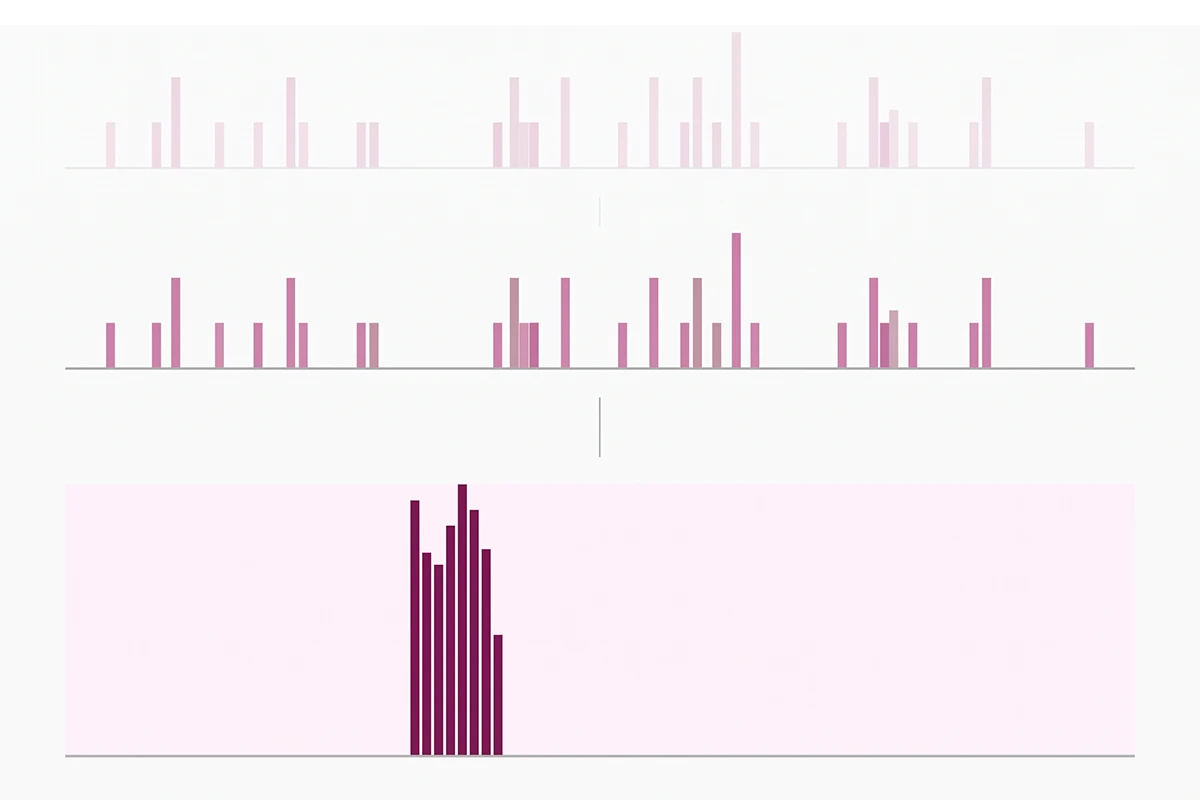
Timing and clustering. Real reviews arrive raggedly. They follow your order volume with a lag, cluster loosely around delivery dates, and leave gaps. Purchased reviews arrive in a block, because they were fulfilled as an order. Fifty reviews across four days on a store with eleven orders is not a subtle signal.
Trust scoring on the merchant. Review apps score stores dynamically and rate-limit the risky ones, watching sending velocity, bounce rates, and complaint ratios. A new store that suddenly behaves like a mature one is what that scoring exists to notice.
Language patterns. The counterintuitive part. AI-written reviews get flagged for being too average. Real reviews vary unpredictably in length, vocabulary, and sentiment because real people do, while generated text clusters near the statistical middle, because that is what the models are built to produce. Systems also check whether the emotional tone matches the star rating attached to it. Polish is a tell, not a defence.
The verified purchase gap. If your reviews are not attached to real orders in your own Shopify data, that gap is visible to your app, to Shopify, and often to shoppers through the missing verified badge. It is also the first thing an investigator asks for.
If you hire a third party and the reviews arrive implausibly fast, in unusual volume, or referring to the wrong product, failing to look into it can trigger liability under a "should have known" standard. Not asking is not the same as not knowing.
What buying reviews costs you even if nobody catches you
Set enforcement aside and assume you get away with it. Three things still happen.
You lose your instrument panel. Reviews are the cheapest product research a small store has. They tell you the sizing runs small, the packaging arrives dented, the scent is not what the photo suggests. Once part of the set is invented, you cannot tell whether a four-star average means a product problem or a shipping problem.
Shoppers read a perfect wall as managed. A hundred reviews with no criticism in them does not read as a great product. It reads as curation, and the shopper starts hunting for what is missing. The number you need before a product looks credible is lower than most owners assume, and the mix matters more than the count.
They become permanent baggage. Reviews are an asset you move. You migrate them when you switch apps, and you merge them onto a replacement listing when you retire a SKU. Fabricated ones cannot be cleanly separated later, so every future migration either carries the problem forward or throws out the genuine reviews with it.
How to spot fake reviews on a competitor's store
Useful twice over: it shows what your own review set looks like from outside, and it settles whether the competitor beating you is doing something you cannot. Six checks:
- Date clustering. Sort by newest and scan the dates. Blocks on consecutive days with dead air either side are the strongest single signal.
- Star distribution shape. Genuine sets are lopsided but not empty. All five stars and nothing else, across hundreds of reviews, does not occur naturally.
- Specificity. Real reviews mention the wrong thing: delivery, a colour that differed from the photo, how it fits their kitchen. Generic praise is cheap to produce because it can be reused.
- Reviewer name patterns. A uniform format across many reviewers, or names that do not match the store's actual market.
- Verified badge ratio. A store where most reviews carry no verified-purchase marker, on a platform that supports the badge, is telling you something.
- Plausibility against volume. Estimate their order count from social following or how long they have traded, then ask whether the review count is arithmetically possible.
What to do with it, honestly. You can report through the app's channel, and both the FTC and the apps list complaints as investigation triggers, so it is not shouting into a void. But it is slow, invisible from your side, and the same hour spent on your own review flow does more this month. If the fakes are pointed at you rather than propping up a rival, that is a different problem with a different fix: here is the walkthrough on getting a fake or defamatory review removed.
The legitimate fast start: your first 25 reviews
The $40 offer works because the alternative sounds slow. It is slower, but not as slow as you think, and four routes are open today.
Automated requests, timed properly. The highest-return fix by a distance. Most stores with an empty widget are not being ignored, they never asked. A request a few days after delivery, with a direct link and one gentle reminder, converts a real share of buyers.
Disclosed incentives that are not conditional on sentiment. The FTC does not ban incentives. It bans requiring, expressly or by implication, that the review be positive to earn the reward. "Tell us how much you loved it and get $5" is the implied version and breaks the rule. "Leave a review, honest or not, and get $5" does not. The incentive still has to be disclosed in the review itself. Full breakdown in the post on asking for reviews without breaking the FTC rules.
Product seeding with disclosure. Send the product to people outside your household, ask for an honest review, and have them state they received it free. Disclosed, honest, allowed. The disclosure is not fine print.
Reviews you already have elsewhere. Feedback sitting in your email, your DMs, or an Etsy listing is real. Ask those customers to post it properly. If you have no sales yet at all, the routes are narrower but they exist, and they are covered in getting reviews with zero sales.
One thing plainly, because it is the difference between the vendor's offer and an honest one. Nobody can promise you 25 reviews by a date. Volume depends on your order count, your product, and whether your customers were happy, and none of those are things a service controls. What can be promised is that the requests go out, on schedule, to everyone. Buying or incentivizing fake reviews is one of the few things Studio Niza refuses outright, and the reason is boring: a service that guarantees you a number is guaranteeing a number it made up.
Wrapping up
Three things to take away.
First, the definition is wider than you think. Bought reviews are obvious, but undisclosed reviews from friends, family, and staff are the version that catches otherwise honest owners, and it is the version the FTC charged in 2026. If your review app says no insiders at all, follow the app.
Second, the enforcement stack is uneven in a way that should worry you. The FTC is slowest and loudest. Your review app is fastest and quietest, and reports upward to Shopify. Google sits in the middle and can remove the exact thing the reviews were for. The chance any of them notices a small store this month is low. The cost if one does is not proportional to $40.
Third, the empty widget is a real problem and waiting is genuinely hard. That frustration is not irrational. But the fix is a request flow that runs on its own plus a few months of orders, not fifty reviews delivered on Thursday. The stores ahead of you asked earlier, not better.
If you already bought some, the useful move is not panic. Remove them, take them out of your review markup so Google is not reading them, note what you did and when, and cut off the source. That is a bad afternoon. The alternative is a bad year.
Want the slow version handled for you?
Reviews Management covers the compliant side of all this: request flows that go out on the right schedule, replies to the reviews that come back, widget and schema setup so your stars can show up in search, and migration of existing reviews when you retire or merge a listing. No volume promises, because nobody can honestly make one.
See how Reviews Management works →Or email contact@studioniza.com if you have a specific question about your store. I read every one.
Frequently asked questions
If you're still unsure after reading these, just send the question.
Does Shopify allow fake reviews? +
No. Deceptive practices breach Shopify's platform terms, and Shopify can suspend or close a store over them. Review apps enforce the same thing from their side and report confirmed review fraud to Shopify through its official abuse escalation process. Fake reviews on Shopify are also separately illegal in the US under the FTC's Consumer Reviews and Testimonials Rule.
Can I ask my friends and family to review my Shopify store? +
Two rules apply and they differ. The FTC allows insider reviews if the relationship is disclosed clearly and unavoidably, such as in the first line of the review. Most review apps are stricter and say reviews should not come from an employee, family member, or close friend of the merchant at all. Follow the app's rule, because the app controls your widget.
Is it legal to offer a discount in exchange for a review? +
Yes, with two conditions. The incentive cannot be conditional on the review being positive, expressly or by implication, so wording like “tell us how much you loved it” already breaks the rule. The incentive also has to be disclosed in the review itself so readers understand the context.
Can I write a review of my own product if I genuinely use it? +
As the owner you are an insider, so a review without a conspicuous disclosure misrepresents your relationship to the business no matter how honest your opinion is. Even with a disclosure, insider reviews that materially lift your average star rating can still be a problem, because shoppers often see only the rating. Put your perspective in your product copy instead.
What happens if I already bought fake reviews on my Shopify store? +
Remove them, take them out of any review structured data so Google is not reading them, document what you removed and when, and stop the source. Voluntary cleanup is not a legal shield, but it ends the ongoing conduct and gives you something to show if the account is ever reviewed. Then rebuild with a real request flow.
Can a competitor report my store for fake reviews? +
Yes. Complaints from consumers, competitors, and partner platforms are a documented trigger for investigation at both the FTC and the major review apps. Reports do not produce fast results, but they do create a record, and review conduct is increasingly picked up as an added charge inside investigations that started over something else.