
You published your first few Shopify blog posts, waited a month, opened your analytics, and saw close to nothing. Now you are wondering if the whole thing was a waste of time. That reaction is normal, and the honest answer to how long until blog traffic shows up is longer than anyone selling you content wants to admit.
Here is the short version. A new Shopify blog usually takes four to twelve months to produce traffic you would call meaningful, with the first real movement around month three or four and the bigger gains arriving after month six. The first eight to twelve weeks almost always look flat.
That flat stretch is not failure. It is the part of the process nobody shows you. The reason owners quit is rarely that content does not work. It is that they were told to expect results on a timeline that was never realistic, so a normal slow start feels like proof that something is broken.
This post lays out a realistic month-by-month curve for a new store, explains why the early weeks look dead, and shows you the leading indicators that tell you it is working before traffic ever shows up. Then it covers what shortens the timeline, and what makes it drag on or never happen. By the end you will know whether to keep going or change something, which is a better place to be than guessing.
The short answer: how long until blog traffic actually shows up
For a brand new Shopify store, plan on four to twelve months before blog content drives traffic worth measuring. Google's own guidance lands in the same range. In its guidance on hiring an SEO, former Google search lead Maile Ohye put the window at four months to a year to first implement changes and then see the benefit.
That range is wide for a reason. A store with a few existing links and some brand searches moves faster. A store launched last month, with no links and no history, sits at the slow end. Either way the shape is the same: slow, then slow, then a curve that starts to bend upward.
Why "it depends" is not a cop-out here
The timeline depends on three things you can partly control: how competitive your keywords are, how much real authority your domain has built, and how good and well-connected your content is. Targeting a low-competition long-tail phrase can pay off in two to three months. Chasing a head term like "best running shoes" can take a year or more, if it happens at all.
None of this means your writing is bad. It means search engines treat a young domain as unproven, and proving it takes published work plus time. That is the real cost of the channel. It is also why it compounds later, in a way paid traffic never does.
Why the first 8 to 12 weeks look completely flat
The early flatness is not random. Three things are happening at once, and none of them put visitors on your site yet.
Indexing and crawling take time
Before a post can rank, Google has to crawl it, index it, and work out what it is about. On a new store with little authority, that can take days to weeks per post, and being indexed is not the same as ranking. Google's John Mueller has noted that small changes like a new title get recrawled fairly quickly, while bigger gains in authority take months to register. If your pages are not getting indexed at all, that is a separate and fixable problem worth ruling out early.
A young domain has not earned trust yet
Google leans on signals that take time to build: links, engagement, topical depth, and domain history. A brand new page on a brand new domain has almost none of these. Ahrefs studied this directly and found that only 1.74% of newly published pages reach the top 10 within a year for even one keyword, and the average page sitting at position one is about five years old.
Page two gets almost no clicks
Here is the part that makes early traffic read as zero even when you are ranking. Almost all clicks go to the first page of results. Ahrefs found that in August 2025, 96.98% of desktop clicks happened in the top 10. So a post climbing from position 60 to position 18 is real progress that still produces almost no visits, because nobody clicks page two.
This is why month-one traffic is the wrong thing to watch. Your posts can be moving up steadily and still send near-zero clicks until they cross onto page one. The movement is the signal. The traffic is the lagging result of that movement.
A realistic month-by-month traffic curve for a new Shopify blog
Here is the shape most new Shopify blogs follow when posts are published consistently and built properly. Your exact numbers will differ by niche and price point, but the curve is the part that transfers.
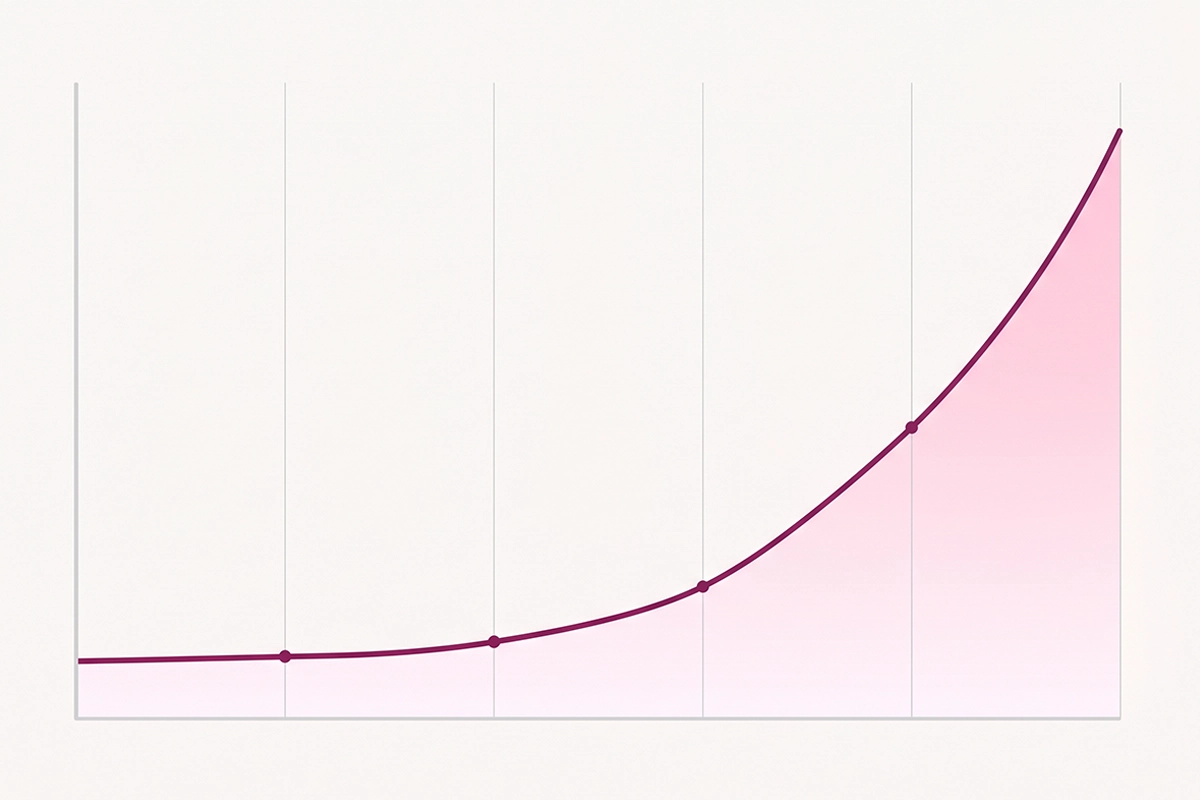
| Timeframe | What's happening | What you'll see in Search Console | What not to expect yet |
|---|---|---|---|
| Weeks 1 to 4 | First posts get crawled, indexed, and sorted | A handful of impressions, average position 50+ | Any real clicks |
| Months 2 to 3 | Posts settle into low positions, long-tail starts surfacing | Impressions climbing, average position improving | Steady traffic |
| Months 3 to 4 | A few posts cross onto page two, the strongest reach page one | First trickle of clicks, some queries under position 20 | A spike |
| Months 4 to 6 | Best posts hold page one for long-tail, clusters reinforce each other | Clicks growing week over week, more ranking queries | Head-term rankings |
| Months 6 to 12 | Compounding begins, older posts keep climbing, new posts rank faster | Meaningful, growing organic traffic | Overnight results |
Notice that the interesting changes happen inside Search Console long before they happen on your traffic graph. That gap, where the leading indicators move but the visits do not yet, is exactly where most owners give up.
The leading indicators that tell you it's working (before traffic shows)
You do not have to wait blind for six months. Open Google Search Console, which is free and the single most useful tool you own, and watch these five signals. If they are moving, your content is working even when the traffic graph is flat.

1. Impressions are climbing
Impressions count how often your pages appear in search results, whether or not anyone clicks. Rising impressions mean Google is showing your content to more people for more queries. This signal moves first, often within weeks, and it is the earliest proof of life.
2. Average position is improving
Watch your average position fall from the 50s toward the 20s, then under 10. A post moving from position 45 to position 22 adds almost no traffic, but it is the move that precedes traffic. Page three to page two to page one is the actual path, and it is visible here before it reaches your visitors.
3. More queries are showing up
A healthy young blog starts appearing for long-tail queries you never explicitly targeted. When the queries list in Search Console grows from a handful to dozens, your topical coverage is registering with Google. Breadth of queries is an early sign of depth.
4. Pages are getting indexed on schedule
Check that each new post moves into the indexed state within a week or two of publishing. Consistent indexing means your technical foundation is sound and the only missing ingredient is time. Stalled indexing is the one early problem worth fixing immediately.
5. AI engines start citing you
A newer signal worth tracking is whether ChatGPT, Perplexity, or Google's AI answers reference your store. AI engines often surface useful content faster than Google ranks it, which makes an early citation a genuine leading indicator. If you want to set this up deliberately, here is how to approach getting cited by AI search engines.
What actually shortens the timeline
You cannot skip the wait entirely. You can compress it. These four moves consistently pull the curve forward for a new store.
Build topical clusters, not scattered posts
A cluster is one broader pillar post plus several supporting posts that all link to each other around a single theme. Clusters tell Google you have real depth on a topic, and depth ranks faster than ten unrelated one-off posts. This is also why publishing two to three deeper posts a week beats a daily thin-post sprint.

Link your posts together on purpose
Internal links pass authority between your pages and help Google understand how your content fits together. New posts that link to and from existing ones rank faster than orphan pages with nothing pointing at them. A deliberate internal linking strategy is one of the few free SEO wins that genuinely moves the timeline.
Target keywords you can actually win
A young store should chase low-competition, long-tail phrases like "how to season a carbon steel pan," not head terms like "cookware." Long-tail keywords have less competition, clearer buyer intent, and rank months sooner. They are also where the early conversions hide. This is the heart of solid Shopify SEO foundations.
Write to be cited, not just crawled
AI engines reward clear, well-structured, genuinely useful answers, and they often surface content before Google ranks it. Opening each section with a complete answer in the first one or two sentences makes a post citable. That can bring referral traffic from AI answers while you wait on traditional rankings to catch up.
What makes it take longer (or never happen)
Some stores publish for a year and still see nothing. The reasons are usually the same, and they are avoidable once you can name them.
Thin or generic content is the biggest one. Posts with nothing original, no data, and no real answer rarely rank, because they give Google no reason to prefer them over the thousand near-identical posts already there. Volume without quality does not compound. It just sits there taking up space.
Publishing in isolation is the second. Posts with no internal links, no cluster, and no connection to your products read as orphans, and orphans climb slowly. The third is chasing head terms a new store cannot win, then concluding that "blogging does not work" when the real problem was keyword choice.
The most common reason is simply stopping. Owners publish for six to eight weeks, hit the flat stretch, and quit at the exact point the curve was about to bend. I tell clients this plainly: if you are not prepared to publish consistently for at least six months, the honest move is to hold off on a blog and put that time into a channel that pays sooner. The studio's Blog Content service exists for owners who want that consistency handled instead of carried alone.
What to do at month one when you see nothing
When month one looks dead, do not overhaul your strategy and do not quit. Open Search Console and check the leading indicators instead of the traffic graph. If impressions are rising and your average position is improving, the system is working and you are simply early.
Keep your cadence steady. Two to three solid posts a week beats a daily sprint you abandon by March. Build clusters, link your posts together, and target keywords a young store can win. A simple 90-day content calendar makes the consistency far easier to sustain when motivation dips.
The realistic expectation is months three to four for the first trickle, month six for steady growth, and the back half of year one for the compounding that makes the channel worth the wait. That is slower than the internet promised you, and faster than starting over. The owners who win at content are rarely the most talented writers. They are the ones who kept publishing through the flat stretch because they understood what the flat stretch actually was.
Want the content engine built so it actually compounds?
The Studio Niza Blog Content service builds the things that pull this timeline forward: topical clusters, real internal linking, schema, and indexing follow-up, not just word count. From $449/mo.
See how Blog Content works →Or email contact@studioniza.com if you have a specific question about your store. I read every one.
Frequently asked questions
If you're still unsure after reading these, just send the question.
Does a new Shopify blog ever rank faster than a year? +
Yes. Of the pages that do reach Google's top 10 within a year, Ahrefs found roughly 40% get there within the first month, usually low-competition long-tail posts on a site with some existing authority. A brand new domain targeting realistic keywords can see its first ranking posts in two to three months. The faster timelines come from keyword choice and internal linking, not luck.
How many blog posts do I need before I see any traffic? +
There is no magic number, but topical depth matters more than raw count. A focused cluster of eight to twelve connected posts on one theme usually outperforms thirty scattered posts. Most stores see their first long-tail traffic once they have a dozen or so quality posts indexed and linked together.
Why are my Shopify blog impressions going up but clicks staying at zero? +
Because your posts are ranking on page two or lower, where almost nobody clicks. Ahrefs found that around 97% of clicks go to the first page of results. Rising impressions with flat clicks is normal and actually good news: it means you are climbing and just have not crossed onto page one yet.
Should I delete blog posts that get no traffic after a few months? +
Not at a few months. Most posts have not had time to rank yet, and deleting them strips internal links and topical signals that help the whole site. Wait at least six to nine months, then update or consolidate weak posts rather than deleting them outright.
Does posting more often make my blog rank faster? +
Not on its own. Google rewards depth and usefulness over frequency, so two to three strong posts a week beat seven thin ones. Posting daily only helps if every post is genuinely good and part of a connected cluster, which is hard to sustain as a solo owner.
How long until a Shopify blog post gets cited by ChatGPT or Perplexity? +
AI engines often surface useful content faster than Google ranks it, sometimes within weeks of indexing, because they weight clarity and direct answers heavily. There is no guarantee, but well-structured posts that answer a question completely in the first sentence or two are the most likely to be cited.
What's a realistic monthly organic traffic number for a Shopify blog in year one? +
It varies too much by niche to promise a number, but a useful frame is near zero for the first three months, a slow trickle through months four to six, and steady month-over-month growth in the back half of year one. The shape of the curve matters more than any single figure.
Is it too late to start a Shopify blog in 2026? +
No. Older content does dominate search, which is exactly why starting now beats starting next year: every post needs time to age into authority. AI search has also lowered the barrier for clear, useful content to get surfaced quickly, so a well-built blog started today is an asset, not a lost cause.