
Most Loox vs Judge.me comparisons frame the choice as pretty versus cheap. That framing is wrong, and believing it will cost you money in one direction or the other.
It is wrong because Judge.me's free plan already collects photo and video reviews. The question was never "do I want visual social proof, or do I want to save money." Both apps do photos. The actual trade is narrower and more interesting: Loox's capture defaults and widget presentation against Judge.me's cost certainty.
That word "certainty" is doing real work. Judge.me charges a flat fee that never moves with your sales. Loox bills in order blocks, which means your review app invoice rises as your orders rise. If you are reading this in late August, that matters more than usual, because the month your orders triple is the month your Loox bill climbs with them.
This post gives you the numbers. Current 2026 pricing from both vendors' own pages, total cost at 100, 500, and 2,000 orders a month, where each app wins on Google Shopping and rich snippets, break-even math on whether Loox's lift covers its fee, and a verdict by store type.
One caveat before we start. I recommend Judge.me to most new Shopify stores under $200K a year, and I will show you why. But "most" is not "all," and there is a specific kind of store where Loox earns its price. If that is you, I would rather you know it than take a blanket recommendation.
What Loox and Judge.me actually cost in 2026
Start with the thing that trips people up: the price you found on a comparison site is probably wrong.
Loox restructured its plans during 2026. The Beginner tier is now free, with access to 14 review widgets and, since July 15, 2026, up to 2,000 review request emails a month. The catch is the order ceiling. Beginner supports up to 500 total orders from the end of your trial, not 500 a month. Cross that and you upgrade.
Convert is where most paying Loox stores land. It starts at $49.99 a month for the first 300 orders, and each additional block of 300 orders adds $50. The charge stops climbing at $999.99 a month once you pass 6,000 orders. Unlimited sits above it at a flat $299.99.
Judge.me has two plans and no order metering at all. Forever Free covers unlimited product and store reviews, unlimited photo and video reviews, Google rich snippets, and the core display widgets, with a small Judge.me badge on the widget. Awesome is a flat $15 a month and adds the AI features, Google Shopping and social syndication, all integrations, coupons, and full customization. A store doing 30,000 orders pays the same $15 as a store doing 300.
| Plan | Price | Order limit | What it adds |
|---|---|---|---|
| Judge.me Forever Free | $0 | None | Unlimited requests, photo and video reviews, rich snippets, core widgets |
| Judge.me Awesome | $15/month flat | None | AI features, Google Shopping, all integrations, coupons, product grouping, no branding |
| Loox Beginner | $0 | 500 orders total, lifetime | 14 widgets, 2,000 request emails/month, photo review discounts, rich snippets |
| Loox Convert | $49.99 + $50 per extra 300 orders | 300 included, caps at $999.99 | Video reviews, Google Shopping, referrals, AI suite, product grouping, no branding |
| Loox Unlimited | $299.99/month flat | Unlimited | Unlimited requests and referrals, priority support |
Why the price you found on a comparison site is probably wrong
Loox's old Scale tier, which showed up variously as $34.99 and $39.99, is legacy and closed to new stores. It still appears on directory pages, roundup posts, and cached app store listings. If you budgeted around a $35 Scale plan, that plan does not exist for you.
Check the vendor's own pricing page before you commit to either app. The same discipline applies when you look at how Loox compares to Yotpo or at Judge.me against Stamped. Directory numbers go stale within weeks. Vendor pages do not.
Your cost at 100, 500, and 2,000 orders a month
Sticker price tells you almost nothing. Your monthly order volume is the whole story, so here is the same store at three stages.
| Orders per month | Loox | Judge.me | Yearly difference |
|---|---|---|---|
| 100 | $0 for about five months, then $49.99/month on Convert | $0 free, or $15/month on Awesome | About $420 in year one |
| 500 | $99.99/month on Convert | $0 free, or $15/month on Awesome | $1,019.88 |
| 1,800 | $299.99/month, either tier | $0 free, or $15/month on Awesome | $3,419.88 |
| 2,000 | $299.99/month on Unlimited ($349.99 if you stay on Convert) | $0 free, or $15/month on Awesome | $3,419.88 |
Two rows in that table deserve a second look.
The crossover sits at 1,800 orders a month. At that volume Convert and Unlimited both cost $299.99. Above it, the tier that looks cheaper is the expensive one. Plenty of stores never rerun this math after a growth spurt and quietly overpay for months.
The annual gap is larger than most owners picture. At 500 orders a month, Loox Convert runs $1,199.88 a year against Judge.me Awesome's $180. That is a $1,019 difference for a store doing perhaps $300K in revenue, which is real money for a solo founder.
The billing pattern nobody flags in August
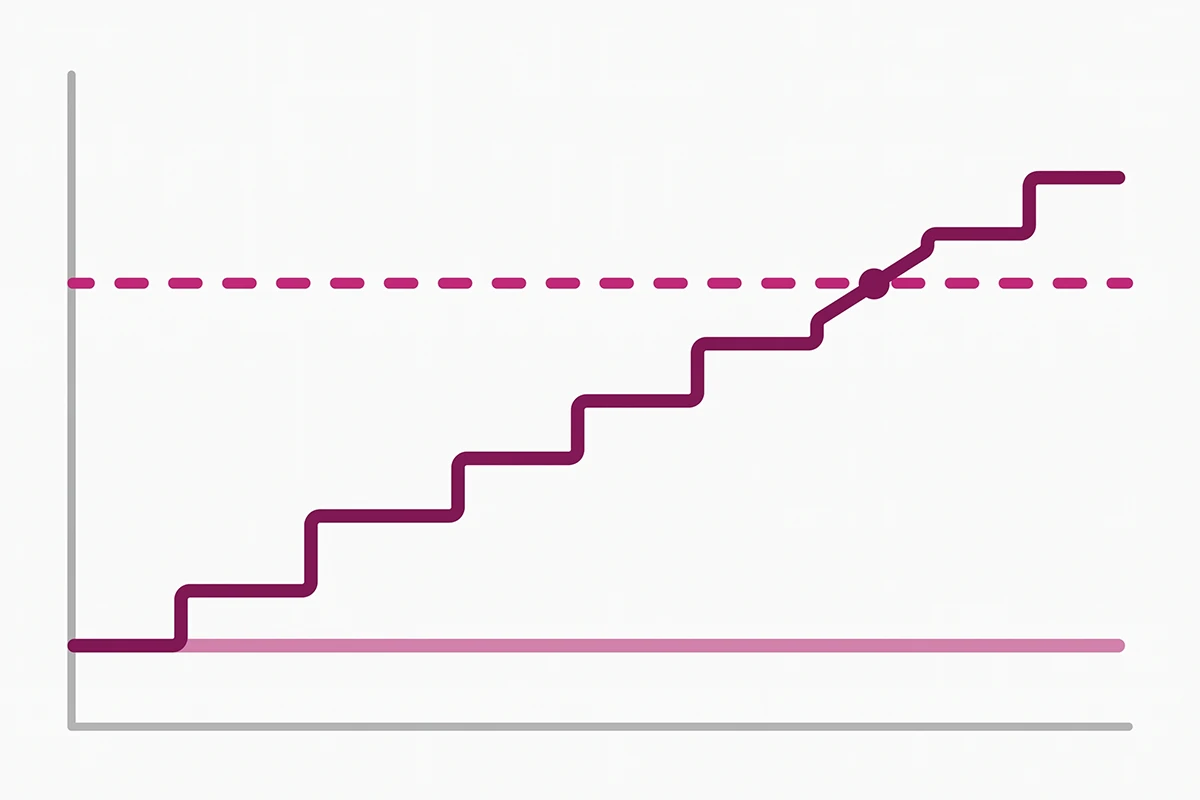
Order-block pricing has a seasonal edge to it. If you normally do 400 orders a month, you are on Convert at $99.99. Do 1,400 orders in November and that same month bills at $249.99.
Nothing went wrong there. The model worked as published. But the charge arrives after the fact, buried in a Shopify invoice alongside every other app, and it is easy to miss. If you are working through the August to November review plan, add a calendar note to check your Loox tier in the first week of November.
Does Loox actually collect more photos than Judge.me?
Somewhat, yes. The reason is a mechanic rather than magic, and understanding it changes what you should pay for.
Loox builds a discount-for-photo-review incentive into the request flow and turns it on by default. A customer who submits a photo gets a code toward their next order. That single default is the clearest capture-rate advantage Loox holds, because most stores never configure incentives themselves, and defaults decide outcomes.
Judge.me can run the same play with coupons, but coupons sit on the $15 Awesome plan and you have to set them up. Free-plan Judge.me stores usually ask for a photo and hope.
So the honest comparison is not "Loox collects photos, Judge.me does not." It is "Loox collects photos by default, Judge.me collects photos once you configure it." Configure it and the gap narrows considerably.
What the incentive actually buys you
Photo and video reviews carry more weight than text reviews, and that part is not contested. It is worth understanding what photo reviews actually do to conversion before you pay for capture rate, because the effect concentrates in categories where the shopper's real question is what this looks like on a real person, in a real room. Apparel, beauty, home decor, food.
If you sell digital downloads or replacement parts, a customer photo adds less than a specific text review does. Paying a premium for photo capture there is paying for something your buyer is not asking for.
Where Loox's widgets genuinely win
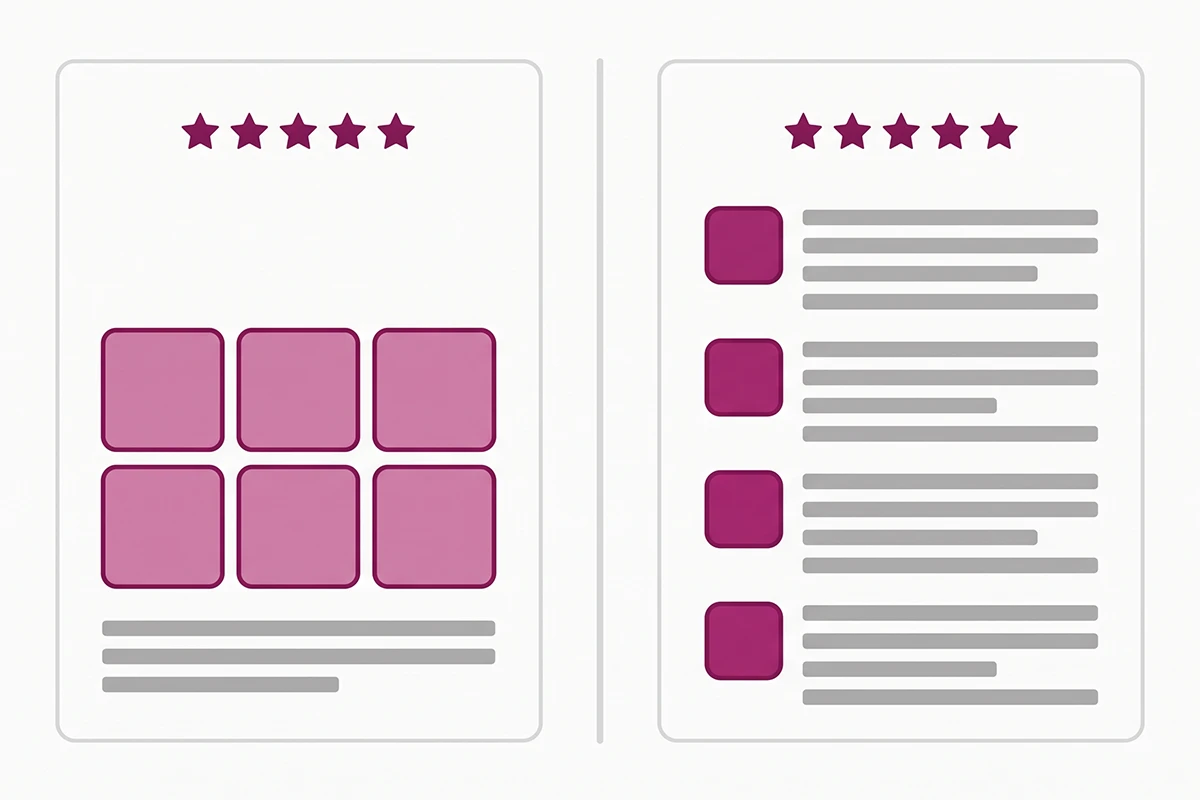
Loox widgets lead with the photo grid. The visual mass hits first and the text sits underneath it. Judge.me's default review widget leads with the text block and places thumbnails alongside. Both are customizable, Judge.me fully so on Awesome, but out of the box the Loox layout reads like a lookbook and the Judge.me layout reads like a review list.
If your product sells on how it looks, that default matters. If it sells on specs, ingredients, or compatibility, it matters much less than the price gap implies.
One asymmetry is worth naming plainly. Video reviews sit on Judge.me's free plan and are gated to Loox's $49.99 Convert tier. The app marketed on visual social proof charges more for video than the app marketed on value does.
Google Shopping, rich snippets, and where the two apps split
Both apps inject review schema into your product pages so Google can show star ratings in organic results, and both do it on their entry tier. Loox adds the rich snippets code automatically on install and notes it can take up to 30 days for ratings to appear while Google re-indexes your pages. Judge.me includes rich snippets on the free plan.
Google's requirement is identical for both apps: the rating you mark up has to be visible on the page. Schema claiming 4.9 stars on a page where a shopper cannot see 4.9 stars gets treated as spam. Neither app creates that problem on its own, but stores that bury the review widget inside a lazy-loaded tab sometimes do. The mechanics of getting star ratings into search results are the same whichever app you pick.
The split is Google Shopping. Loox gates Shopping syndication to Convert at $49.99 a month. Judge.me includes it on Awesome at $15. Same outcome, roughly three times the price.
The detail that makes the Shopping comparison moot for new stores
Google's Product Ratings program requires at least 50 reviews across all your products before ratings show on Shopping listings or ads, and your review feed has to upload at least once a month to stay eligible. After you qualify, onboarding can take about two weeks before anything appears.
Read that again if you are under 50 reviews. Paying $49.99 a month for Shopping syndication before you have 50 reviews buys you nothing. Get to 50 first on a free plan, then decide which app deserves your money.
When Loox's fee pays for itself (and when it never will)
Let's run the arithmetic instead of arguing about it. Take a store doing 500 orders a month at a $50 average order value, so $25,000 in monthly revenue, at a 40% gross margin.
Loox Convert costs $99.99 a month at that volume. Judge.me Awesome costs $15. The gap is $84.99. To cover it, Loox has to produce about $212 in extra gross revenue, which works out to roughly four extra orders out of 500. That is a 0.85% relative lift.
| Orders per month | Monthly price gap | Extra orders needed at 40% margin | Relative lift required |
|---|---|---|---|
| 100 | $34.99 | About 1.8 orders | 1.75% |
| 500 | $84.99 | About 4.3 orders | 0.85% |
| 2,000 | $284.99 | About 14.3 orders | 0.71% |
Those are low bars. If you stopped here you would conclude Loox is obviously worth it, and plenty of comparison posts do.
Here is the part they skip. That lift has to come from Loox's advantage over an app that already collects photo and video reviews, displays them in customizable widgets, and injects the same schema. Not from Loox's advantage over having no reviews at all.
Every impressive conversion number both vendors quote measures reviews against no reviews. Nobody has published a clean figure for Loox against Judge.me, because that test would have to run per store, in one category, over months. Treat any Loox-versus-Judge.me lift percentage with suspicion, including mine.
The honest read: at 500 orders a month, a store selling visually driven products can plausibly clear a 0.85% bar. A store selling replacement filters probably cannot, and will never know either way. And if your gross margin is 25% rather than 40%, every bar in that table rises by about 60%.
If you are a newer store doing 40 orders a month, the whole question is premature. Run Judge.me free, collect your first 50 reviews, and revisit this with your own data in six months.
The verdict by store type
| Your store | Pick | Why |
|---|---|---|
| Pre-first-sale or under 50 reviews | Judge.me Free | Nothing paid helps yet. Collect reviews, then decide. |
| Apparel, beauty, home decor, food under 500 orders | Loox Convert, if the budget is genuinely spare | Photo-first defaults earn their keep in visual categories |
| Anything sold on specs, ingredients, or compatibility | Judge.me | Your buyer wants detail, not a lookbook. The premium buys nothing. |
| Variants split into separate product listings | Judge.me Awesome | Product grouping costs $15 here versus $49.99 on Loox |
| Above 1,800 orders a month | Judge.me, or Loox Unlimited if you are committed | The yearly gap passes $3,400 |
| Thin margins under 30% | Judge.me | Cost certainty beats capture rate when every margin point counts |
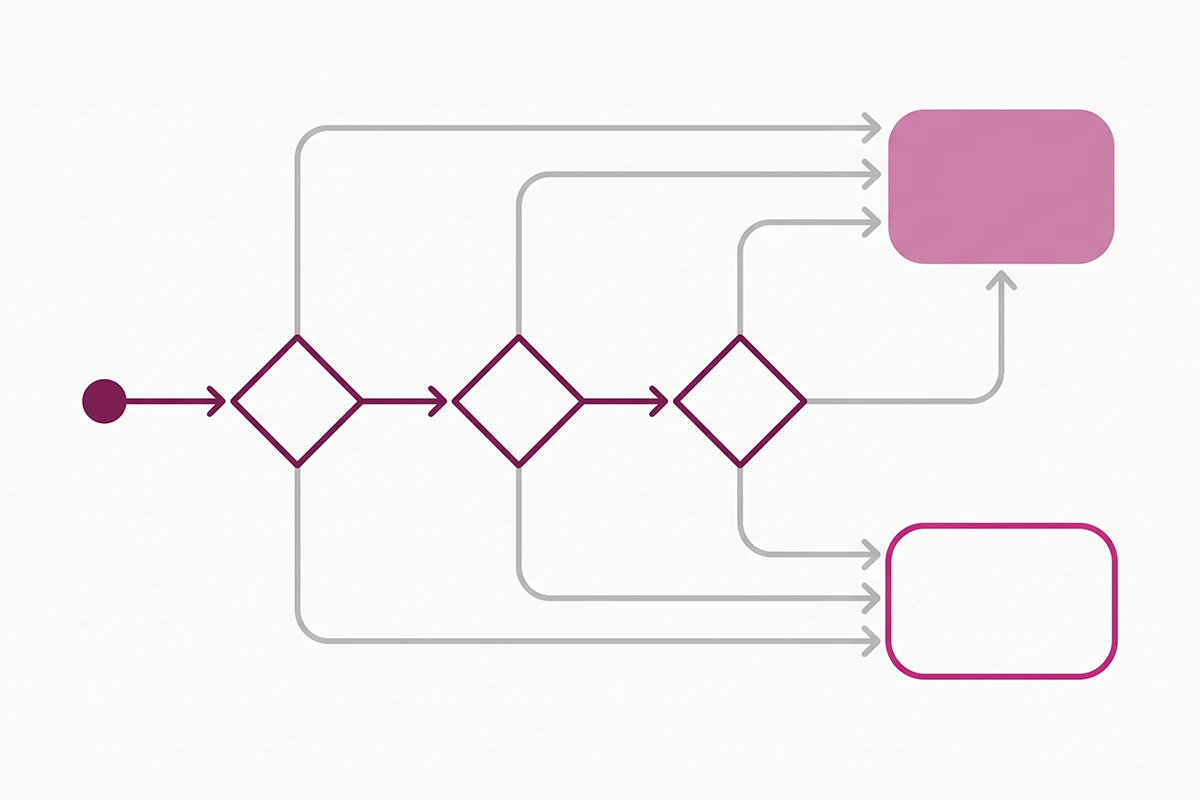
Two of those rows need a note.
Variant-split catalogs. If you list Navy, Olive, and Sand as three separate Shopify products, each one carries its own review count and each one looks thinly reviewed. Product grouping pools reviews across the group so they share a combined count and rating. It is a paid feature on both apps, at $15 on Judge.me and $49.99 on Loox, which is the single clearest price-per-feature gap between them.
It matters later too. When you eventually retire a color, those reviews are usually orphaned and the star rating on that listing disappears with it. Judge.me's native product merge is what lets you migrate those reviews to the replacement listing instead of losing two years of accumulated trust signals. Most stores do not think about this until they are already sunsetting a SKU.
Visual categories with spare budget. Note the condition. "Spare" means the $85 monthly difference is not coming out of inventory or ad budget. If it is, take Judge.me Awesome, set up photo review coupons yourself, and put the difference into stock.
Wrapping up
Three things to take away from the Loox vs Judge.me comparison.
Judge.me wins on cost at every order volume, and it is not close. $15 flat against $99.99 at 500 orders and $299.99 at 2,000. The free tier is genuinely usable, including photo and video reviews and rich snippets, which is why it is my default recommendation for stores under $200K a year. If a free tool fits your stage, take the free tool.
Loox wins on capture defaults and presentation, and that is a real advantage in visually driven categories. It is just a narrower advantage than the price gap suggests, because it is measured against an app that already does photos well.
Order-block billing is the thing to actually watch. Not because it is unfair, since it is published clearly on Loox's own pages, but because it is easy to stop noticing. Rerun the math after any growth month and check whether the flat tier has quietly become the cheaper one.
What I would do this week. If you have fewer than 50 reviews, install Judge.me free and start collecting, because nothing else you decide today matters until you clear that number. If you are already on Loox and past 1,800 orders a month, open your Shopify invoice and compare it against $299.99. If you are on Judge.me free and your category sells on looks, run Loox's 14-day trial and measure your photo submission rate against your current one.
That last one is a real test with a real number at the end, which beats reading another comparison post. Including this one.
Want the review system set up properly?
Reviews Management at Studio Niza covers app setup, the request flow, widget placement, schema, and replies to every review. It starts at $199/month, and I will tell you when the free plan is all you need.
See how Reviews Management works →Or email contact@studioniza.com if you have a specific question about your store. I read every one.
Frequently asked questions
If you're still unsure after reading these, just send the question.
Can I switch from Loox to Judge.me without losing my reviews? +
Yes. Both apps include importers that transfer reviews, photos, ratings, and reviewer details from the other, and both also accept CSV imports. Plan for one to three hours depending on your review volume. Remove the old app's widgets from your theme afterward so shoppers don't see two review sections on the same product page.
Is the Judge.me free plan really free forever? +
Yes. The Forever Free plan has no order cap, no review cap, and no time limit. It covers unlimited review requests, unlimited photo and video reviews, Google rich snippets, and the core display widgets. The trade is a small Judge.me badge on your widgets and a reduced set of integrations and customization options.
Does Loox have a free plan in 2026? +
Yes, but it is capped. The Loox Beginner plan is free and includes 14 review widgets and up to 2,000 review request emails a month. It supports only 500 total orders after your trial ends, not 500 per month. Once your store passes 500 lifetime orders, you move to Convert at $49.99 a month.
Do both Loox and Judge.me show star ratings in Google search results? +
Yes. Both apps add review schema to your product pages on their entry tiers, so both can produce organic star snippets. Google requires the rating to be visible on the page itself, and it can take several weeks for stars to appear while your pages are re-indexed. Google Shopping syndication is a separate feature and costs $15 a month on Judge.me versus $49.99 on Loox.
Which app is better if my product variants are split into separate listings? +
Judge.me, mostly on price. Product grouping pools reviews across separate listings so each one shows the combined count and rating, and it is a paid feature on both apps: $15 a month on Judge.me Awesome, $49.99 a month on Loox Convert. Judge.me also supports merging products natively, which makes it easier to keep those reviews when you retire a listing.
Can I run Loox and Judge.me at the same time? +
You can install both, but you should not leave both running. Two review apps on the same product page means duplicate widgets, split review counts, and two sets of review schema competing for the same star snippet. Pick one, import your history into it, and remove the other app's code from your theme.
Which is better for a dropshipping store importing AliExpress reviews? +
Both apps import AliExpress reviews, and Loox includes photo selection during import, which gives you more control over which images land on your product page. The bigger point is that imported reviews are not verified purchases from your store. Treat them as a starting display rather than real social proof, and disclose them honestly if you keep them.
How much does Loox cost at 1,000 orders a month? +
$199.99 a month on the Convert plan. Convert covers the first 300 orders at $49.99 and adds $50 for each additional block of 300 orders, so 1,000 orders needs three extra blocks. Judge.me costs $15 a month at the same volume, or $0 if you stay on the free plan.