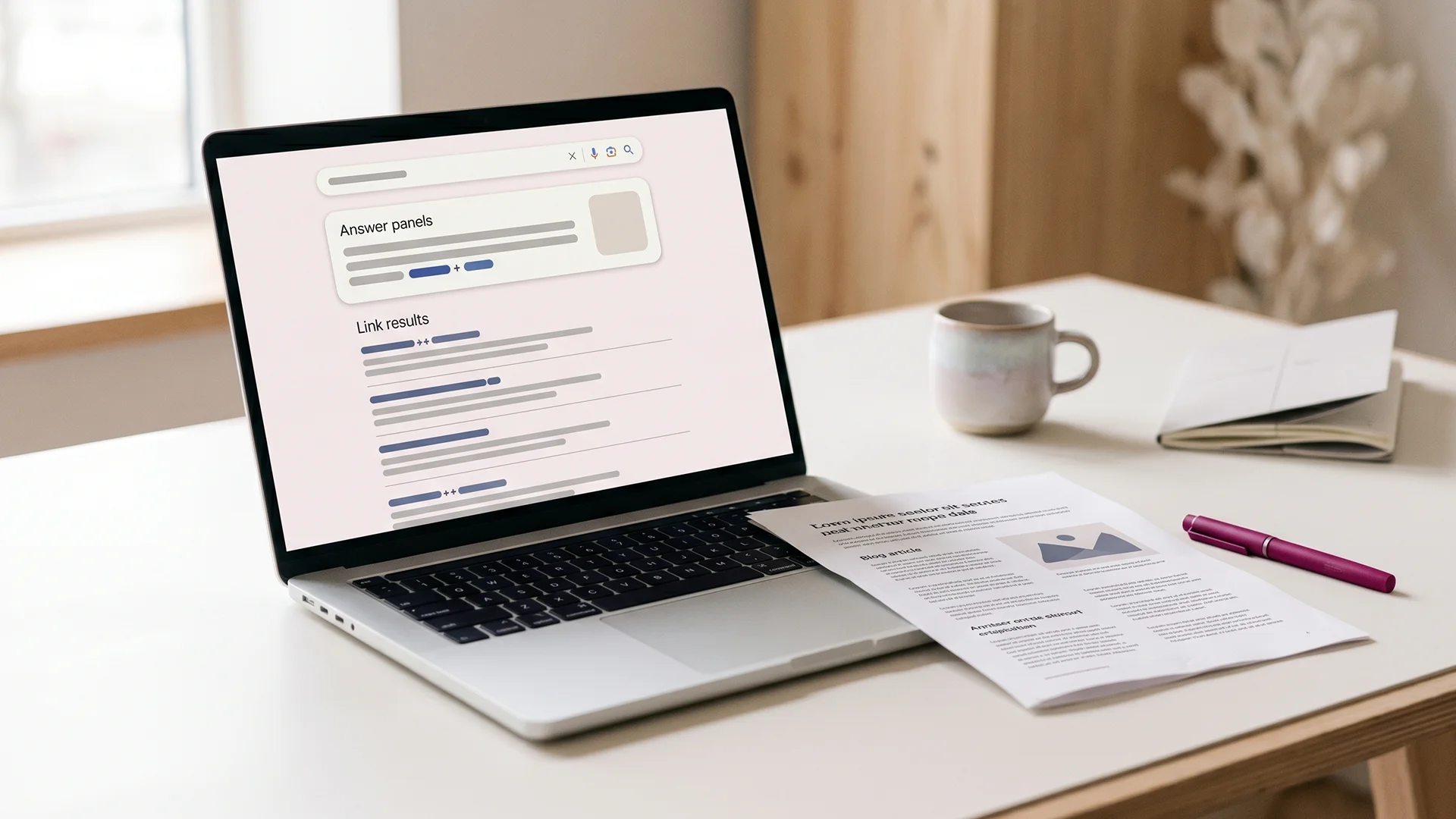
Your blog posts probably still rank. That is the confusing part. You open Google Search Console, impressions are flat or even climbing, and clicks have quietly fallen off a cliff. Nothing broke. The click just moved.
What moved it is the AI Overview: the AI-generated summary Google now drops at the top of the results page, above the blue links. When it appears, it answers the question before the reader ever reaches your post. The Pew Research Center found that people click a link only 8% of the time when an AI summary is present, compared with 15% when it is not. Roughly half the click is gone on the queries where the Overview shows up.
For a Shopify store running a blog to bring in buyers, that is a real problem. You wrote the post that answers "how do I clean a cast iron pan" or "what size rug for a king bed," and now Google answers it for you, sometimes using your words, often without sending the visit.
Here is the part most "AI is killing SEO" posts skip: writing content for AI Overviews is not a new dark art, and this is a structure problem, not a death sentence. AI Overviews are built out of someone's content. The question is whose, and why. This post is about how to make it yours. We will look at the structure these summaries pull from, the difference between writing for a click and writing to be cited, and a real before-and-after rewrite of a single paragraph. This is the content side of the same shift the technical side of GEO for Shopify covers.
What changed: the answer moved above the blue links
An AI Overview is Google's AI-generated answer that sits at the top of the results page, summarizing several sources before the reader sees a single link. It quietly changed search from a list of places to go into an answer you can read without leaving.
The scale is what makes this urgent. Pew found that about 18% of searches in its March 2025 sample produced an AI Overview, and Google has said the feature now reaches roughly 1.5 billion people a month. When the Overview appears, two things happen at once: fewer people click any link at all (8% versus 15%), and the links inside the Overview itself are clicked only about 1% of the time. People read the summary and move on.
For informational queries, the kind most Shopify blogs target, the Overview shows up most often. That is by design. Google says these summaries appear when its systems decide a quick synthesis is more useful than a page of links. So the posts that used to earn steady traffic by answering a common question are exactly the posts most exposed.
The honest read: your blog did not stop working. The economics of the click changed underneath it. A post that gets summarized and cited still does something valuable. It puts your store's name in front of a buyer at the moment they are deciding. It just does it without the session you used to count. So the goal shifts. You are no longer only writing to be clicked. You are writing to be the source the summary is built from.
Writing for clicks vs writing for citation
Writing for clicks and writing to be cited pull in different directions, and most existing blog posts were built entirely for the click.
A click-optimized post uses a curiosity gap. The headline hints at the answer, the intro builds a little suspense, and the actual payoff sits three scrolls down so you stay on the page and see the product. That structure works on a human who chose to click. It fails completely when the reader is an AI model skimming for a clean, extractable answer to lift into a summary.
A citation-optimized post does the opposite. It states the answer plainly, near the top of the relevant section, in a sentence that makes sense on its own. It backs that answer with a specific number or source. It uses headings that match the question a person actually typed. The model can pull one or two sentences and have something complete to show.
You do not have to pick one. A well-built post satisfies both: a reader who clicks through gets the full piece, and a model skimming the page finds a quotable answer in the first line of each section. The only difference is whether the answer is buried or surfaced.
This matters more for newer stores than it sounds. If you are a first-year founder competing against older, higher-authority sites, the citation game is oddly more winnable than the ranking game. The research we will get to in a moment found that lower-ranked pages often gained the most visibility in AI answers once their content was structured for it. Being on page five of Google does not lock you out of the Overview.
What do AI Overviews actually pull from your post?
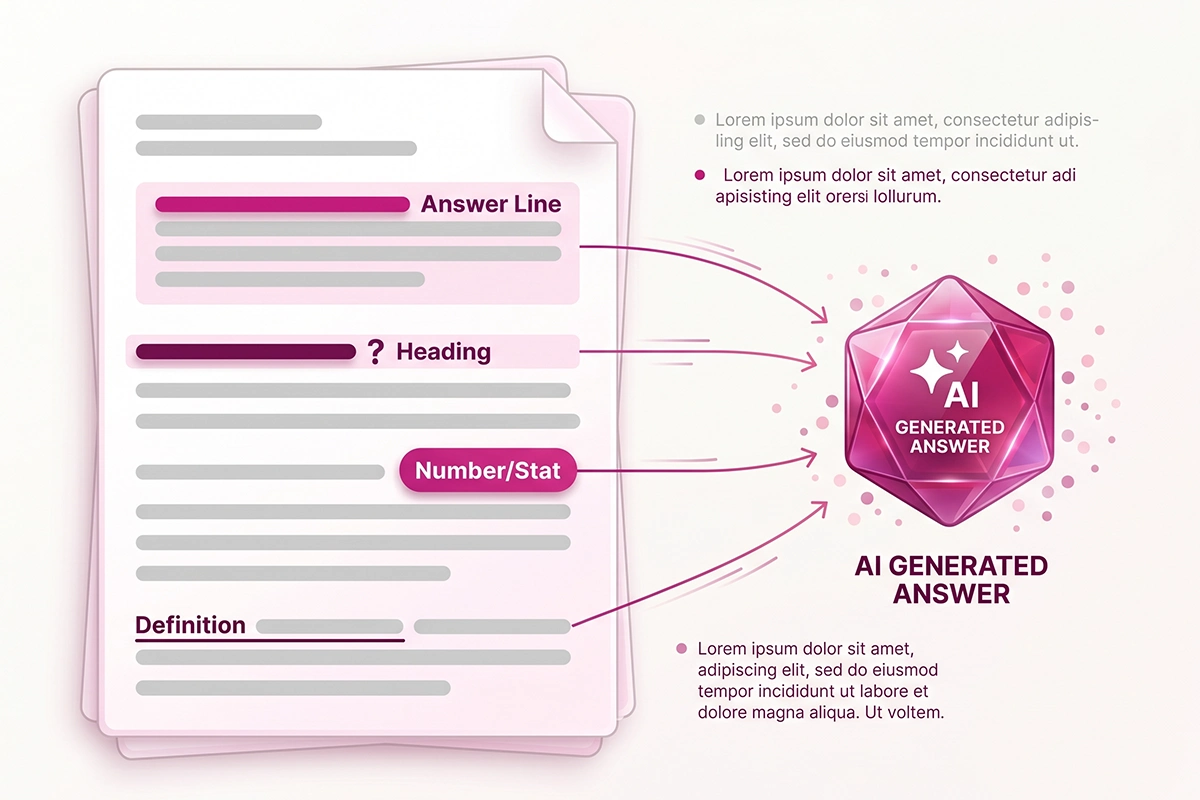
AI Overviews pull from content that answers a clear question, in plain language, with a fact attached. Four things make a passage easy to lift.
There is real research behind this, not just folklore. A team from Princeton, Georgia Tech, the Allen Institute for AI, and IIT Delhi tested optimization tactics across thousands of queries and found that adding statistics, quotations, and cited sources lifted a page's visibility in AI answers by 30 to 40%. These were small edits with outsized effect. Here is what they look like on a Shopify blog post.
A direct answer in the first sentence
Open each section with the answer, not a wind-up. If the heading asks "how often should I wash a wool rug," the first sentence should say "Wash a wool rug every 12 to 18 months, or sooner if it sits in a high-traffic room." A model can lift that as-is. A paragraph that starts with "there are many factors to consider" gives it nothing.
Headings shaped like the question
Phrase your H2s and H3s the way a person types or speaks the question. "How long do lab-grown diamonds last?" beats "Durability considerations." This does double duty: it matches the query the Overview is answering, and it tells the model exactly what the section below resolves. The same logic is why FAQ schema now earns its place for AI search rather than for Google rich results.
Fact density
Specific numbers beat vague claims, both for trust and for citation. "Reduces drying time by about 30%" is liftable. "Dries much faster" is not. The Princeton finding that adding statistics was the single most effective edit is the whole point here: a sourced number is the most quotable thing on your page.
A quotable definition line
Somewhere in any explainer post, write one clean sentence that defines the core term. "A French press is a manual coffee brewer that steeps coarse grounds in hot water, then separates them with a metal plunger." Self-contained, with no pronouns pointing back at earlier text. That sentence is what gets pulled when someone asks their assistant "what is a French press."
A before-and-after rewrite of one paragraph
The fastest way to understand citation-ready writing is to watch one weak paragraph become a strong one.
Say you sell cast iron cookware and you have a post titled "How to season a cast iron skillet." Here is a paragraph most stores would write:
"Seasoning your skillet is really important and something a lot of people overlook. There are a few different oils you can use, and everyone has their own opinion. Once you get the hang of it, you will wonder how you ever cooked without a well-seasoned pan."
That paragraph has no answer in it. It does not say what seasoning is, how to do it, or how often. A model skimming it finds nothing to lift, and a reader learns nothing. Here is the same paragraph rewritten to be cited:
"Seasoning is the process of baking a thin layer of oil onto cast iron so it becomes naturally non-stick and rust-resistant. To season a skillet, coat it lightly with a high-smoke-point oil like grapeseed, then bake it upside down at 450 degrees Fahrenheit for one hour. Most home cooks should reseason two or three times a year, or whenever food starts sticking."
Same topic, same length. The rewrite leads with a definition, gives a specific method with real numbers, and ends with a frequency. Every sentence stands on its own. Here is what changed, line by line.
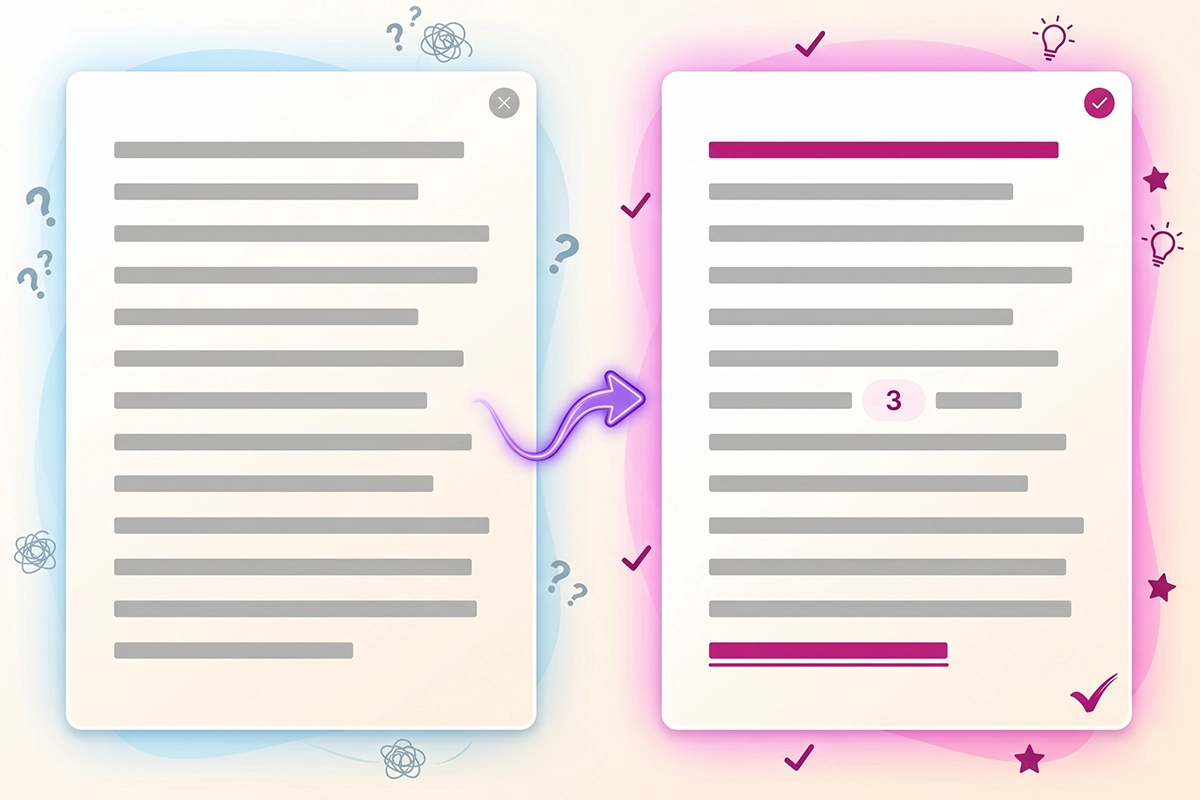
| Before | After | Why it gets cited |
|---|---|---|
| Opens with an opinion ("really important") | Opens by defining the term | A definition line is what gets pulled for "what is seasoning" |
| No method, no measurements | A method with temperature and time | Specific steps and numbers read as a direct answer |
| Ends on a vague feeling | Ends with a frequency ("two or three times a year") | Answers the follow-up question before it is asked |
| Reads like filler to a model | Reads like a self-contained answer | Each sentence makes sense out of context |
You do not need to rewrite every post this way overnight. Start with the posts that already rank on page one or two, since those are the ones a query is most likely to trigger an Overview for, and the ones a model is most likely to already be reading.
What does not help (and what Google actually says)
There is no special markup, file, or secret format that gets you into AI Overviews. Google has said so directly.
In its guidance for site owners, Google states there are no additional requirements to appear in AI Overviews or AI Mode, and no special optimization necessary beyond the SEO fundamentals you already know. Its newer guide to generative AI features is blunter still: you do not need an llms.txt file, you do not need to "chunk" your content into machine blocks, and there is no special schema.org markup for AI features. The structured data you already use for rich results is still worth keeping, but it is not a secret AI key.
So ignore anyone selling you an "AI Overview markup package." The work here is editorial, not technical.
Two more things do not help, and quietly hurt. The first is thin, AI-generated filler. If you publish a wall of generic posts written by a model with no edits, you are producing exactly the content these summaries skip, because it reads like every other generic page. We have written before about whether AI-generated blog content is worth it: the short version is that it can work, but only with real editing and real facts.
The second is volume for its own sake. Forty thin posts a month do not out-cite twelve strong ones. A few strong posts beat a wall of thin ones, and Google's own guidance warns against treating AI search as a content-manufacturing contest. Depth is the strategy. It always was. AI search just made the penalty for thin content arrive faster.
How do you know if your content is getting cited?
You measure it in two places: Google Search Console for impressions, and the AI engines themselves by asking them your buyers' questions.
Search Console is the first stop. Google has started showing site owners insights about how their pages appear in AI features, along with a toggle controlling whether your site helps ground these responses at all. Watch the gap between impressions and clicks. Rising impressions with flat clicks is often the signature of getting summarized: you are being shown inside an Overview without the visit. That is the pattern most blogging Shopify owners are seeing right now.
The second stop costs nothing. Open ChatGPT, Perplexity, Gemini, and Google's AI Mode, and ask the exact questions your buyers ask. "What is the best rug size for a king bed?" "How do I season a cast iron skillet?" See whether your store is mentioned or cited. Do it once a month and keep a simple log. The same approach explains why your store might be invisible to ChatGPT, not just to Google.
Now the honest part. Even when you are cited, the click may not come. Pew found only about 1% of visits to pages with an AI summary included a click on a source inside the Overview. So judge this work by presence, not sessions. Being the source a buyer's AI assistant names, right when they are deciding what to buy, has value that does not show up cleanly in a traffic graph. It shows up later, when they search your brand directly or arrive ready to buy.
Where to start this week
You do not need to touch every post. Start with the handful that already rank, and rewrite their openings to answer first. Here is the order that returns the most for the least time.
First, pick your three or four posts with the most impressions in Search Console. These are already showing up, so they are the ones most likely feeding Overviews. Second, rewrite the first sentence of each section to state the answer plainly, with no wind-up. If the heading asks a question, answer it in the first line. Third, add one specific number or named source to any section that makes a vague claim, since a statistic is the single most liftable thing you can add. Fourth, reshape two or three headings to match how a buyer phrases the question. Fifth, write one clean definition sentence for the core term in the post.
That is a couple of hours per post, and it is the same work whether you sell coffee gear or diamond earrings. None of it requires new tools, plugins, or markup. It is editing, done with the model's skimming habit in mind.
The move to AI Overviews feels like a loss because the click economics changed. The underlying job did not: write the clearest, most specific answer to a question your buyer is actually asking, and make it easy to find on the page. Stores that do that get cited. Stores that pad and bury get skipped. That was true before AI Overviews. It just matters more now.
Want your posts written to be cited, not skipped?
The Studio Niza blog content service writes posts structured for Google and AI search: a clear answer in every section, question-shaped headings, real sources, schema, and internal linking. Keyword-researched, no AI slop. From $449/month.
See content pricing & services →Or email contact@studioniza.com if you have a specific question about your store. I read every one.
Frequently asked questions
If you're still unsure after reading these, just send the question.
What is content for AI Overviews? +
Content for AI Overviews is blog or page content written so Google's AI summaries can lift a clear, self-contained answer from it. In practice that means leading each section with a direct answer, attaching a specific fact or source, and using headings shaped like the questions people actually ask.
How do I get my blog cited in Google AI Overviews? +
Answer the question plainly in the first sentence of each section, back it with a specific number or credible source, and phrase your headings the way buyers type their questions. Research from Princeton found that adding statistics, quotations, and citations raised visibility in AI answers by 30 to 40%.
Do I need special schema or markup to appear in AI Overviews? +
No. Google states there is no special schema.org markup, llms.txt file, or AI-only format required to appear in AI Overviews or AI Mode. Standard structured data is still useful for rich results, but the work that earns citations is editorial: clear answers, real facts, and helpful structure.
Does writing for AI Overviews hurt my regular Shopify SEO? +
No. Google treats AI features as part of normal search, so the same fundamentals apply. Writing clearer, better-structured answers tends to help both your traditional rankings and your chances of being cited, because both reward content that directly answers the query.
How long after publishing can a post get cited in an AI Overview? +
First the page has to be indexed, which usually takes a few days to a few weeks for a newer store. After that, citation depends on whether your content is the clearest available answer for a given query, so there is no fixed timeline. Posts that already rank tend to get pulled into Overviews sooner.
Will an AI Overview send me traffic if it cites me? +
Often not directly. Pew Research found only about 1% of visits to pages with an AI summary included a click on a cited source. The value of being cited is brand presence at the moment of decision, which tends to show up later as direct or branded visits rather than an immediate click.
Is it worth rewriting old Shopify blog posts for AI Overviews? +
Yes, and it is usually the highest-return place to start. Rewriting the openings of posts that already rank takes a couple of hours each and targets the queries most likely to trigger an Overview. Research also found that lower-ranked pages often gain the most AI visibility once their content is structured to be cited.
Can I just use AI to write content for AI search? +
Carefully. Thin, unedited AI content is exactly what these summaries skip, because it reads like every other generic page. AI can help with a first draft, but the facts, sources, structure, and editing are what make a post citation-worthy.