You went looking for a price. You found a demo request. Most Shopify chatbot vendors hide the number behind a "contact us" form, and the ones that do publish a price show you the smallest part of the bill.
Here is the honest version. A Shopify chatbot cost in 2026 lands in one of three shapes: free and native (Shopify Inbox), a self-serve app you set up yourself (roughly $20 to $400 a month), or a managed build someone configures and runs for you ($99 to $2,000 a month, usually plus a setup fee). That range is wide because the monthly subscription is only one of four things you actually pay for.
This post breaks down all four layers, shows you the real difference between a cheap widget and a managed build, and gives you a simple way to work out the break-even for your own order volume. I did the same honest breakdown for Shopify SEO, and it is the post new owners tell me they trust most, because real numbers beat vague promises. No demo required.
What you're actually paying for
When someone asks how much is a Shopify chatbot, they picture one tidy number. The bill has four parts, and only the first one shows up on a pricing page.
The four layers are the app subscription, the message or resolution volume, the setup and training time, and the human hours the bot does or does not replace. The first two are money out the door every month. The last two are where most owners get surprised, because they either cost your own time or hide inside a "we'll handle it" quote.

Start with layer one, the app subscription, because it sets the floor. It splits into three brackets.
The free and native bracket is Shopify Inbox, which costs nothing on any Shopify plan. The honest catch is that Inbox is a messaging tool with AI-suggested replies, not a true AI agent. It does not answer questions on its own or hold a multi-turn conversation, so it fits a new store doing under 100 chats a month where you can still reply yourself.
The self-serve app bracket runs roughly $20 to $60 a month for a small store. Most of these apps advertise a low base price, then charge for the AI separately, so a "$29" plan can become a $50 plan once the AI is actually on. The mid bracket, for stores adding social channels and higher volume, usually lands between $100 and $400 a month.
| Subscription bracket | Typical monthly cost | What it fits |
|---|---|---|
| Free and native (Shopify Inbox) | $0 | New stores under ~100 chats a month, founder still replies |
| Self-serve AI app (entry) | $20 to $60 | First-year stores wanting real AI answers on a budget |
| Self-serve AI app (mid) | $100 to $400 | Higher volume, multiple channels, more integrations |
| Managed build (done for you) | $99 to $2,000+ (plus setup) | Owners who want it built, watched, and tuned for them |
Why per-message and per-resolution pricing spikes bills
Layer two is the one that turns a predictable subscription into a scary invoice. It comes down to how the app charges for volume, and there are three models in 2026. The model matters more than the headline price once you get busy.
The first model is flat, either a fixed monthly fee or a set allowance of replies with a known overage rate. This gives you a ceiling, which is the whole point: your November bill looks like your March bill.
The second model is per-conversation. You pay for every conversation the bot handles, resolved or not. It is easy to forecast in a steady month, but conversation counts balloon during a sale or a Black Friday rush, and the bill balloons with them.
The third model is per-resolution, and it is the one that catches people out. You pay each time the AI closes a ticket without a human. Intercom's Fin charges about $0.99 per resolution with a 50-resolution monthly minimum, so the floor is roughly $49.50. Zendesk charges around $1.50 to $2.00 per automated resolution on top of per-seat fees. Gorgias charges about $0.90 to $1.00 per resolution on top of a tiered helpdesk plan, and because an AI resolution also counts as a billable ticket, one conversation can be charged twice.
Here is the quiet trap in the per-resolution model: your bill grows as the bot gets better. A bot that improves from resolving a quarter of chats to three quarters can roughly triple its own cost on the same traffic. Some plans also count a "resolution" when a customer simply goes quiet, so you can be billed for a chat that did not actually help anyone.
None of this makes per-resolution pricing wrong. It aligns the vendor's incentive with yours. It just means you have to model your busy month, not your sleepy one, before you sign. If the difference between resolution rate and deflection rate is new to you, I wrote a plain-English guide to resolution rate versus deflection rate and which number to trust.
Setup and training: the hidden cost
Layer three never appears on a pricing page, because it is measured in hours, not dollars. Installing a chatbot app is genuinely fast, often under ten minutes, and most sync your product catalog automatically. That part is real.
The work that decides whether the bot is any good comes after the install. Someone has to feed it your policies, write the escalation rules, connect order lookups, and test it against real questions until it stops giving wrong answers. On a self-serve app, that someone is you, and a careful first setup is usually a solid afternoon or two, plus a check-in every week while it settles.
With a managed build, that time becomes a line item. Setup fees for a done-for-you Shopify chatbot commonly run from a few hundred dollars to a couple of thousand, and fully custom development runs far higher. Ongoing retraining and monitoring for custom work is often quoted at $500 to $3,000 a month, which is worth knowing before you assume "managed" and "cheap" go together.
The reason this layer matters is simple. A chatbot that answers a return-policy question wrong is worse than no chatbot, because it creates a second ticket and a frustrated customer. The training hours are what buy accuracy, so they are not a corner you can skip. They are the product.
What a chatbot replaces, and what it doesn't
Layer four is the one that decides whether any of the other three are worth it: what the bot actually takes off your plate. This is where the marketing runs ahead of reality, so use honest numbers.
A well-configured AI chatbot on a small Shopify store realistically handles somewhere between 40 and 60 percent of incoming conversations on its own. Rule-based bots that only match keywords land lower, closer to 20 to 35 percent. When a vendor claims 80 or 90 percent deflection, read it with a raised eyebrow, because those figures usually come from the vendor's own best case.
The sweet spot is repetitive, factual questions. "Where is my order" and basic product and policy questions are what a bot answers well and tirelessly, including at 2 a.m. when you are asleep. That alone can clear a real chunk of your inbox.
What a bot does not replace is the hard 30 to 60 percent: refund disputes, damaged items, edge cases, and anything that needs a judgment call or a bit of empathy. So a chatbot rarely replaces a person. It removes the repetitive first layer so a person (often still you) only touches the messages that actually need a human. If you are weighing the bot against a hire, I compared both paths in when to add a chatbot versus hire customer support.
A cheap widget vs a managed build
Now the question most owners are really asking: what is the difference between a $15 widget and a managed build, and why is the gap so wide? The honest answer is that you are buying different amounts of the four layers above.
A cheap widget sells you layer one and a slice of layer two. You get the app and the AI. You still own the setup, the training, the monitoring, and the risk that it answers wrong on a slow week when you are not watching. For a founder who enjoys tinkering and has light volume, that can be a fine trade.
A managed build sells you all four layers as a service. Someone configures the bot on your real store data, watches how it performs, and fixes it when it drifts. You are paying for the hours and the expertise, not just the software seat. Self-serve chatbot software runs about $39 to $279 a month with none of that included, while managed AI chatbot services often charge $300 to $2,000 a month for it.
For what it is worth, I price my own chatbot service in the middle of that on purpose: $599 to set it up and $99 a month all in, which covers hosting, monitoring, and ongoing tuning. The math behind $99 is not a mystery. The AI platform and credits cost a low double-digit amount per store, and the rest pays for the hour or two a month I spend watching and adjusting it. I would rather show that math than hide it behind a demo.
| Option | What you pay | What you own |
|---|---|---|
| Budget widget | $15 to $40 a month | Setup, training, monitoring, and the wrong-answer risk |
| Mid self-serve app | $40 to $400 a month | Still your setup and tuning, with more features and channels |
| Managed build | $99 to $2,000+ a month, plus setup | Someone else builds, watches, and tunes it for you |
There is no universally right answer here, only the right fit for your volume and how much of this you want to run yourself. If you want the full decision framework, I laid out self-serve versus managed, and the honest tradeoffs, in its own post.
How to work out your break-even
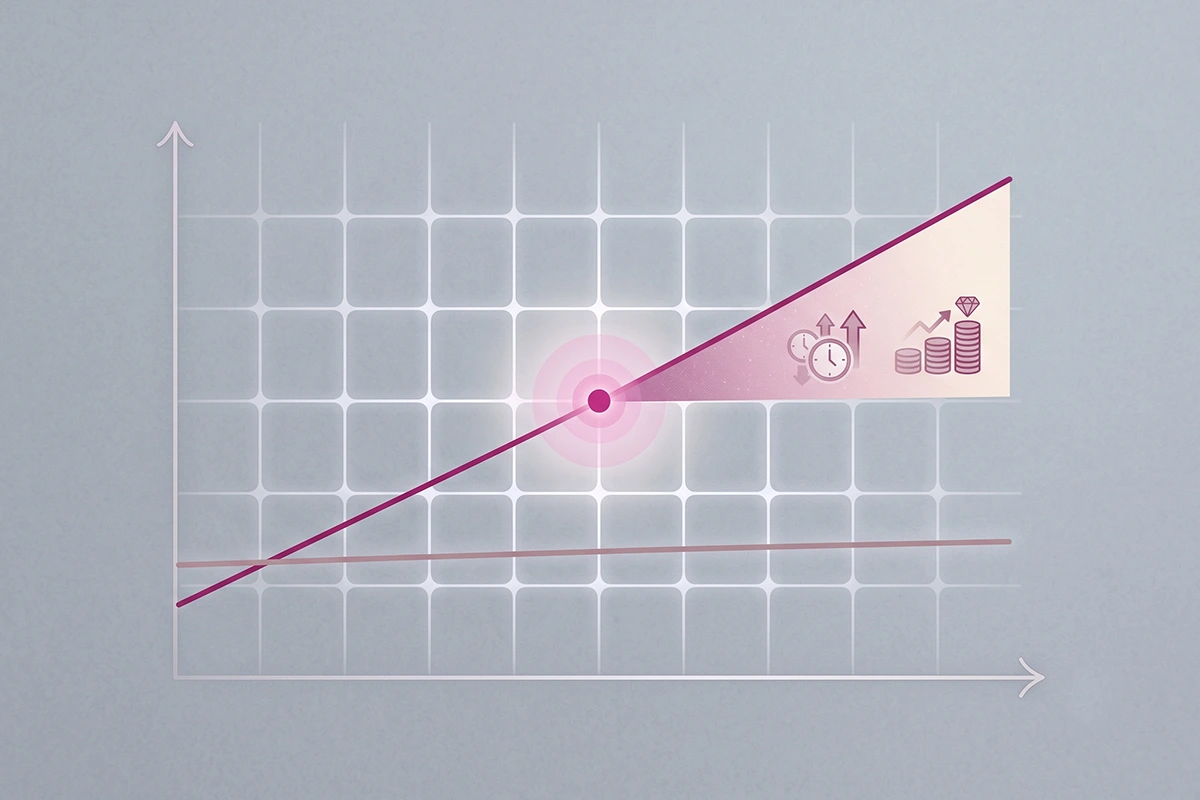
Forget the sticker price for a minute. The number that tells you whether ai chatbot pricing for ecommerce makes sense for your store is your own break-even, and you can work it out in four small steps.
First, count your monthly support conversations. If you do not track this, a rough rule for many small stores is somewhere between 0.3 and 0.7 conversations per order, but your inbox is the truer source. Second, take the realistic share a bot can handle, and use 50 percent as a sensible middle rather than the vendor's headline. Third, estimate the time each of those conversations costs you, around five minutes is fair for a WISMO or FAQ reply. Fourth, put a value on your hour.
Here is a worked example for a store doing 300 orders a month. That is roughly 150 support conversations. A bot handling half of them clears about 75 conversations, and at five minutes each that is a little over six hours a month back in your week. If your time is worth $25 an hour, that is about $156 in time, before you count the after-hours sales you would otherwise miss while asleep.
Against a $99 to $150 monthly chatbot cost, a store at that volume roughly breaks even on time alone and pulls ahead once you add recovered sales. Run the same math at 60 orders a month and it usually flips the other way: too few conversations to justify a paid tool, so a free Shopify Inbox plus your own replies wins. I dug into that threshold in the break-even order volume for small stores.
So, is a Shopify chatbot worth the price?
The honest answer to whether a chatbot is worth the price depends on your stage, so here it is by stage rather than as one blanket yes.
If you are a brand-new store doing under about 100 conversations a month, usually not yet. Free Shopify Inbox and fast personal replies will serve you better than a paid tool you have to train and watch. Spend the money on getting found first.
If you are a first-year store doing roughly 100 to 500 conversations a month, a chatbot starts to earn its keep, especially if "where is my order" dominates your inbox. This is the stage where a self-serve app or a managed build both make sense, and the break-even math above tells you which. Past 500 conversations a month, the question is less whether and more which pricing model protects your margin, because a flat or per-reply plan beats per-resolution once volume climbs.
Whatever you choose, give it time. A chatbot needs its first 30 to 60 days to learn your store and your customers, so cancelling at day 30 means you paid for setup and never saw the payoff. That is also why a managed bot usually stops working if you cancel the service: the monthly fee is hosting, monitoring, and tuning, not a one-time purchase you keep. Budget for the real Shopify chatbot cost, which is all four layers, give it a fair run, and let your own order volume, not a demo, make the call.
Want the chatbot without the pricing-page math?
Studio Niza builds and runs your Shopify chatbot for $599 setup and $99 a month, all in: hosting, monitoring, and tuning included, with no per-resolution surprises. Honest scope, priced for small stores.
See chatbot pricing & scope →Or email contact@studioniza.com if you have a specific question about your store. I read every one.
Frequently asked questions
If you're still unsure after reading these, just send the question.
How much does a Shopify chatbot cost per month? +
Most small Shopify stores spend $0 to $60 a month, using free Shopify Inbox or an entry self-serve AI app. Mid-size stores usually land between $100 and $400 a month, and a managed done-for-you build typically runs $99 to $2,000 a month plus a setup fee. The monthly subscription is only one of four cost layers, so the real Shopify chatbot cost also includes volume charges, setup time, and the human hours it replaces.
Is Shopify Inbox a real AI chatbot? +
Not in the full sense. Shopify Inbox is free and includes AI-suggested replies, but it is a messaging tool rather than an autonomous agent. It does not answer questions on its own or handle multi-turn conversations, so it fits new stores with low volume where you can still reply yourself within an hour or two.
What's cheaper: per-conversation or per-resolution chatbot pricing? +
It depends on your resolution rate and how spiky your volume is. Per-conversation charges for every chat whether it is solved or not, so it punishes busy months. Per-resolution only charges when the AI closes a ticket, which feels fair but grows as the bot improves. For a store with steady, low volume a flat monthly plan is usually the safest and cheapest choice.
Do I need a chatbot if I only get a few support messages a day? +
Probably not yet. If you are handling under about 100 conversations a month, free Shopify Inbox plus your own replies is usually the better value. A paid chatbot starts to pay for itself once repetitive questions like order tracking eat real hours of your week, which tends to happen past a few hundred orders a month.
How much does it cost to have someone build and manage a Shopify chatbot for me? +
Managed AI chatbot services generally charge $300 to $2,000 a month, and many add a one-time setup fee for building and training the bot on your store data. The monthly fee covers hosting, monitoring, and ongoing tuning, not just software. Studio Niza sits at the lower end at $599 setup and $99 a month all in, on purpose, so smaller stores can afford a bot that is actually watched.
Will my chatbot bill go up during Black Friday? +
On per-conversation or per-resolution pricing, yes, because your bill scales with volume and both climb during a sale. On a flat monthly or per-reply plan with a set allowance, your ceiling stays predictable. If you run seasonal spikes, model your busiest month before you commit, not your quietest one.
At what order volume does a Shopify chatbot start paying for itself? +
For many stores the break-even sits somewhere around 200 to 300 orders a month, where support conversations are frequent enough that the time saved covers a $99 to $150 monthly cost. Below roughly 60 to 100 orders a month, a free tool plus your own replies usually wins. The honest way to know is to run your own numbers: conversations, the share a bot handles, minutes each, and the value of your hour.
Can I keep the chatbot if I cancel a managed service? +
Usually not, and that is by design rather than a trap. A managed monthly fee pays for hosting, monitoring, and continual tuning, so when the service stops, the running bot stops with it. This is also why many managed chatbots have a 90-day minimum: the bot needs time to learn your store before you can judge it fairly.