
Two kinds of Shopify stores have a collection description problem, and they look nothing alike.
The first has twenty collections and not one of them has a word on it. The page loads, the grid appears, and Google sees a title, a row of product names, and nothing else. The second has two thousand collections and every one is full. Generated over a weekend, fluent, and interchangeable. Swap "Ceramic Mugs" for "Ceramic Bowls" in any of them and nobody would notice.
Both stores fail the same way. A Shopify collection description earns its place by saying something only that collection can say. Empty says nothing. Generated at scale says the same thing two thousand times, which is also nothing.
The advice is split down the middle too. Shopify's own guidance on category pages says one to two sentences. SEO posts say 300 words or more. Both are right, and they are describing two different blocks of text in two different places on the same page. Nobody says that out loud, which is why the title asks.
Here is the formula, where each block goes, ten rewritten examples, and guardrails for batches.
The 120 to 250 word collection description formula
A collection description has four jobs: name what the collection is, say who it is for, help the shopper choose between the products inside it, and send them somewhere useful next. Everything else is padding.
The four parts, with a word budget for each
| Part | What it answers | Words |
|---|---|---|
| 1. What it is | Plain naming, in the words shoppers actually use | 25 to 40 |
| 2. Who it is for | Occasion, body type, skill level, room, climate, budget | 20 to 35 |
| 3. How to choose | The distinctions that split this collection | 50 to 120 |
| 4. Where to go next | A sibling collection, a size guide, a buying guide | 25 to 55 |
| Total | 120 to 250 |
Parts one, two, and four can be written by anyone with your product list open. Part three needs catalog knowledge, which is why competitors cannot copy it.
Why 120 to 250 and not 500?
Because part three has a ceiling. Once you have named the two or three real distinctions inside a collection (matte versus glossy, 20L versus 40L, sensitive versus normal skin), you are finished. Anything past that is repetition, or it belongs in a buying guide, which is a separate page with a separate job.
Long collection copy is usually one good paragraph followed by four restating it. Shoppers scroll past the restating and Google does not reward it.
The floor matters too. Under roughly 100 words you rarely get past parts one and two, which is the empty-collection problem in a shorter sentence.
Top, bottom, or both? Where the description actually goes
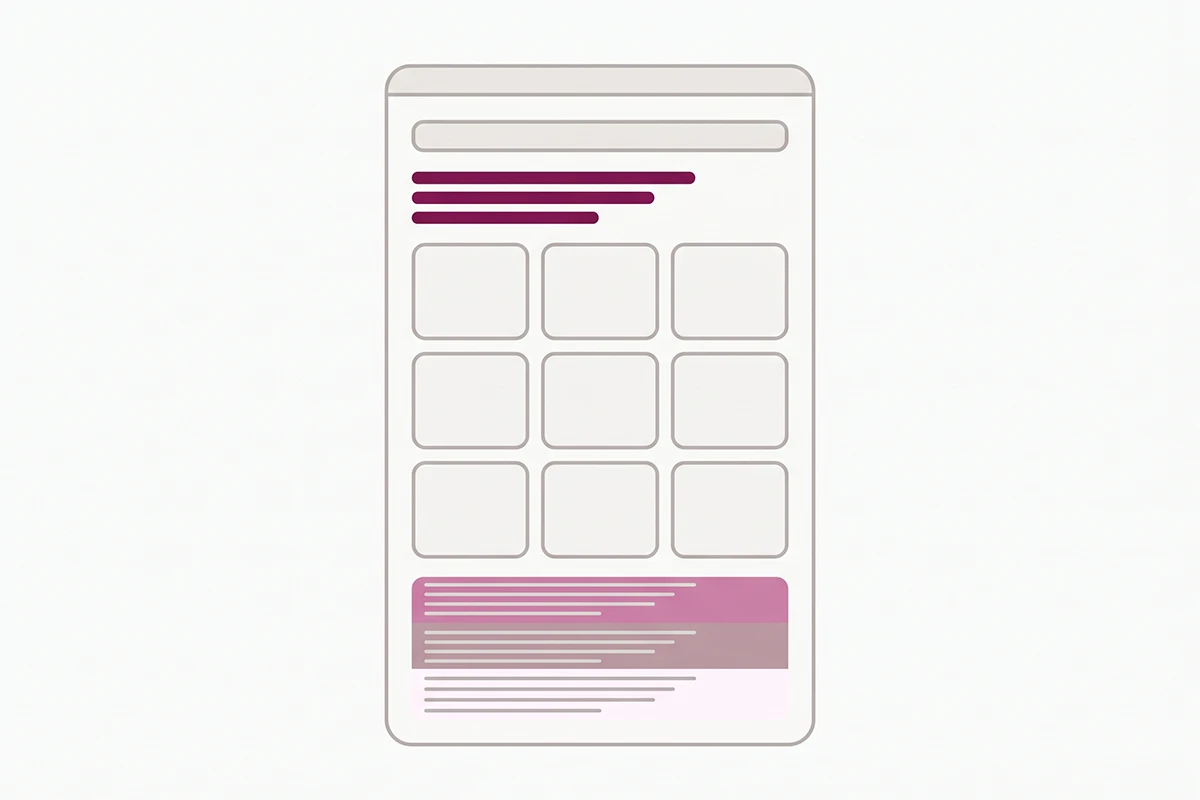
Both, split. Roughly 40 to 60 words above the product grid, and the rest below it.
Above the grid you are writing for a shopper who came to see products, and every word up there sits between them and the thing they came for. Shopify's own category page guidance says one to two sentences, and for that block Shopify is right. Below the grid you are writing for the shopper who scrolled all the way down without buying, and for Google. That is where parts three and four go, and where the word count lives.
The reasoning behind the split, including what Google's John Mueller said about text under a product grid, is in the collection page SEO post. What that post does not cover is the part that stops most people: getting the text down there at all.
How Shopify themes actually handle it
Most themes only give you the top slot. In Dawn, the description is rendered by the collection banner section behind a "Show collection description" checkbox, above the grid. The product grid section does not output it at all, and no setting in Dawn moves it below the products.
Three routes, in the order I would try them:
1. Add a Rich text section below the grid. Add it in the theme editor and drag it under the product grid. Two minutes. The catch: that text is identical on every collection using the template, which makes it useless for SEO.
2. Use a collection metafield with a dynamic source. Create a rich text metafield on collections (Settings, then Custom data, then Collections), add a Rich text section below the grid, and connect it with the dynamic source icon. Every collection now carries its own below-grid text, editable from admin, no code. Pick rich text over plain text, which drops headings and links.
3. Pay for theme code. A developer can split the description on a delimiter and render half above, half below. It works, and it breaks the next time you change themes.
Route two is the one I set up for clients.
The field that matters and the two that don't
The collection description field in admin, under Products, then Collections, then your collection. This is the one. Page content, per-collection, and what your theme renders.
The meta description field, behind the edit icon in the Search engine listing section. Separate field, separate job: bidding for the click in search results, not describing the page on the page. Shopify's guidance is up to roughly 320 characters.
A theme Rich text section with copy typed straight into it. Theme content, not collection content. It shows on every collection using that template, and switching themes loses it.
If you have been typing collection copy into a theme section, that is the most common version of this mistake, and it is a ten-minute fix. Cut it, paste it into the admin description field.
Ten Shopify collection descriptions, rewritten
For each one, the thin version most stores have now, then the rewritten above-grid block. Ten shapes instead of three. The full-length version follows number ten.
1. Apparel: Women's Linen Dresses
Before: Shop our women's linen dresses. Breathable, stylish, perfect for any occasion.
After: Linen cut for real heat, not air-conditioned offices. European flax in midi or maxi, pre-washed so it arrives soft. Sizes 6 to 22. Hate ironing? Start with the slub weaves; they wrinkle least.
2. Jewelry: Gold Hoop Earrings
Before: Beautiful gold hoop earrings to complete any look. Shop the collection today.
After: Hoops from 8mm huggies to 50mm statement sizes, in 14k solid gold and 14k gold fill. Solid if you never take them out, fill for the same look at a third of the price.
3. Home: Handmade Ceramic Mugs
Before: Our handmade ceramic mugs are made with care, perfect for your morning coffee.
After: Wheel-thrown stoneware in 8oz, 12oz, and 16oz, dishwasher and microwave safe. Speckled clay varies more between pieces than the white glaze, so order two at once if you want a matching pair.
4. Skincare: Vitamin C Serums
Before: Discover our range of vitamin C serums for brighter, healthier looking skin.
After: Sorted by form and strength: L-ascorbic acid at 10% to 20% for the most studied version, gentler derivatives for skin that stings with it. All in opaque packaging, because it degrades in light.
5. Pet: No-Pull Dog Harnesses
Before: Keep your dog safe and comfortable with our no-pull dog harnesses.
After: Front-clip and dual-clip harnesses sized by chest girth, 30cm to 95cm, not by breed. Front-clip redirects a hard puller; dual-clip suits dogs already in training. Measure the widest part of the ribcage.
6. Digital: Printable Budget Planners
Before: Take control of your finances with our printable budget planners. Instant download.
After: Instant PDF downloads in US Letter and A4, undated so you can start any month. Weekly layouts for variable income, monthly for a steady paycheck. Every file prints in black and white.
7. Coffee: Single-Origin Coffee Beans
Before: Premium single-origin beans sourced from the world's best growing regions.
After: Roasted to order, shipped within 48 hours of the roast date. Ethiopia and Kenya lean fruity and acidic, Colombia and Guatemala lean chocolate and nut. Whole bean by default, ground on request.
8. Outdoor: Two-Person Camping Tents
Before: Explore the outdoors with our durable, reliable two-person camping tents.
After: Two-person tents from 1.4kg ultralight shelters to 3.2kg freestanding domes. Lighter means smaller vestibules and thinner floors. Carrying it more than a mile, stay under 2kg. Car camping, buy the roomier one.
9. Baby: Organic Cotton Baby Blankets
Before: Soft and gentle organic cotton baby blankets, perfect for your little one.
After: GOTS-certified cotton in muslin and knit, sized for bassinet, stroller, and crib. Muslin breathes better in warm rooms and softens with every wash. Knit holds more warmth. All survive a hot wash.
10. Accessories: Leather Laptop Sleeves
Before: Protect your device in style with our handcrafted leather laptop sleeves.
After: Full-grain leather for 13in, 14in, and 16in laptops, felt-lined, no zips near the screen. Full-grain darkens and marks with use instead of peeling. Check exact dimensions, not just screen size.
Number three, at full length
Above the grid: the rewritten block from number three, unchanged. That is 38 words, parts one and two, plus the first half of part three.
Below the grid, 92 words: Most people choosing a handmade mug are deciding between size, glaze, and whether the pieces need to match. The 8oz suits espresso, the 12oz is the everyday choice, and the 16oz holds a full French press serving without a refill. Glossy glazes wipe clean and keep stains off the interior; matte feels better in the hand but shows water marks sooner. Speckled bodies vary batch to batch because the iron in the clay reacts differently each firing, so buy a gift set together. To pair one with a pour-over setup, see our brewing collection.
That last sentence is part four doing its job: it moves a shopper sideways instead of dead-ending them, and on a live store it carries a link. The rules for those are in the internal linking post.
The stuffing that makes Google rewrite your snippet
Google is explicit about this one. Its documentation on snippets says descriptions made of long strings of keywords do not give users a clear idea of the page's content and are less likely to be displayed as a snippet. The example it labels as bad is a comma-separated list: sewing supplies, yarn, colored pencils, sewing machines, threads, bobbins, needles.
That is written about the meta description, and the same instinct wrecks on-page collection copy. The tell is a sentence that lists instead of saying anything: "Our women's linen dresses collection features linen dresses, linen midi dresses, linen maxi dresses, and summer linen dresses for women." Nobody writes that on purpose. It happens when you have a keyword list open in another tab and you are trying to use all of it on one page.
How many times is too many?
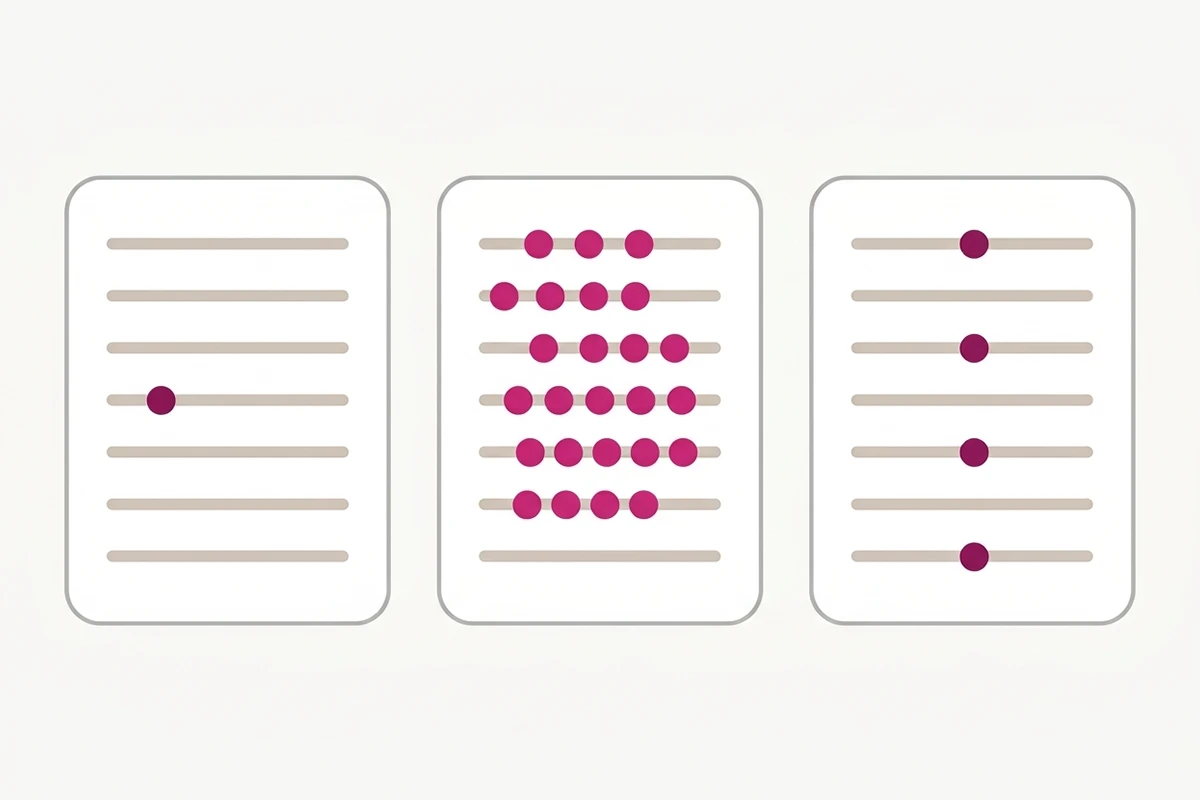
For a 120 to 250 word description: the exact target phrase once or twice above the grid, and twice below. Your keyword is already in the H1 and the title tag, so the description does not need to carry it over and over. Variations and related terms can appear as often as they read naturally, usually three or four times.
The test: if you cannot fit a keyword into a sentence a person would say out loud, it does not belong on the page. The on-page SEO checklist has the one-pass version of this for every page type.
The other reason to care: when Google decides your description is a keyword list, it writes its own snippet from your page content instead. You lose control of the one sentence that decides the click.
Guardrails for AI-generated collection descriptions at scale
For a store with thousands of collections, hand-writing every description is not a real option, and I will not pretend otherwise. But the way most stores run these batches produces exactly the thing Google's spam policies name.
Google defines scaled content abuse as generating many pages primarily to manipulate rankings rather than help users, and it explicitly lists using generative AI tools to produce many pages without adding value. That page was last updated on August 28, 2026. The trigger is not that a machine wrote the text. It is that the pages are interchangeable.
Before you pick a tool: Shopify Magic writes product descriptions, not collection descriptions, so the batch tools people reach for here are third-party. Shopify's own note on Magic is still the right standard whatever you use. You are responsible for the accuracy of everything you publish, even when automatic generation wrote it, and you are expected to read it first.
The three-tier batch system
Tier 1, your top 50 collections by impressions. Written or heavily edited by hand. These are the ones that can realistically rank, and they are worth the hours.
Tier 2, the next 200. Generated from real per-collection inputs: product count, price range, the two or three attributes that differ across the products inside, and the best seller's name. Then read every one before publishing.
Tier 3, the long tail. Same structured inputs, spot-checked at 10%, and flagged for a rewrite the moment a collection picks up impressions in Search Console.
Two rules apply to every tier. First, the opening clause has to differ between collections, because a shared first sentence across two thousand pages is the clearest duplication signal you can send. Second, every description needs at least one fact from your catalog rather than from the model: a material, a price range, a size range, a count. If the model cannot produce it, your prompt is missing the input, and the output will be interchangeable no matter how well it reads.
That is the whole difference between two thousand descriptions and two thousand useful ones, and it is why real SEO work is not template fill-in work.
Wrapping up: where to start this week
Three things.
First, if you have fewer than about twenty collections, you do not need a system. You need one afternoon and the four-part formula. Write your top five by traffic today, the rest over two weeks, and skip the batch tooling. It is built for a problem you do not have.
Second, split the text. Roughly 40 to 60 words above the grid, the rest below, using a collection metafield connected to a Rich text section. If your theme only shows the top block right now, that is normal, and it is a theme editor fix rather than a code fix.
Third, read your descriptions side by side before publishing a batch. Open five in five tabs. If you can swap the category names between any two and both still read fine, neither is doing its job yet.
The part that takes real time is part three, because writing it means knowing what actually separates the products inside each collection. That is not a writing problem. It is a catalog knowledge problem, and it is the reason stores that do this well are hard to catch.
Want this done for every collection?
The Studio Niza SEO & GEO service covers collection copy, the split placement, schema, internal linking, and indexing follow-up, written per collection instead of filled in from a template. Pricing starts at $499 one-time.
See pricing & services →Or email contact@studioniza.com if you have a specific question about your store. I read every one.
Frequently asked questions
If you're still unsure after reading these, just send the question.
Do I need a unique description for every Shopify collection? +
For the collections you want ranking, yes. Near-identical descriptions across dozens of collections are what Google's scaled content abuse policy targets, and they give shoppers nothing either. If you have 2,000 collections, prioritize: write the top 50 by impressions properly, generate the rest from real per-collection inputs, and read them before publishing.
Is the collection description the same thing as the meta description on Shopify? +
No. They are two separate fields with two separate jobs. The collection description is the text that appears on the page itself, edited from the collection under Products, then Collections. The meta description sits behind the edit icon in the Search engine listing section and only appears in search results, where Shopify's guidance is up to roughly 320 characters.
How many times should my target keyword appear in a collection description? +
Once or twice in the block above the product grid, and twice in the longer block below it. Your keyword is already in the H1 and the title tag, so the description does not need to carry it repeatedly. Related terms can appear as often as they read naturally, usually three or four times.
Is it bad for SEO if I use AI to write collection descriptions? +
Not by itself. Google's spam policies target scaled content abuse, meaning many pages generated without adding value, rather than the use of any particular tool. The problem starts when the descriptions become interchangeable. Feed the model real per-collection facts, vary the opening line, and read every one before it goes live.
What should I write for a collection that only has two or three products? +
Write less. A three-product collection rarely supports 250 words honestly, and padding it reads worse than leaving it short. Sixty to eighty words covering what it is, who it is for, and the difference between the two or three products is enough. If you cannot name a difference, the collection may not need to exist yet.
Should I write collection descriptions before or after product descriptions? +
Collections first, for most new Shopify stores. There are far fewer of them, they target broader keywords with more search volume, and they usually sit closer to the top of your site structure. Product descriptions still matter, but you will write 200 of those and only 15 collection descriptions.
Do collection descriptions help with AI search engines like ChatGPT and Perplexity? +
Yes, for a different reason than Google. AI engines summarize and cite pages that state facts plainly. A collection description naming materials, price ranges, sizes, and the real difference between options gives them something quotable. A description made of adjectives gives them nothing to work with.
Should a collection description link to blog posts or other collections? +
Yes, one or two links, placed in the block below the product grid. A sibling collection, a size guide, or a buying guide are the three that consistently earn their place. Use descriptive anchor text rather than repeating the page title, and keep it to links a shopper would actually want next.